

The APAC Trust Playbook
Download Now
Core SERVICES
Project Solutions
The APAC Trust Playbook
Download Now
Core SERVICES
Project Solutions

In the recent Mumbrella Comms Con, AZK Media had the opportunity to explores what it takes to increase your brand presence in the APAC region. Revealing the common misconceptions global businesses have about what local agencies can do for them compared to other regions, we discussed how to best engage with a strategy that suits.
As economies continue their slow recovery in 2022, one region is set up stronger than the rest: Asia-Pacific
According to Singtel Asia is expected to lead global growth in 2022. For companies looking to expand in the region, opportunities are plenty.
Employ.com calls the Asia Pacific (APAC) region the new ‘goldmine’ for businesses that
are looking for global operations.
Here’s some fun facts as to why:
For global enterprises with dreams of expansion in this region, it's an exciting time to push through with those plans.


In today’s rapidly changing, increasingly digital environment, business as usual just won’t cut it. Businesses need to be agile, flexible, and fast.
There must be some base systems in place to ensure business continuity - and you’ll want to keep up with customers who’ll demand anytime, anywhere access to experiencing your product or service.
At the heart of that experience is communication.
If you want to engage with customers on a deeper level in a new region, connect with them emotionally, in an authentic way, you need to regionalise your business and marketing messages.
Bottom line, as a business if you want to expand into the APAC region, you need to understand what it takes to build local resilience from the ground up, and how to set up the local regional media and marketing frameworks for success.
Ready to expand? Contact AZK Media to find out how we can strengthen your growth in the APAC region.
This article was published on Little Black Book Online

AZK Media is passionate about helping CDP vendors and implementation partners grow in the APAC region. We're proud to partner with The CDP Institute, to provide this weekly insider on the customer data platform landscape across the APAC region. Check out the latest issue below:
LATEST ISSUE
Issue 35 of 2022: Friday September 2
Amperity expands into APAC with new Australian Office
Customer data platform (CDP) for consumer brands Amperity has expanded its offices into APAC with Billy Loizou leading the expansion as area vice president. The new Australian office will offer local engagement to the growing number of brands. A holistic customer view reduces expenses, grows revenue, and improves the customer and employee experience. Read more
Australia’s Uber Eats bolsters advertising capabilities with Rokt tech rollout
Australia’s Uber Eats is set to become one of the first country deployments of Rokt’s commerce technology accelerating advertising opportunities on the platform. Uber Ads general manager, Mark Grether, said growing the digital company’s advertising business is a strategy priority and positioned Rokt as a key tech component that will help realise this ambition. Read more
Customer details accessed by 'unauthorized party' in DoorDash data breach
DoorDash on Thursday said the personal details of some customers and drivers had been accessed by an "unauthorised party" in a phishing attack on a third-party vendor. The unauthorised party, which used stolen credentials of the vendor's employees to gain access to some internal tools, also got hold of names, phone numbers or email addresses of some drivers, customer payment details. Read more




Issue 34 of 2022: Friday August 26
Australian Competition and Consumer Commission flags social focus in upcoming report
Social media is diminishing Meta market power. ACCC said it is looking to understand the potential social media competition and consumer protection issues that matter most to consumers, businesses and advertisers, including: The degree of competition between social media services; trends in mergers and acquisitions by social media platforms and more. Read more
Student details, photos exposed in University of WA data breach
The University of Western Australia notified students and alumni of the breach of its Callista student information system on Friday, as investigations into the extent of the “random attack” continue. The university said personal information held in Callista that was accessed included names, residential addresses, phone numbers, email addresses, course details and photos. Read more
Google fined $60 million for misleading Australian mobile users
The consumer watchdog, the Australian Competition and Consumer Commission (ACCC), took Google to the Federal Court last year. The Federal Court found Google represented to some Android users that the setting titled Location History was the only account setting that affected whether Google collected, kept and used personally identifiable data about their location. Read more


Issue 33 of 2022: Friday August 19
Aussie vendor Cyara releases new chatbot testing capabilities
Australian-based vendor, Cyara, is debuting its new Botium chatbot and conversational AI testing features for CX testing and assurance. The new release introduces two new test types for testing bots in the IVR channel as well as voice tests to ensure voicebots perform well in all environments, including mobile devices and browsers. Read more
Upguard releases a list of latest Aussie data breaches
Despite the fact that the Australian government is revising its cybersecurity frameworks and policies to strengthen resilience against nation-state threat actors, Australian Signals Directorate admits that proposed security frameworks only raise the baseline of security. To help Australian businesses avoid the mistakes, here is a list including the biggest data breaches including brands like Canva, ProctorU etc.. Read more
Australian Federal Court fines Google $60m for collecting data on the sly
Google was found to have misrepresented the fact that the only setting in an Android system that could affect data collection was "location history". However, another setting, "web and app activity" could also enable data slurping by the system. The Australian Federal Court has fined the company $60 million due to these actions. Read more



Issue 32 of 2022: Friday August 12
IAB Australia reveals marketers must assess strategies
IAB report found that seamless omnichannel shopping experiences will present the biggest opportunity for brands this year as shoppers return instore. Retail marketers must assess their marketing strategies to ensure they can adjust activities to respond to economic changes, navigate the continuing influence of covid, optimise shoppers omnichannel experiences and bolster confidence among hesitant shoppers. Read more
Aussie Martech company Metigy goes under, leaving 75 staff jobless
Metigy was a platform based in AI, offering machine-led marketing solutions for small businesses. Metigy has gone into voluntary administration, leaving Metigy’s 75 employees shocked, given that the Australian Financial Review recently reported the company had grown more than 300 per cent in 2020 and 2021, and was planning on raising money with a valuation of $1 billion. Read more
Liquor Marketing Group LMG acquires Adelaide-based loyalty company Zen Global
Zen is an Adelaide-based company specialising in providing data connectivity, loyalty, digital marketing, gift card solutions and in-store digital advertising to retail liquor and hospitality industries. LMG is incorporating Zen’s loyalty and digital marketing platforms to complement LMG’s existing digital marketing reach. Read more

Issue 31 of 2022: Friday August 5
APAC CDP experts reveal concerns about Google delaying third party cookie removal
In 2020, Google the search engine giant announced that it would begin to phase out cookies on its browser Chrome within two years. Good news is, UK regulators forced Google to push the phase-out back until 2023. Tim Glomb from Cheetah Digital said the ramifications of third-party cookies going away will have a massive impact on global advertising. Read more
Aussie global retailer Cotton On Group selects Lexer as the CDXP partner
Lexer has been selected as the customer data experience (CDXP) partner for Cotton On Group’s e-commerce site across nine different regions and for all of its eight brands. Cotton On says it will use Lexer’s CDXP to better understand its customers and use that insight to build more relevant, personalised communications through the customer’s preferred communication channel. Read more
Aussie bank giant NAB leaks massive personal data
National Australia Bank (NAB) has become embroiled in its second significant data breach in three years, revealing the names and contact details of about 13,000 customers were accidentally shared with two data service companies. Confidential information such as drivers’ licences was also inadvertently uploaded to third-party servers. Read more
Issue 30 of 2022: Friday July 29
Nexion to acquire New Zealand based tech companies Aiscorp and Silicon
Nexion's second region - Nexion Pacific spans the East coast of Australia to the West coast of North America. Aiscorp and Silicon are outstanding businesses with long histories of delivering services in the Pacific region, according to reports, the acquisitions would triple the company's net worth to $18.3 million. Read more
Aussie Enterprises turn to Google Cloud Platform to leverage data
Australia’s Google Cloud Platform ecosystem is approaching critical mass just five years after Google established its first GCP data centre in Sydney in 2017, enterprises are adopting GCP for its core strengths in data analytics, sustainability, and alignment with cloud-native technologies. Read more
AR ads provide utility and help build deeper connections with Aussie consumers
Magna Australia's new research demonstrates the power of AR to offer consumers a personalised experience they have the luxury of controlling. The fact consumers noted utility and usefulness alongside an increase in purchase intent has confirmed ARs ability to help drive decision making in the purchase journey. Read more
Issue 29 of 2022: Friday July 22
Bank of Queensland pays penalty for alleged breach of Consumer Data Right Rules
The Australian Competition and Consumer Commission alleges that Bank of Queensland did not meet this obligation on 1 July 2021 as required, and did not make the required services available until 13 December 2021, which meant that the bank’s customers were unable to share their CDR data causing a penalty of $133,200 to the bank. Read more
Aussie messaging provider purchased Smooth Messenger for an undisclosed sum
Australia-based messaging provider, MessageMedia has purchased Melbourne-based Smooth Messenger for an undisclosed sum. Smooth Messenger has a text messaging application that integrates with Zoho’s customer relationship management (CRM) platform and allows businesses to seamlessly send two-way messages to their contacts via SMS and MMS. Read more
Australian sustainable packaging company Pact Group streamlines operations with SnapLogic
Melbourne-based reusable and recycling packaging manufacturer Pact Group taps enterprise automation SnapLogic’s no-code platform to handle its data flow and process data management faster and more scalable than before. Given how effective the solution is, Pact Group is planning to use it in other areas of the business such as human resources. Read more
Issue 28 of 2022: Friday July 15
Australian company Audience Precision unveils new proprietary tech platform Precise360
Sydney-based global media consultancy and technology business, Audience Precision, this week unveiled its proprietary end-to-end technology platform, Precise360, for media strategy and guidance. The platform is being positioned as a single source of truth underpinned by consumer behavioural data that provides a full media strategy guidance system. Read more
Aussie data security in doubt after TikTok admits US data accessible by China
TikTok admitted to US senators that US user data was accessible in China. The company has previously stated some Australian data is kept in US servers therefore Liberal senator James Paterson wrote to TikTok to request information on Australian users' data security. Read more
RMIT online partners with Adobe & Merkle to offer design courses to marketers
Melbourne-based RMIT University has partnered with Adobe and Merkle to create a course to accelerate careers with graphic design principles, capabilities, and industry-leading tools within a flexible, digital delivery environment. In the last 12 months, job ad analysis through Burning Glass revealed 13,535 job postings requiring Adobe Photoshop skills or graphic design skills. Read more
Issue 27 of 2022: Friday July 8
Aussie Marketing company launches APAC tracking integration for Google Ads
Delacon is claiming an Asia-Pacific first after integrating its call tracking solution into Google Ads to support campaign performance attribution. This integration increases call tracking accuracy and gives greater visibility on calculating cost per lead and cost per acquisition, which in turn improves campaign optimisation and drives increased return on investment. Read more
Sydney startup Veridooh debuts verification solution for DOOH advertising
Veridooh has debuted a new solution for verifying programmatic digital out-of-home (DOOH) advertising that combines out-of-home’s impact with digital’s efficiency and metrics. By providing third-party verification, advertisers can have confidence that their investment is being delivered as planned, encouraging further ad spend in the sector. Read more
Australian retail giants named in facial recognition tech complaint
CHOICE, in a complaint to the Office of the Australian Information Commissioner (OAIC) published on Monday said use of the technology by three of Australia's biggest retail was unwarranted. They have been referred to the privacy regulator for recommended enforcement action. Read more


Issue 26 of 2022: Friday July 1
HubSpot launched Nonprofits platform aimed at helping local Aussie businesses
HubSpot's new Nonprofits platform is set to help NFP organisations through a specific set of tools, resources, support and pricing. The launch of HubSpot for Nonprofits comes after new research from HubSpot found that over nine in ten (95 per cent) Australian not-for-profits experience barriers to growth, such as disparate software, multiple sources of data and a clouded source of truth. It also found nearly 3 in 10 don’t use a CRM.Read more
Aussie bank giant Westpac takes Panorama platform to the cloud
Westpac’s BT is modernising its Panorama financial planning platform by migrating it to run in the cloud, which should also make the platform easier to separate from the group. Westpac reveals challenges of ring-fencing large IT assets and unwinding tight system integrations to prepare those assets for life outside of the Westpac Group. Read more
Qld gov proposes mandatory data breach reporting for agencies
The Queensland government is considering forcing agencies to report data breaches to affected individuals and the state’s privacy commissioner as part of proposed privacy and right to information reforms. The Department of Justice and Attorney-General on Friday released a consultation paper calling for feedback. Read more
Issue 25 of 2022: Friday June 24
Aussie apparel giant brings on customer data platform to power personalisation
Cotton On has selected Lexer’s homegrown customer data platform (CDP) to power its customer experience and personalisation ambitions. With CDP, Cotton On aims to better understand customers at an individual level and use that insight to build more relevant, personalised communications through the customer’s preferred communication channel. Read more
Hypeauditor report shows Aussies aren't so crash-hot on nfts
The report found that Aussie influencers and brands are not jumping on the NFT bandwagon as fast and as eagerly as its counterpart countries. The top 3 categories for NFTs in Australia are Art (12.7 percent), Music (10.4 percent) and Photography (8.4 percent). Read more
Australian retailers using facial recognition without consumer consent in stores
Consumer advocate CHOICE has revealed that three of Australia's largest retailers - Kmart, Bunnings and The Good Guys are using facial recognition technology in their stores, often without shoppers realising that they are being surveilled and their biometric information stored, raising concerns among privacy experts. Read more
Issue 24 of 2022: Friday June 17
Australia-based retail media platform, Zitcha has officially launched to empower retailers
Zitcha has officially launched with the ambition to empower retailers to become publishers by monetising their owned and external media ecosystem. It connects the media assets of a retail brand including email, apps, digital in-store screens, Web and social media, allowing retail suppliers to connect directly with consumers. Read more
Aussie charity giant Leukaemia Foundation consolidated its marketing data approach
Head of data and analytics Glen Shields shares the journey to bring together multiple marketing and data systems together to start driving personalisation. Shields dives into how to form the data team, get the data side of things happening better and also to manage the Salesforce environment that Leukaemia consolidated all of those different CRMs into. Read more
Selligent Marketing Cloud's new report unpacks engagement issues with Generation Z
Selligent's new report reveals that only half of Gen Z respondents say they have control over their personal data. This generation is also rewriting the rules of consumer engagement in areas like technology, shopping, media and brand loyalty. it’s vital marketers forge a new toolkit aimed at reaching and engaging with Gen Z exclusively. Read more
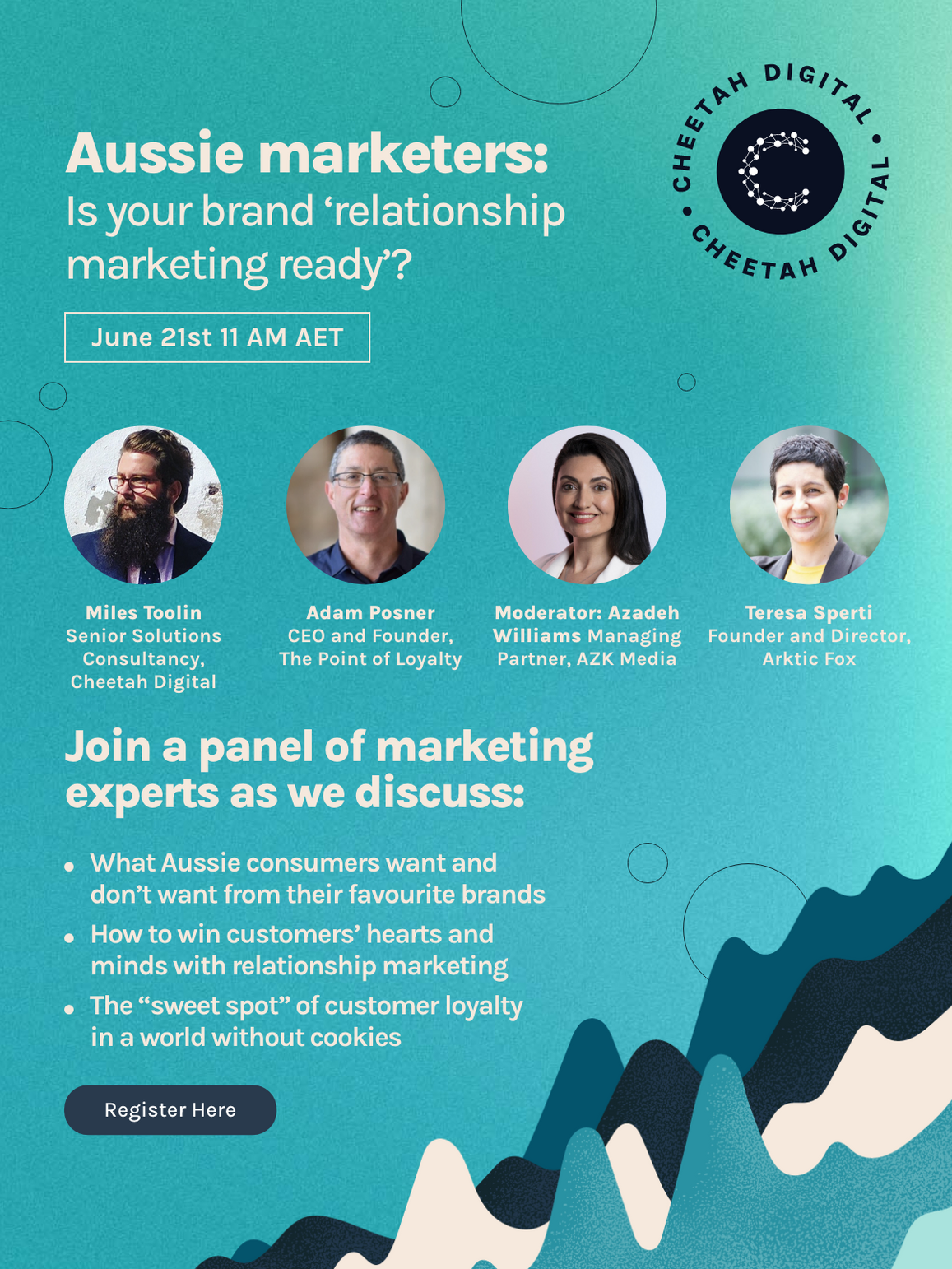
Issue 23 of 2022: Friday June 10
IAB Australia figures show Q1 2022 digital advertising buoyed by government spending
Australian online advertising continued to grow in the first quarter of the year, buoyed by political and government spending. On the flip side, retail experienced the biggest decline in share, dropping from 16.4 percent to 13.5 percent of the general digital advertising market over the quarter. Read more
The data foundations underpinning Australian Hospitality giant's loyalty transformation
Data-driven loyalty offers tailored to a segment of one and across multiple brands and regions is one step closer to reality for Seagrass Boutique Hospitality Group. With plans to open upwards of 10 venues a year across different brands and locations, the utility of a consolidated loyalty program will also continue to grow. Read more
Cisco joins Lifeline Australia to ‘push’ for better mental health in the technology sector
Cisco, one of the Australia’s leading IT and networking companies, has joined Lifeline in pushing for better Mental Health in the workplace. For the second year running, Cisco will take part in The Push-Up Challenge as it aspires to top the community fundraising chart. Read more
Issue 22 of 2022: Friday June 3
Australians less familiar, optimistic about metaverse than global consumers
New Ipsos report for the World Economic Forum looks at consumer familiarity with VR, AR and metaverse, the gender attitude towards them and use cases. The report surveyed adults across 29 countries and found 52 per cent overall are familiar with the metaverse, compared to 44 per cent in Australia. Read more
Aussie content marketing engine, Convo Ink secures $1.5 million seed funding
Convo Ink offers a smart content marketing engine designed to connect marketers, content producers and publishers in order to deliver branded content to audiences. The new seed funds will be used to expand content platform capabilities and further invest in the recently launched attention measure, the Quality Attention Score. Read more
ABC reports firms slyly collecting data, fails to disclose it's in same game
Australian broadcast giant ABC has reported that learning software providers were slurping up data of students during the pandemic without clearly indicating they were doing so, but failed to disclose that both its iview service and its news website do something quite similar Read more
Issue 21 of 2022: Friday May 27
Sisense report reveals new findings among the APAC data professionals
According to the new Sisense Future of Data Analytics Report 2022 - Asia Pacific Edition, data professionals in the APAC region see data and analytics as valuable to digital transformation and future-proofing their business, yet find their organisations’ strategic capabilities are far from reaching their true potential. Read more
Australian company Robotic Marketer debuts AI-based marketing strategy dashboard
Robotic Marketer, has unveiled a new digital marketing dashboard to complement what it says is the world’s first marketing strategy technology platform. The technology uses data-driven benchmarking, peer-sourced insights, data mining and machine learning to help marketing teams create and execute more effective marketing strategies. Read more
Australian bank giant brings share trading into master app
CommBank has moved to the next phase of its plan to build a huge loyalty platform of linked services for banking customers. It is launching loyalty scheme Yello to six million retail banking customers in a bid to retain customers in the face of global competition from big tech while getting ahead of incoming data privacy regulatory changes. Read more
Issue 20 of 2022: Friday May 20
New index shows Australian consumers heavily influenced by other consumer reviews
According to the latest Bazaarvoice Shopper Experience Index, reviews and photography from peers, along with an ability to view other consumer insights and purchase via social channels are rising up the ranks when it comes to how Australian shoppers convert. Read more
Enterprise data platform Odaseva expands into APAC and UK
Enterprise data platform for Salesforce, Odaseva, is extending operations across the Asia-Pacific region as well as UK as it also releases new product offerings. Odaseva chief revenue officer said. “We are meeting rising demand for our solutions which can keep data close to the customer across geographies, while also keeping the enterprise in line with local data regulations.” Read more
Small telcos could get consumer data right exemption in Australia
Smaller telcos could be exempt from obligations under Australia’s consumer data right (CDR), if a proposal by Treasury is adopted. Federal Treasury and the Data Standards Body suggest the telecommunications sector follow the model used in the energy sector, where the CDR doesn’t apply to companies below a minimum number of customers. Read more
Issue 19 of 2022: Friday May 13
Aussie retailer aims for better global customer picture and segmentation
Aussie brand Dissh launched phase one of the rollout in February to link up all email, social advertising and customer data. It is expected to deliver greater customer visibility by automating and integrating of audiences across all channels, while built-in test-and-learn capabilities will eventually be extended across all touchpoints to bring personalisation into business processes. Read more
CX leaders broaden their scope of impact during APAC conference in Sydney
It’s time for customer experience leaders to open the aperture and think more broadly about the ways they can impact, align with and accelerate key business initiatives. Forrester’s CX executive partner and senior analyst, Su Doyle said the trajectory of customer experience leadership maturity today is following a similar path to marketing leadership in terms of demonstrating value of widespread business benefit. Read more
Australian bank accelerates its digital, data and analytics plans
NAB is accelerating its digital plans with further acquisitions and the continued rollout of a digital home loan platform. NAB chief executive Ross McEwan told investors it has “more than 60 percent of our apps migrated to the cloud”. The bank credited its investment and technology work for better positioning it to combat cybercrime, and its use of digital data and analytics for improve consumer outcomes. Read more
Issue 18 of 2022: Friday May 6
Early martech investment helps Aussie fintech build customer rapport and digital efficiency
Aussie fintech HelpPay has created a technology that turns a bill into a shareable link and payment page, which consumers then share via email, social channels and chat with multiple individuals so they can pay any amount directly towards the bill in order to understand what’s driving customer engagement and rapid-fire website innovation. Read more
Aussie retail giants embracing personalised digital gifting tool for Mother's Day
The new personalised digital gift messages are being facilitated by Melbourne tech startup, gift flick, which has created an ecommerce plug-in allowing consumers to virtually send a product or gift voucher in an online retailer’s store via their preferred messaging channel and at a time they set. The gifts are then revealed as part of a ‘gift story’ featuring a personalised message, photo and/or video. Read more
CX investment becomes a top priority in the APAC countries
UserTesting, a video-based human insight, released the 2022 CX Industry Report that reveals a strong demand for actionable human understanding in the APAC region across every industry and organisations of all sizes. The report found that more than 57% of APAC respondents noted that CX is a top investment area. Read more
Issue 17 of 2022: Friday April 29
Aussie accommodation comparison website fined $44.7m by Federal Court for misleading consumers
The Australian Competition and Consumer Commission (ACCC) initially launched legal proceedings against Trivago in 2018, alleging the site’s hotel comparison service had been misleading consumers for nearly four years. The highlighted prices were often not the cheapest, but instead those Trivago was prioritising for advertisers willing to pay the best cost-per-click rates for promotion. Read more
SMI reveals the top line programmatic revenue of Australian news websites
At the Independent Media Agencies of Australia’s ‘Operation Bounceback’ event earlier this month, SMI’s Managing Director AU/NZ Jane Ractliffe said it is notoriously difficult to get a breakdown of programmatic spend, which is usually lumped in with digital – but that would soon change for News media. Read more
Australian Privacy Foundation raises concerns over ABC compulsory iview logins
The ABC has been asked to clarify whether iview users are being informed about the extent to which their data is being shared with commercial entities or whether they are in the dark about it altogether. The question was posed by the Australian Privacy Foundation on Friday. It was a follow-up to a missive from ABC chairman Ita Buttrose in which she had responded to the APF's concerns over the introduction of compulsory logins. Read more
Issue 16 of 2022: Friday April 22
Alida to open Sydney data centre
Alida plans to launch a data centre in Sydney in winter 2022 in order to provide enhanced data services as well as scale to serve more customers operating in the Oceanic region.
Having an onshore data centre will help it not only to better meet the needs of customers in Australia and New Zealand but also enhance the data collection process and efficiently meet clients’ regional compliance requirements. Read more
Shopify has listed Aussie indie agency Optimising in its Shopify Plus Partner Program
Indie agency Optimising has become a preferred search engine optimisation (SEO) vendor for global e-commerce platform Shopify, joining its Shopify Plus Partner Program after a lengthy screening process, citing its good client relationships, trust and genuine approach. Read more
Australian media network TotallyAwesome has launched world's first programmatic solution for teens
TotallyAwesome is the world’s first programmatic solution aimed at younger people in the APAC region, engaging with users contextually via apps, websites and games in an attempt to provide brand-safe environments for teens. The platform aims to deliver over 300 million monthly active online users under 18 across Asia Pacific, without collecting any personal information or data. Read more
Issue 15 of 2022: Friday April 15
New report shows Aussie consumers want hyper-personalisation
The report, 2022 Digital Consumer Trends: Australian edition has revealed consumers across Australia trust ads less and prefer to interact with a brand in more personalised ways. According to the report, email continues to sit comfortably as Australian consumers’ preferred channel. Read more
Australian government tops up digital economy strategy with $130m
The federal government will pour another $130.1 million into its digital economy strategy over the next four years, the new funding will build on the $1.2 billion provided in last year’s budget in a bid to help make Australia a top ten data and digital economy by 2030. Read more
Australian marketing professionals reveal the risk with personalisation on Mumbrella panel
Head of product for Nine’s BVOD service 9Now, Lewis Evans said right now one of the risks associated with personalisation can come in the pursuit of ‘perfect personalisation’. The risk with personalisation right now is ‘doing it too well and being creepy’ . Read more
Issue 14 of 2022: Friday April 8
Cheetah Digital reveals consumer data and privacy concerns across Australia, U.S and other countries
The 2022 Global Digital Consumer Trends Index, released by Cheetah Digital, a cross-channel relationship management solution provider, in conjunction with eConsultancy, examined consumer attitudes and year over year trends across personalisation, privacy, messaging, advertising and brand loyalty. Read more
Adobe's new report reviews digital and data maturity in AUS/NZ businesses
Adobe’s recent 2022 Digital Trends Report across Asia-Pacific paints a clear picture of digital’s significance today and into the future on CX, it tells us about digital and data maturity and how organisations continue to keep up with with customer experience expectations. A/NZ businesses in particular are set to outstrip other global regions in customer experience investment in 2022. Read more
Australia-based communications tech player, Soprano acquired UK-based Ubisend for an undisclosed sum
Consumers and citizens are demanding ever more tailored communication experiences from the brands and organisations they’re engaging. Soprano said it’s looking to leverage ubisend’s AI-powered communication technology to launch, manage and monitor conversational solutions and scale AI communications and automation across an organisation. Read more
Issue 13 of 2022: Friday April 1
Over half of all Australian leave a website after page one
Based on analysis of 46 billion web sessions from around the globe and across 14 industries, these findings and the report are designed to help brands benchmark their digital performance against industry averages, highlighting where they should focus their attention and resources to gain a competitive advantage in today’s crowded market. Read more
Australian indie publishers pressure Facebook to negotiate
A coalition of independent news publishers including Broadsheet, Concrete Playground, Urban List, Star Observer, Australian Jewish News and Australian Chinese Daily have stopped publishing news for 24 hours as part of collective action called WaitingOnZuck, pressuring Facebook to pay small and medium organisations for journalism. Read more
Australia ranks number one in Asia Pacific for most ransomware attacks
Australia ranks number one in Asia Pacific for most ransomware attacks, and seventh globally according to new research which reveals that 37% of all attacks on Australian organisations targeted the commercial and professional services sector, research also found that ransomware payments hit new records in 2021 as cybercriminals increasingly turned to Dark Web “leak sites”. Read more
Issue 12 of 2022: Friday March 25
In conjunction with eConsultancy, the global report looks at consumer attitudes and year over year trends in personalisation, privacy, messaging, advertising and brand loyalty based on survey insights. The report details consumer preferences including: What they expect from the brands they buy from; The channels and formats they prefer to communicate; The type of data they’re willing to share; and the terms under which they’re willing to share it. Read more
CPG giant Kimberly-Clark is backing ad verification providers to underpin programmatic advertising after Google kills cookies, unlocking the ability to optimise media investment to attention and enabling brands to plug automated creative directly into programmatic pipes. It's a big call given recent shenanigans, but Global Programmatic Capability Lead Rachel Mervis is confident the likes of IAS, Double Verify and White Ops can deliver. Read more
The Australian Competition and Consumer Commission (ACCC) is lining up alongside Twiggy Forrest and taking Facebook parent company, Meta, to court for publishing scam celebrity cryptocurrency advertising on its platform. The regulatory watchdog last week confirmed it had instituted Federal Court proceedings against the two businesses making up Meta - Meta Platform and Meta Platforms Ireland – alleging the business engaged in false, misleading or deceptive conduct by publishing scam advertisements featuring high-profile Australia business entrepreneurs and public figures. Read more
Issue 11 of 2022: Friday March 18
After a fraught time recovering and rebuilding from the loss of a crucial global data verification alliance with Facebook, Nielsen is launching a new online advertising measurement service here that is no longer reliant on one provider – and will ultimately match and measure ad exposure to sales impact. Nielsen Identity System, which starts in early April and will underpin Nielsen's plans to create a rival audience measurement service to the IAB-sanctioned Ipsos contract, takes local data from Unpacked by Flybuys, The Trade Desk, Equifax and others. Read more
Yabble has launched in-house proprietary algorithms and AI combined product to scale AUS/NZ market
A Yabble survey of insights professionals found that only 35 per cent of Australian respondents currently use text analytics tools to glean insights from data, but 91 per cent plan to use them the same or more in the next 12 months. Respondents describe the advantages they’re looking for in AI driven tools as removing manual processes (42 per cent), making analysis faster (41 per cent) and making analysis easier (52 per cent). Hey Yabble is meeting all of those needs and has already helped to save insights teams nearly 100,000 hours of manual processing. Read more
The integration enables advertisers across APAC to increase performance on campaigns by targeting and retargeting more precisely when using Yahoo’s demand-side-platform (DSP). Through the partnership, Yahoo clients now have access to more accurate campaign measurement and attribution plus a complete offline-online view of audiences, crucial in today’s fragmented world. Nearly 40 advertisers have since adopted the integration into their campaigns and achieved outstanding results, including BIG W’s “Toy Mania” artificial reality omnichannel campaign. Read more
Issue 10 of 2022: Friday March 11
Aussie media intelligence startup Truescope raises $6.2m
Home grown media intelligence startup, Truescope, has secured $6.2 million in funding to support its international expansion efforts.
The latest investment round was led by venture capital firms, Investible and Jelix Ventures, as well as other private investors. The funds will be used to launch and support Truescope’s USA market entry and accelerate engineering and technology innovations in the SaaS platform’s pipeline. Read more
11 Biggest Data Breaches in Australia
Data breaches in Australia are on the rise, particularly in the financial and healthcare industries. The Australian government is revising its cybersecurity frameworks and policies to strengthen resilience against nation-state threat actors. However, even the Australian Signals Directorate (ASD) admits that proposed security frameworks only raise the baseline of security. To help Australian businesses avoid some of the common malpractices that facilitate data breaches, we've compiled a list of some of the biggest data breaches in Australia, ranked by magnitude of impact. Read more
New Zealand data insights provider Hey Yabble sets sights on disrupting the insights space
A Yabble survey of insights professionals found that only 35% of Australian respondents currently use text analytics tools to glean insights from data but 91% plan to use them the same or more in the next 12 months.
Respondents describe the advantages they’re looking for in AI driven tools as removing manual processes (42%), making analysis faster (41%) and making analysis easier (52%). Yabble CEO and founder Kathryn Topp says this evolution will allow businesses to spend time on what really matters — capitalising on opportunities — rather than manually analysing data. Read more
Issue 9 of 2022: Friday March 4
Zonos opens first international office in Australia
Zonos, a company that provides cross-border commerce solutions, has opened its first international office in Australia’s Gold Coast and appointed Travis Robinson as its APAC general manager. With Asia-Pacific expected to continue to lead global ecommerce sales, the need for accurate cross-border duty and tax calculations, VAT compliance and HS code classification will continue to grow, the company said. Read more
Australian gov data breach numbers slip out of public view
The Australian government fell outside the top industry sectors for data breaches in the second half of 2021, despite agencies logging 28 notifications during the six-month period.
The latest notifiable data breaches report, released on Tuesday, shows there were 464 notifications in total received by the Office of the Australian Information Commissioner (OAIC) between July and December 2021, up from 446 in the first half of the year. Read more
Australian data insights company TechConnect hits near double revenue growth, gears up for 2022
TechConnect CEO Mike Cunningham says it was already clear that 2022 will be a pivotal year for how Australian organisations use data to differentiate themselves. He says, “The Australian economy, like many others, is facing a once in a hundred-year period of fundamental change, driven by forces like new global rules for operating in the face of climate change, faster decision making at scale due to COVID, and an avalanche of information to come to terms with. Read more
Issue 8 of 2022: Friday February 25
Digital buys New Republique, Blended Digital and Venntifact
Deloitte Digital has acquired three digital experience consultancies – Blended Digital, New Republique and Venntifact – adding a team of 70 professionals to its ANZ headcount. With now over 1,100 consultants and technologists across Australia, Deloitte Digital is one of the largest players in the digital transformation space at the nexus of creativity, marketing and technology. Read more
Optus rolls out 5G innovation program and new Australian 'hub'
Optus Enterprise, has announced the launch of a new 5G led Innovation Program, designed to bring enterprise, SMBs and startups together. Read more
Group M launches influencer marketing platform Inca in Australia
Group M Australia has become the latest country in the Group M network to launch Inca, an AI-powered influencer and content marketing platform designed to promote brand safety and return on investment.The platform was first rolled out for APAC in 2019, and launched in New Zealand in early 2021 and – with the addition of Australia – now spans across 30 countries. Read more
Issue 7 of 2022: Friday February 16
A 17 per cent lift in active loyalty members, increase in unaided brand awareness, higher Net Promoter Score and significant omnichannel take-up are among the highlights touted by Baby Bunting in its half-year report.
The retailer reported a 10 per cent increase in comparable sales growth in the first half of FY2022 to $239.1 million, 23.8 per cent of which was sales conducted online. Total online sales including click-and-collect were up 32.6 per cent to $56.8m Read more
Australian retail giants are taking on Meta and Alphabet, and where that leaves everyone else
CommBank is leading the counteroffensive against platforms that are eating the world, with Woolies, Coles and the major card providers hot on its heels, powering first party data markets and moving away from legacy digital economics. But what does that mean for everybody else? Opportunity for those that can collaborate, reckons Tim Tyler, Managing Partner at Ellipsis & Co. Read more
Announcement marks continued growth and expansion for Samba TV in the Australian market
Samba TV, a leading global provider of omniscreen advertising and analytics, today announced a partnership together with PubMatic (Nasdaq: PUBM), an independent technology company delivering digital advertising’s supply chain of the future, to bring programmatic omniscreen TV audience targeting to Australia. The announcement marks an expansion of Samba TV’s existing European partnership with PubMatic. Read more
Issue 6 of 2022: Friday February 11
Australian-based Cyara secures $485 million in investment
Cyara was co-founded in Melbourne in 2006, its flagship offering is the SaaS-based Automated CX Assurance Platform, which has more than 250 global brands clients. The investment will be used to accelerate product innovation, expand CX assurance into new emerging digital channels, fund strategic acquisitions of complementary technologies and fuel geographic expansion. Read more
Google warns Australia’s media bargaining laws could harm democracy
Google saw that replication of Australia’s framework would force information to be consumed in a particular manner, “favouring a narrow range of sources for the diffusion of knowledge.”
In effect, this would carry the huge implication of undermining democratic discourse and media diversity. Read more
Covid gave Reckitt Benckiser a snapshot of just about every Australian who could possibly buy cleaning products – and along with retailers, a huge trove of shopper data to fuel digital campaigns. Harnessing that data has already driven 2.5x better returns, says Reckitt Hygiene product marketing boss Saurabh Jain. Read more
Issue 5 of 2022: Friday February 4
Anzu and Livewire partner to help APAC advertisers reach the metaverse
Livewire is a global gaming marketing and gametech company that creates integrated gaming marketing strategies. The partnership with Anzu will allow advertisers to run non-disruptive ads within many of Roblox’s most popular games. As of January 2022, Roblox claims to have over 40 million games and be reaching 9.4 million daily active users across APAC in Q3 2021. It also claims 110 million global active monthly users. Read more
Leading Australian brands' leaders say 'digital transformation' doomed
Australia’s brands continue to scramble to digitally transform. The problem is, they don’t have the capability. Chronic underinvestment in people and skills, combined with high churn and a tightening talent crunch, means the wheels are spinning but marketing departments are getting nowhere fast. We can’t just hire our way out of trouble. Here’s an alternative plan. Read more
New APAC report reveals data collaboration to be a big focus for 2022
Advertising investment is forecast to grow by 9.2 per cent globally in 2022, according to the latest dentsu Global Ad Spend Forecast report. Ad spend in Asia Pacific is expected to grow by 5.9 per cent, with digital forecast to increase 9.6 per cent to a share of 61.1 per cent of total APAC advertising spend. Read more
Issue 4 of 2022: Friday January 28
Tealium survey across U.S., Europe, and APAC reveals digital demand drives wider adoption of CDPs
Report shows organizations rely on CDPs to comply with data privacy and security regulations as well as deliver relevant customer experiences in an increasingly competitive digital landscape. This survey helps to understand why global businesses implemented their CDP, priorities for customer data management, and what's coming next in the age of data. Read more
2022 will be a critical year for marketers. Digital and eCommerce are accelerating, and Google’s 2023 plan to end support for third-party cookies is Chrome inching closer. Colin Barnard looks at how this is causing a last-minute scramble to implement first-party data strategies and martech integrations. Read more
Purebaby was on the hunt for a software solution that would enable them to send personalised email messages to their existing and prospective customer base and allow them to move away from ‘batch-and-blast’ customer emails. Read more
Issue 3 of 2022: Friday January 21
Salesforce announces new innovations across the APAC market
Salesforce believes in having flexible, connected, and highly-personalised shopping experiences. Utilising their existing and new technology, they will endeavour to provide a gateway for organisations looking to scale up their cloud systems with the latest commerce technology. Read more
Digital trade in APAC to enter 'golden age' over next three years
According to a new report by Deloitte, the APAC region is set to enter the ‘golden age’ of digital trade over the next three years. This evolution is due to the dynamic nature of cross-border e-commerce, a consumer trend towards digital lifestyles, the development of digital infrastructure, and regional cooperation. Read more
Twitter and Snapchat caution against the Australian Government anonymity measures
Twitter and Snapchat have voiced privacy concerns over proposed laws that would force Australians to verify their age on many popular websites. Such legislation would effectively require technology companies to keep users’ IDs and contact information. Read more
Issue 2 of 2022: Friday January 14
Why marketers should say no to "Renting" customer data
It’s a stressful time for marketers. Many believe that their lives will be disrupted to the nth degree without cookies. Meanwhile consumers are more protective of their personal data than ever. Read more
12 martech trends to watch in 2022
As artificial intelligence (AI) and advanced automation progress, capabilities being introduced into the ever-growing array of martech stacks and customer engagement technologies is exploding. Read more
How GameDay is using data-driven insights to pursue customer growth
Sports technology platform provider talks through the data intelligence and analytics approach that's helping it to improve internal commercial reporting as well as new and existing customer opportunities. Read more
Data privacy – the dos and don’ts of collecting customer data
For brands, data is everything. Those key insights into core consumers – how & when they shop, their key interests, and what makes them tick – are crucial in order to create powerful and tailored marketing strategies. Read more
Constant Contact To Acquire Australian SMS, Email Platform Vision6
Digital marketing platform Constant Contact will acquire Vision6, a provider of SMS and email marketing software based in Brisbane, Australia, the firm announced on Tuesday. Terms were not disclosed. Read more

In partnership with the CDP Institute
AZK Media is passionate about helping CDP vendors and implementation partners grow in the APAC region. We're proud to partner with The CDP Institute, to provide this weekly insider on the customer data platform landscape across the APAC region. Check out the latest issue below:
LATEST ISSUE
Issue 25 of 2022: Friday June 24
Aussie apparel giant brings on customer data platform to power personalisation
Cotton On has selected Lexer’s homegrown customer data platform (CDP) to power its customer experience and personalisation ambitions. With CDP, Cotton On aims to better understand customers at an individual level and use that insight to build more relevant, personalised communications through the customer’s preferred communication channel. Read more
Hypeauditor report shows Aussies aren't so crash-hot on nfts
The report found that Aussie influencers and brands are not jumping on the NFT bandwagon as fast and as eagerly as its counterpart countries. The top 3 categories for NFTs in Australia are Art (12.7 percent), Music (10.4 percent) and Photography (8.4 percent). Read more
Australian retailers using facial recognition without consumer consent in stores
Consumer advocate CHOICE has revealed that three of Australia's largest retailers - Kmart, Bunnings and The Good Guys are using facial recognition technology in their stores, often without shoppers realising that they are being surveilled and their biometric information stored, raising concerns among privacy experts. Read more
Issue 24 of 2022: Friday June 17
Australia-based retail media platform, Zitcha has officially launched to empower retailers
Zitcha has officially launched with the ambition to empower retailers to become publishers by monetising their owned and external media ecosystem. It connects the media assets of a retail brand including email, apps, digital in-store screens, Web and social media, allowing retail suppliers to connect directly with consumers. Read more
Aussie charity giant Leukaemia Foundation consolidated its marketing data approach
Head of data and analytics Glen Shields shares the journey to bring together multiple marketing and data systems together to start driving personalisation. Shields dives into how to form the data team, get the data side of things happening better and also to manage the Salesforce environment that Leukaemia consolidated all of those different CRMs into. Read more
Selligent Marketing Cloud's new report unpacks engagement issues with Generation Z
Selligent's new report reveals that only half of Gen Z respondents say they have control over their personal data. This generation is also rewriting the rules of consumer engagement in areas like technology, shopping, media and brand loyalty. it’s vital marketers forge a new toolkit aimed at reaching and engaging with Gen Z exclusively. Read more
Issue 23 of 2022: Friday June 10
IAB Australia figures show Q1 2022 digital advertising buoyed by government spending
Australian online advertising continued to grow in the first quarter of the year, buoyed by political and government spending. On the flip side, retail experienced the biggest decline in share, dropping from 16.4 percent to 13.5 percent of the general digital advertising market over the quarter. Read more
The data foundations underpinning Australian Hospitality giant's loyalty transformation
Data-driven loyalty offers tailored to a segment of one and across multiple brands and regions is one step closer to reality for Seagrass Boutique Hospitality Group. With plans to open upwards of 10 venues a year across different brands and locations, the utility of a consolidated loyalty program will also continue to grow. Read more
Cisco joins Lifeline Australia to ‘push’ for better mental health in the technology sector
Cisco, one of the Australia’s leading IT and networking companies, has joined Lifeline in pushing for better Mental Health in the workplace. For the second year running, Cisco will take part in The Push-Up Challenge as it aspires to top the community fundraising chart. Read more
Issue 22 of 2022: Friday June 3
Australians less familiar, optimistic about metaverse than global consumers
New Ipsos report for the World Economic Forum looks at consumer familiarity with VR, AR and metaverse, the gender attitude towards them and use cases. The report surveyed adults across 29 countries and found 52 per cent overall are familiar with the metaverse, compared to 44 per cent in Australia. Read more
Aussie content marketing engine, Convo Ink secures $1.5 million seed funding
Convo Ink offers a smart content marketing engine designed to connect marketers, content producers and publishers in order to deliver branded content to audiences. The new seed funds will be used to expand content platform capabilities and further invest in the recently launched attention measure, the Quality Attention Score. Read more
ABC reports firms slyly collecting data, fails to disclose it's in same game
Australian broadcast giant ABC has reported that learning software providers were slurping up data of students during the pandemic without clearly indicating they were doing so, but failed to disclose that both its iview service and its news website do something quite similar Read more
Issue 21 of 2022: Friday May 27
Sisense report reveals new findings among the APAC data professionals
According to the new Sisense Future of Data Analytics Report 2022 - Asia Pacific Edition, data professionals in the APAC region see data and analytics as valuable to digital transformation and future-proofing their business, yet find their organisations’ strategic capabilities are far from reaching their true potential. Read more
Australian company Robotic Marketer debuts AI-based marketing strategy dashboard
Robotic Marketer, has unveiled a new digital marketing dashboard to complement what it says is the world’s first marketing strategy technology platform. The technology uses data-driven benchmarking, peer-sourced insights, data mining and machine learning to help marketing teams create and execute more effective marketing strategies. Read more
Australian bank giant brings share trading into master app
CommBank has moved to the next phase of its plan to build a huge loyalty platform of linked services for banking customers. It is launching loyalty scheme Yello to six million retail banking customers in a bid to retain customers in the face of global competition from big tech while getting ahead of incoming data privacy regulatory changes. Read more
Issue 20 of 2022: Friday May 20
New index shows Australian consumers heavily influenced by other consumer reviews
According to the latest Bazaarvoice Shopper Experience Index, reviews and photography from peers, along with an ability to view other consumer insights and purchase via social channels are rising up the ranks when it comes to how Australian shoppers convert. Read more
Enterprise data platform Odaseva expands into APAC and UK
Enterprise data platform for Salesforce, Odaseva, is extending operations across the Asia-Pacific region as well as UK as it also releases new product offerings. Odaseva chief revenue officer said. “We are meeting rising demand for our solutions which can keep data close to the customer across geographies, while also keeping the enterprise in line with local data regulations.” Read more
Small telcos could get consumer data right exemption in Australia
Smaller telcos could be exempt from obligations under Australia’s consumer data right (CDR), if a proposal by Treasury is adopted. Federal Treasury and the Data Standards Body suggest the telecommunications sector follow the model used in the energy sector, where the CDR doesn’t apply to companies below a minimum number of customers. Read more
Issue 19 of 2022: Friday May 13
Aussie retailer aims for better global customer picture and segmentation
Aussie brand Dissh launched phase one of the rollout in February to link up all email, social advertising and customer data. It is expected to deliver greater customer visibility by automating and integrating of audiences across all channels, while built-in test-and-learn capabilities will eventually be extended across all touchpoints to bring personalisation into business processes. Read more
CX leaders broaden their scope of impact during APAC conference in Sydney
It’s time for customer experience leaders to open the aperture and think more broadly about the ways they can impact, align with and accelerate key business initiatives. Forrester’s CX executive partner and senior analyst, Su Doyle said the trajectory of customer experience leadership maturity today is following a similar path to marketing leadership in terms of demonstrating value of widespread business benefit. Read more
Australian bank accelerates its digital, data and analytics plans
NAB is accelerating its digital plans with further acquisitions and the continued rollout of a digital home loan platform. NAB chief executive Ross McEwan told investors it has “more than 60 percent of our apps migrated to the cloud”. The bank credited its investment and technology work for better positioning it to combat cybercrime, and its use of digital data and analytics for improve consumer outcomes. Read more
Issue 18 of 2022: Friday May 6
Early martech investment helps Aussie fintech build customer rapport and digital efficiency
Aussie fintech HelpPay has created a technology that turns a bill into a shareable link and payment page, which consumers then share via email, social channels and chat with multiple individuals so they can pay any amount directly towards the bill in order to understand what’s driving customer engagement and rapid-fire website innovation. Read more
Aussie retail giants embracing personalised digital gifting tool for Mother's Day
The new personalised digital gift messages are being facilitated by Melbourne tech startup, gift flick, which has created an ecommerce plug-in allowing consumers to virtually send a product or gift voucher in an online retailer’s store via their preferred messaging channel and at a time they set. The gifts are then revealed as part of a ‘gift story’ featuring a personalised message, photo and/or video. Read more
CX investment becomes a top priority in the APAC countries
UserTesting, a video-based human insight, released the 2022 CX Industry Report that reveals a strong demand for actionable human understanding in the APAC region across every industry and organisations of all sizes. The report found that more than 57% of APAC respondents noted that CX is a top investment area. Read more
Issue 17 of 2022: Friday April 29
Aussie accommodation comparison website fined $44.7m by Federal Court for misleading consumers
The Australian Competition and Consumer Commission (ACCC) initially launched legal proceedings against Trivago in 2018, alleging the site’s hotel comparison service had been misleading consumers for nearly four years. The highlighted prices were often not the cheapest, but instead those Trivago was prioritising for advertisers willing to pay the best cost-per-click rates for promotion. Read more
SMI reveals the top line programmatic revenue of Australian news websites
At the Independent Media Agencies of Australia’s ‘Operation Bounceback’ event earlier this month, SMI’s Managing Director AU/NZ Jane Ractliffe said it is notoriously difficult to get a breakdown of programmatic spend, which is usually lumped in with digital – but that would soon change for News media. Read more
Australian Privacy Foundation raises concerns over ABC compulsory iview logins
The ABC has been asked to clarify whether iview users are being informed about the extent to which their data is being shared with commercial entities or whether they are in the dark about it altogether. The question was posed by the Australian Privacy Foundation on Friday. It was a follow-up to a missive from ABC chairman Ita Buttrose in which she had responded to the APF's concerns over the introduction of compulsory logins. Read more
Issue 16 of 2022: Friday April 22
Alida to open Sydney data centre
Alida plans to launch a data centre in Sydney in winter 2022 in order to provide enhanced data services as well as scale to serve more customers operating in the Oceanic region.
Having an onshore data centre will help it not only to better meet the needs of customers in Australia and New Zealand but also enhance the data collection process and efficiently meet clients’ regional compliance requirements. Read more
Shopify has listed Aussie indie agency Optimising in its Shopify Plus Partner Program
Indie agency Optimising has become a preferred search engine optimisation (SEO) vendor for global e-commerce platform Shopify, joining its Shopify Plus Partner Program after a lengthy screening process, citing its good client relationships, trust and genuine approach. Read more
Australian media network TotallyAwesome has launched world's first programmatic solution for teens
TotallyAwesome is the world’s first programmatic solution aimed at younger people in the APAC region, engaging with users contextually via apps, websites and games in an attempt to provide brand-safe environments for teens. The platform aims to deliver over 300 million monthly active online users under 18 across Asia Pacific, without collecting any personal information or data. Read more
Issue 15 of 2022: Friday April 15
New report shows Aussie consumers want hyper-personalisation
The report, 2022 Digital Consumer Trends: Australian edition has revealed consumers across Australia trust ads less and prefer to interact with a brand in more personalised ways. According to the report, email continues to sit comfortably as Australian consumers’ preferred channel. Read more
Australian government tops up digital economy strategy with $130m
The federal government will pour another $130.1 million into its digital economy strategy over the next four years, the new funding will build on the $1.2 billion provided in last year’s budget in a bid to help make Australia a top ten data and digital economy by 2030. Read more
Australian marketing professionals reveal the risk with personalisation on Mumbrella panel
Head of product for Nine’s BVOD service 9Now, Lewis Evans said right now one of the risks associated with personalisation can come in the pursuit of ‘perfect personalisation’. The risk with personalisation right now is ‘doing it too well and being creepy’ . Read more
Issue 14 of 2022: Friday April 8
Cheetah Digital reveals consumer data and privacy concerns across Australia, U.S and other countries
The 2022 Global Digital Consumer Trends Index, released by Cheetah Digital, a cross-channel relationship management solution provider, in conjunction with eConsultancy, examined consumer attitudes and year over year trends across personalisation, privacy, messaging, advertising and brand loyalty. Read more
Adobe's new report reviews digital and data maturity in AUS/NZ businesses
Adobe’s recent 2022 Digital Trends Report across Asia-Pacific paints a clear picture of digital’s significance today and into the future on CX, it tells us about digital and data maturity and how organisations continue to keep up with with customer experience expectations. A/NZ businesses in particular are set to outstrip other global regions in customer experience investment in 2022. Read more
Australia-based communications tech player, Soprano acquired UK-based Ubisend for an undisclosed sum
Consumers and citizens are demanding ever more tailored communication experiences from the brands and organisations they’re engaging. Soprano said it’s looking to leverage ubisend’s AI-powered communication technology to launch, manage and monitor conversational solutions and scale AI communications and automation across an organisation. Read more
Issue 13 of 2022: Friday April 1
Over half of all Australian leave a website after page one
Based on analysis of 46 billion web sessions from around the globe and across 14 industries, these findings and the report are designed to help brands benchmark their digital performance against industry averages, highlighting where they should focus their attention and resources to gain a competitive advantage in today’s crowded market. Read more
Australian indie publishers pressure Facebook to negotiate
A coalition of independent news publishers including Broadsheet, Concrete Playground, Urban List, Star Observer, Australian Jewish News and Australian Chinese Daily have stopped publishing news for 24 hours as part of collective action called WaitingOnZuck, pressuring Facebook to pay small and medium organisations for journalism. Read more
Australia ranks number one in Asia Pacific for most ransomware attacks
Australia ranks number one in Asia Pacific for most ransomware attacks, and seventh globally according to new research which reveals that 37% of all attacks on Australian organisations targeted the commercial and professional services sector, research also found that ransomware payments hit new records in 2021 as cybercriminals increasingly turned to Dark Web “leak sites”. Read more
Issue 12 of 2022: Friday March 25
In conjunction with eConsultancy, the global report looks at consumer attitudes and year over year trends in personalisation, privacy, messaging, advertising and brand loyalty based on survey insights. The report details consumer preferences including: What they expect from the brands they buy from; The channels and formats they prefer to communicate; The type of data they’re willing to share; and the terms under which they’re willing to share it. Read more
CPG giant Kimberly-Clark is backing ad verification providers to underpin programmatic advertising after Google kills cookies, unlocking the ability to optimise media investment to attention and enabling brands to plug automated creative directly into programmatic pipes. It's a big call given recent shenanigans, but Global Programmatic Capability Lead Rachel Mervis is confident the likes of IAS, Double Verify and White Ops can deliver. Read more
The Australian Competition and Consumer Commission (ACCC) is lining up alongside Twiggy Forrest and taking Facebook parent company, Meta, to court for publishing scam celebrity cryptocurrency advertising on its platform. The regulatory watchdog last week confirmed it had instituted Federal Court proceedings against the two businesses making up Meta - Meta Platform and Meta Platforms Ireland – alleging the business engaged in false, misleading or deceptive conduct by publishing scam advertisements featuring high-profile Australia business entrepreneurs and public figures. Read more
Issue 11 of 2022: Friday March 18
After a fraught time recovering and rebuilding from the loss of a crucial global data verification alliance with Facebook, Nielsen is launching a new online advertising measurement service here that is no longer reliant on one provider – and will ultimately match and measure ad exposure to sales impact. Nielsen Identity System, which starts in early April and will underpin Nielsen's plans to create a rival audience measurement service to the IAB-sanctioned Ipsos contract, takes local data from Unpacked by Flybuys, The Trade Desk, Equifax and others. Read more
Yabble has launched in-house proprietary algorithms and AI combined product to scale AUS/NZ market
A Yabble survey of insights professionals found that only 35 per cent of Australian respondents currently use text analytics tools to glean insights from data, but 91 per cent plan to use them the same or more in the next 12 months. Respondents describe the advantages they’re looking for in AI driven tools as removing manual processes (42 per cent), making analysis faster (41 per cent) and making analysis easier (52 per cent). Hey Yabble is meeting all of those needs and has already helped to save insights teams nearly 100,000 hours of manual processing. Read more
The integration enables advertisers across APAC to increase performance on campaigns by targeting and retargeting more precisely when using Yahoo’s demand-side-platform (DSP). Through the partnership, Yahoo clients now have access to more accurate campaign measurement and attribution plus a complete offline-online view of audiences, crucial in today’s fragmented world. Nearly 40 advertisers have since adopted the integration into their campaigns and achieved outstanding results, including BIG W’s “Toy Mania” artificial reality omnichannel campaign. Read more
Issue 10 of 2022: Friday March 11
Aussie media intelligence startup Truescope raises $6.2m
Home grown media intelligence startup, Truescope, has secured $6.2 million in funding to support its international expansion efforts.
The latest investment round was led by venture capital firms, Investible and Jelix Ventures, as well as other private investors. The funds will be used to launch and support Truescope’s USA market entry and accelerate engineering and technology innovations in the SaaS platform’s pipeline. Read more
11 Biggest Data Breaches in Australia
Data breaches in Australia are on the rise, particularly in the financial and healthcare industries. The Australian government is revising its cybersecurity frameworks and policies to strengthen resilience against nation-state threat actors. However, even the Australian Signals Directorate (ASD) admits that proposed security frameworks only raise the baseline of security. To help Australian businesses avoid some of the common malpractices that facilitate data breaches, we've compiled a list of some of the biggest data breaches in Australia, ranked by magnitude of impact. Read more
New Zealand data insights provider Hey Yabble sets sights on disrupting the insights space
A Yabble survey of insights professionals found that only 35% of Australian respondents currently use text analytics tools to glean insights from data but 91% plan to use them the same or more in the next 12 months.
Respondents describe the advantages they’re looking for in AI driven tools as removing manual processes (42%), making analysis faster (41%) and making analysis easier (52%). Yabble CEO and founder Kathryn Topp says this evolution will allow businesses to spend time on what really matters — capitalising on opportunities — rather than manually analysing data. Read more
Issue 9 of 2022: Friday March 4
Zonos opens first international office in Australia
Zonos, a company that provides cross-border commerce solutions, has opened its first international office in Australia’s Gold Coast and appointed Travis Robinson as its APAC general manager. With Asia-Pacific expected to continue to lead global ecommerce sales, the need for accurate cross-border duty and tax calculations, VAT compliance and HS code classification will continue to grow, the company said. Read more
Australian gov data breach numbers slip out of public view
The Australian government fell outside the top industry sectors for data breaches in the second half of 2021, despite agencies logging 28 notifications during the six-month period.
The latest notifiable data breaches report, released on Tuesday, shows there were 464 notifications in total received by the Office of the Australian Information Commissioner (OAIC) between July and December 2021, up from 446 in the first half of the year. Read more
Australian data insights company TechConnect hits near double revenue growth, gears up for 2022
TechConnect CEO Mike Cunningham says it was already clear that 2022 will be a pivotal year for how Australian organisations use data to differentiate themselves. He says, “The Australian economy, like many others, is facing a once in a hundred-year period of fundamental change, driven by forces like new global rules for operating in the face of climate change, faster decision making at scale due to COVID, and an avalanche of information to come to terms with. Read more
Issue 8 of 2022: Friday February 25
Digital buys New Republique, Blended Digital and Venntifact
Deloitte Digital has acquired three digital experience consultancies – Blended Digital, New Republique and Venntifact – adding a team of 70 professionals to its ANZ headcount. With now over 1,100 consultants and technologists across Australia, Deloitte Digital is one of the largest players in the digital transformation space at the nexus of creativity, marketing and technology. Read more
Optus rolls out 5G innovation program and new Australian 'hub'
Optus Enterprise, has announced the launch of a new 5G led Innovation Program, designed to bring enterprise, SMBs and startups together. Read more
Group M launches influencer marketing platform Inca in Australia
Group M Australia has become the latest country in the Group M network to launch Inca, an AI-powered influencer and content marketing platform designed to promote brand safety and return on investment.The platform was first rolled out for APAC in 2019, and launched in New Zealand in early 2021 and – with the addition of Australia – now spans across 30 countries. Read more
Issue 7 of 2022: Friday February 16
A 17 per cent lift in active loyalty members, increase in unaided brand awareness, higher Net Promoter Score and significant omnichannel take-up are among the highlights touted by Baby Bunting in its half-year report.
The retailer reported a 10 per cent increase in comparable sales growth in the first half of FY2022 to $239.1 million, 23.8 per cent of which was sales conducted online. Total online sales including click-and-collect were up 32.6 per cent to $56.8m Read more
Australian retail giants are taking on Meta and Alphabet, and where that leaves everyone else
CommBank is leading the counteroffensive against platforms that are eating the world, with Woolies, Coles and the major card providers hot on its heels, powering first party data markets and moving away from legacy digital economics. But what does that mean for everybody else? Opportunity for those that can collaborate, reckons Tim Tyler, Managing Partner at Ellipsis & Co. Read more
Announcement marks continued growth and expansion for Samba TV in the Australian market
Samba TV, a leading global provider of omniscreen advertising and analytics, today announced a partnership together with PubMatic (Nasdaq: PUBM), an independent technology company delivering digital advertising’s supply chain of the future, to bring programmatic omniscreen TV audience targeting to Australia. The announcement marks an expansion of Samba TV’s existing European partnership with PubMatic. Read more
Issue 6 of 2022: Friday February 11
Australian-based Cyara secures $485 million in investment
Cyara was co-founded in Melbourne in 2006, its flagship offering is the SaaS-based Automated CX Assurance Platform, which has more than 250 global brands clients. The investment will be used to accelerate product innovation, expand CX assurance into new emerging digital channels, fund strategic acquisitions of complementary technologies and fuel geographic expansion. Read more
Google warns Australia’s media bargaining laws could harm democracy
Google saw that replication of Australia’s framework would force information to be consumed in a particular manner, “favouring a narrow range of sources for the diffusion of knowledge.”
In effect, this would carry the huge implication of undermining democratic discourse and media diversity. Read more
Covid gave Reckitt Benckiser a snapshot of just about every Australian who could possibly buy cleaning products – and along with retailers, a huge trove of shopper data to fuel digital campaigns. Harnessing that data has already driven 2.5x better returns, says Reckitt Hygiene product marketing boss Saurabh Jain. Read more
Issue 5 of 2022: Friday February 4
Anzu and Livewire partner to help APAC advertisers reach the metaverse
Livewire is a global gaming marketing and gametech company that creates integrated gaming marketing strategies. The partnership with Anzu will allow advertisers to run non-disruptive ads within many of Roblox’s most popular games. As of January 2022, Roblox claims to have over 40 million games and be reaching 9.4 million daily active users across APAC in Q3 2021. It also claims 110 million global active monthly users. Read more
Leading Australian brands' leaders say 'digital transformation' doomed
Australia’s brands continue to scramble to digitally transform. The problem is, they don’t have the capability. Chronic underinvestment in people and skills, combined with high churn and a tightening talent crunch, means the wheels are spinning but marketing departments are getting nowhere fast. We can’t just hire our way out of trouble. Here’s an alternative plan. Read more
New APAC report reveals data collaboration to be a big focus for 2022
Advertising investment is forecast to grow by 9.2 per cent globally in 2022, according to the latest dentsu Global Ad Spend Forecast report. Ad spend in Asia Pacific is expected to grow by 5.9 per cent, with digital forecast to increase 9.6 per cent to a share of 61.1 per cent of total APAC advertising spend. Read more
Issue 4 of 2022: Friday January 28
Tealium survey across U.S., Europe, and APAC reveals digital demand drives wider adoption of CDPs
Report shows organizations rely on CDPs to comply with data privacy and security regulations as well as deliver relevant customer experiences in an increasingly competitive digital landscape. This survey helps to understand why global businesses implemented their CDP, priorities for customer data management, and what's coming next in the age of data. Read more
2022 will be a critical year for marketers. Digital and eCommerce are accelerating, and Google’s 2023 plan to end support for third-party cookies is Chrome inching closer. Colin Barnard looks at how this is causing a last-minute scramble to implement first-party data strategies and martech integrations. Read more
Purebaby was on the hunt for a software solution that would enable them to send personalised email messages to their existing and prospective customer base and allow them to move away from ‘batch-and-blast’ customer emails. Read more
Issue 3 of 2022: Friday January 21
Salesforce announces new innovations across the APAC market
Salesforce believes in having flexible, connected, and highly-personalised shopping experiences. Utilising their existing and new technology, they will endeavour to provide a gateway for organisations looking to scale up their cloud systems with the latest commerce technology. Read more
Digital trade in APAC to enter 'golden age' over next three years
According to a new report by Deloitte, the APAC region is set to enter the ‘golden age’ of digital trade over the next three years. This evolution is due to the dynamic nature of cross-border e-commerce, a consumer trend towards digital lifestyles, the development of digital infrastructure, and regional cooperation. Read more
Twitter and Snapchat caution against the Australian Government anonymity measures
Twitter and Snapchat have voiced privacy concerns over proposed laws that would force Australians to verify their age on many popular websites. Such legislation would effectively require technology companies to keep users’ IDs and contact information. Read more
Issue 2 of 2022: Friday January 14
Why marketers should say no to "Renting" customer data
It’s a stressful time for marketers. Many believe that their lives will be disrupted to the nth degree without cookies. Meanwhile consumers are more protective of their personal data than ever. Read more
12 martech trends to watch in 2022
As artificial intelligence (AI) and advanced automation progress, capabilities being introduced into the ever-growing array of martech stacks and customer engagement technologies is exploding. Read more
How GameDay is using data-driven insights to pursue customer growth
Sports technology platform provider talks through the data intelligence and analytics approach that's helping it to improve internal commercial reporting as well as new and existing customer opportunities. Read more
Data privacy – the dos and don’ts of collecting customer data
For brands, data is everything. Those key insights into core consumers – how & when they shop, their key interests, and what makes them tick – are crucial in order to create powerful and tailored marketing strategies. Read more
Constant Contact To Acquire Australian SMS, Email Platform Vision6
Digital marketing platform Constant Contact will acquire Vision6, a provider of SMS and email marketing software based in Brisbane, Australia, the firm announced on Tuesday. Terms were not disclosed. Read more
Aussie martech firm and LadBible group list on stock exchanges
Australian-based marketing, customer experience and cloud technology company, Xpon Technologies Group, has today listed on the ASX, under the ASX code XPN. Read more
Why a data exchange could be "critical" to growing Australian agri-food exports
Australian AgriFood Data Exchange is the latest step to connect the agricultural supply chain. Read more
Australian Marketers face challenges in reaching organisation-wide consensus on what it means to achieve the 360-degree customer view. Read more
Target Australia re-platforms e-commerce on AWS
The re-platforming improves delivery of new features and performance under the hood. Read More
InterSystems and Veromo power Australia’s economic recovery with new banking solution
InterSystems has partnered with Veromo to deliver Veromo’s Registration-as-a-Service (RaaS) capabilities directly within online banking websites. Read more
Too Many Kiwi SMEs Still Playing Loose With Customer Data
Escalating cyberattacks require companies to get serious about protecting customers. Read more
Dentsu ANZ appoints new CEO of its CX management business Merkle
Dentsu ANZ has announced the appointment of John Riccio as CEO of Merkle, its customer experience management business (CXM) across Australia and New Zealand. Read More
EY Australia and Microsoft team up to tackle energy CDR compliance
Ernst & Young (EY) Australia and Microsoft have established a working group tackling Consumer Data Right (CDR) compliance deadlines for the energy sector. Read more
LogicMonitor opens first Australian data centre
Located in Sydney, the data centre is hosted by AWS, with regional customers’ data hosted locally. The company claims that the results will see improved customer experience from a faster cloud-based platform. Read more
New Zealand Firm Uprise Digital acquires Absolute Analytics
The acquisition of Absolute Analytics means that Uprise Digital will have one of the largest independent Data & Analytics offerings in New Zealand and bring the total number of employees to 42. Read more
Emptying Out the Cookie Jar: Challenges and Opportunities for Marketers
The modern consumer expects truly personalised experiences on whatever touchpoint they engage with your brand. Challenge accepted. They want this complemented by heightened privacy, tighter data controls and the right to have the information erased with the click of a button. Read more
Gathering customer data effectively to create great customer experiences
The secret to using data for fantastic customer experiences is being able to engage customers not merely spy on them. Read more
Zeotap Launches on Google Cloud Marketplace
Zeotap, the next-gen Customer Data Platform (CDP), announced its availability on Google Cloud Marketplace. Read more
How GameDay is using data-driven insights to pursue customer growth
Sports technology platform provider talks through the data intelligence and analytics approach that's helping it to improve internal commercial reporting as well as new and existing customer opportunities. Read more
Simpro raises $350M as demand grows for field service automation software
Simpro, a field service management software company based in Brisbane, Australia, today announced that it raised $350 million from K1 Investment Management with participation from existing investor Level Equity, the new funding brings Simpro’s total capital raised to nearly $400 million. Read more
CommBank launches shopping apps Little Birdie and Cheddar as retail “land grab” continues
The Commonwealth Bank of Australia is going hard on retail with the unveiling of AI-enabled ‘brand discovery and deals’ app Cheddar in the same week as the launch of in-app shopping platform Little Birdie. Read more
As COVID-19 restrictions slowly lifted over the past year, retailers realised that consumer shopping habits created in lockdown were here to stay. Read more
Billy Loizou and Miles Toolin: Customer Engagements and Loyalty Trends for 2022
In this insights and trends piece, Cheetah Digital’s Billy Loizou, VP go to market APAC and Miles Toolin, principal solution consultant, unpack the key innovations and trends driving customer engagement, loyalty and retention for the year ahead. Read more
ForgeRock to Aid Australia’s Reopening of Its International Borders
The ForgeRock Identity and Access Management (IAM) platform will be used to support the delivery of Australia’s new application for Digital Passenger Declaration (DPD) cards to accelerate the safe reopening of its borders to vaccinated citizens, followed by international travellers post-pandemic. Read more
Australian customers shortchanged on data access as open banking falters
Nearly one in every three Australian mid-tier credit unions, building societies and other institutions do not comply with open banking, while others that are compliant on paper have systems that do not work in practice. Read more
Cricket Australia and TEG agree on world-first data partnership
Ticketek-owner TEG and Cricket Australia have announced a world first by merging fan data across ticketing, membership, merchandise and participation to create a comprehensive understanding of engagement, buying behaviour and grassroots involvement in the sport of cricket. Read more
Sysdig launches DevOps SaaS offering in A/NZ region
Sysdig has officially launched its Software-as-a-Service (SaaS) offering in Australia and New Zealand. Read more
Clearview AI told it broke Australia's privacy law, ordered to delete data
After Canada, now Australia has found that controversial facial recognition company, Clearview AI, broke national privacy laws when it covertly collected citizens’ facial biometrics and incorporated them into its AI-powered identity matching service — which it sells to law enforcement agencies and others. Read more
Zendesk moves into customer experience data with $4.13B SurveyMonkey deal
When Zendesk announced it was acquiring Momentive Global Inc for $4.13 billion last week, it might have felt like a steep price to pay, but it seems that companies are willing to pay a high price to understand what users and customers are thinking. Read more
App development services underpin digital transformation push
The ongoing COVID-19 pandemic has seen application development services support the push for digital transformation projects, new research has claimed. Read more
AWS to open cloud region in New Zealand
Amazon Web Services (AWS) will open its first data centre and cloud region in New Zealand by 2024 as it continues to spread its wings in key Asia-Pacific markets. Read more
Businesses struggling to unify data assets for customer engagement
A new study from Hazelcast has revealed 8 in 10 (79%) of retail and financial services companies struggle to harness real-time data and combine it with historical data to gain better insights for engaging customers. Read more
Salsify acquires SKUvantage to expand its Commerce Experience Management network to Australia
Salsify, the Commerce Experience Management platform has acquired SKUvantage to help retailers, distributors, and manufacturers deliver engaging digital product content to buyers, with less time, cost, and effort. Read more
Lacework and Snowflake partner, bring data into the security conversation
The partnership sees Lacework data available in the Snowflake Data Cloud, enabling organisations to analyse and report on risk and threats across their cloud and container environments. Read more
Australia's Housing Industry Association modernises DXP with Sitecore
Housing Industry Association (HIA), the largest residential building organisation in Australia, has partnered with award-winning Platinum Sitecore Implementation Partner, Switch, to overhaul its suite of web-based content platforms and provide a connected digital experience to its 20,000+ member businesses across the country. Read more
Cloudera: CDP Public Cloud Regional Control Plane is Now Available in Australia and Europe
CDP Public Cloud Regional Control Plane is now available in Australia and Europe. This addition will extend CDP Hybrid capabilities to customers in industries with strict data protection requirements by allowing them to govern their data entirely in-region. Read more
Splunk launches updated partner program
Software company Splunk is launching a significant update to its partner program today, including rebranding the program as the “Splunk Partnerverse”. Read more
A decade's worth of digital helped Purebaby grow through lockdowns
A decade's worth of digital development ensured Purebaby, Australia's largest independent babywear brand was able to adjust and grow during the huge shift to digital consumption forced upon retailers by the COVID disruption. Read more
Australian Pharmaceutical Industries turns to Google Cloud to modernise its data platform
Australian Pharmaceutical Industries (API) has announced it is turning to Google Cloud as part of plans to leverage data, machine learning, and AI to personalise the customer journey. Read more
85% of Australians concerned about data privacy
The majority of Australians are concerned about data privacy, with 50 per cent stating companies are requesting too much personal information, according to new research by Toluna, a leading consumer intelligence platform. Read more
Perth Airport to 'connect the dots' on flyers
Perth Airport is implementing a range of digital technologies to simplify the customer experience when passing through its facilities, while also helping the operator to better understand the breadth of customer interactions. Read more
Cheetah Digital announces lineup for 2021 Signals Conference
The fourth annual event will feature keynote addresses from Lauren Bush Lauren as well as a selection of speakers from Arsenal Football Club, Bloomin Brands, Del Taco, GSK, Renault, The North Face, Torchy’s Tacos, Vans and more. Read more
Ad tech companies get creative with cookie communications
Ad tech and martech companies are using humorous brand creative to talk about a future beyond third-party cookies. Read more
Capgemini identifies six focus areas for CMOs looking to develop data-driven teams
The rapid growth in ecommerce during the pandemic has heightened the need for real-time insights to accommodate fast-changing customer behaviour. Read more
Australia’s COVIDSafe app cost taxpayers $9 million
A parliamentary inquiry has heard the government’s COVIDSafe app has now cost taxpayers more than $9m despite being rarely used to assist contract tracers in their efforts. Read more
Data: the key to unlocking loyalty success for Australians
Loyalty programs have evolved significantly, from the simple ‘stamp card’ days to now becoming exciting, dynamic, multifaceted and interactive rewards programs customers love. In fact, according to a Point of Loyalty report, 68% of Australians say that the loyalty program they belong to enhances their brand experience. Read more
Trend Micro launches Cloud One data centre in Sydney
Trend Micro has officially launched its Trend Micro Cloud One regional data centre in Sydney, with the intention of helping to uphold data sovereignty and safeguard data privacy in Australia. Read more
SugarCRM enables data residency for ANZ customers
SugarCRM is enabling full data residency in Australia to allow customer data to be stored in-country for local users. Read more
Female leaders in Australia discuss the importance of women in technology
For National Coding Week in Australia, Elsa Gonzalez, Senior Solution Architect at Cheetah Digital discusses why it is important for organisations to shift their mindset from ‘tech being a predominantly male industry’ to it being about ‘people who enjoy solving problems’. Read more
How Twilio Transforms Customer Engagement For Businesses In Australia
The series of lockdowns that ensued has disrupted business operations, putting tremendous pressure on such vital services as customer engagement. Read more
Diversity and inclusion is a CX opportunity but change must start at the top
Beyond the campaigns and virtue signalling, there is an opportunity in corporate Australia to create more diverse and inclusive customer experiences, but it must start in the boardroom. Read more
How to deliver digital excellence for the personalised experiences consumers now crave
With a choice in the marketplace growing exponentially, organisations must be prepared to pivot their approach when it comes to engaging with customers and employees. Read more
Register for Cheetah Digital Signals
Register here for the award-winning content series that kicks off on October 6 where thought leaders will help marketers help humanise their engagement with customers. Read more
Customer Data Platform Market worth $15.3 billion by 2026
According to a new market research report the Customer Data Platform Market size to grow from USD 3.5 billion in 2021 to USD 15.3 billion by 2026, at a Compound Annual Growth Rate (CAGR) of 34.6% during the forecast period. Read more
How Aussie brands can convert anonymous users into loyal customers
For every brand offering any type of product, there are a hundred others offering the same thing. Just step into the supermarket and look at how many different types of laundry detergent there are. The prices don’t vary much, making it even more difficult for customers to make decisions. Read more
T2 enhances customer experience with order management platform
Tea retailer T2 Tea, in collaboration with eCommerce and digital consulting specialists Amblique, has selected Fluent Order Management, the distributed Order Management System (OMS) from Fluent Commerce, to enhance in-store and online customer experience. Read more
Aussie BNPL Zip acquires South African payment platform
Australian buy now, pay later company Zip this week acquired South Africa-based BNPL player Payflex for an undisclosed amount. Read more
How this Australian B2B marketer is looking to harness data to connect the marketing-sales dots
Ever-sophisticated use of intent data and predictive intelligence, along with a stronger emphasis on marketing’s contribution to revenue, are firmly in the sights of Boomi’s marketing chief as she looks to fuel growth at the tech vendor. Read more
Big tech faces tough new laws under ACCC plan
Apple, Google, Facebook and other big tech companies are facing tough new regulations in Australia to rein in their anti-competitive behaviour. Read more
Unleashing the power of retail loyalty: Who is getting it right?
With the pandemic forcing many retailers to shift online, the digital transformation of the retail experience has never been more urgent. Read more.
iSelect pins growth strategy on Consumer Data Right
ASX-listed comparison site details plans to capitalise on the Open Energy initiative driven by the CDR legislation. Read more.
How Zendesk is gearing up for growth in APAC
Zendesk has its eye on Japan and the enterprise segment while building up its partner ecosystem to grow its business in the Asia-Pacific region. Read more.
Register for an all-female webinar, hosted by Cheetah Digital
The panel, Marketing State of Play: Leadership Material will be held on Wednesday September 8. Panellists will discuss the current state of play in marketing, the challenges and success that come from MarTech and digital adoption, giving insight on how to best make the leap into the new era of digital. Register here.
Issue 13: Friday August 27 2021
Read the State of the CMO 2021 report from CMO Australia
CMO’s State of the CMO is an annual industry research initiative aimed at gauging how Australian marketing leadership is evolving both in terms of functional role, as well as contribution to business. Read more
More than a letter: Why an EDP is more than a CDP
Every marketing technology platform out there promises this end result. One especially, the Customer Data Platform (CDP), has been hailed as the “brain” of marketing technology platforms but marketers tend to overlook an EDP. Read more
Twilio Segment adds developer toolkit to customer data platform
Twilio Segment is bringing a new developer toolkit to market which aims to build on its customer data platform and help users customise their customer data stacks. Read more
Issue 12: Friday August 20 2021
Building best-in-class personalisation: Tabcorp's bold bet
Marketing, customer and product leader details the personalisation technology investments that are helping the Aussie brand not just engage in better odds with customers but to also go bigger than the bet. Read more
News Corp Australia appoints data strategy director
News Corp Australia has appointed Louise Cooper to the new role of director of data strategy & management to lead the company’s enterprise-wide data strategy. Read more
Report: Customer engagement is more difficult in the Covid era
Salesforce's State of Marketing report finds optimism amid challenges of meeting customer expectations and masses of data. Read more
Kmart Australia changes the make-up of its data platform
Kmart Australia has swapped out several core AWS components powering the retailer’s ‘next generation’ data platform and replaced them with a combination of Snowflake and Microsoft Power BI. Read more
Issue 11: Friday August 13 2021
Dovetail, a Sydney-based software company that enables teams to make better decisions through deep customer understanding, today announced that it has raised $5 million AUD to further scale the reach of its customer research platform. Read more
How Aussie activewear brand Ryderwear is building its omnichannel marketing orchestration engine
More than 30 per cent increase in revenue off email marketing, lifts in customer lifetime value and omnichannel marketing are wins from a marketing and customer technology investment. Read more
Citi Australia Launches BNPL Tool Spot
Citi Australia is getting into the buy now, pay later (BNPL) market with its new product called Spot, which is being issued by company subsidiary Diners and will officially launch in October. Read more
Issue 10: Friday August 6 2021
Square to buy ‘buy now, pay later’ giant Afterpay in $29B deal
Square announced today that it is acquiring Australian buy now, pay later giant Afterpay in a $29 billion all-stock deal. Read more.
The Age of Agility: LinkedIn’s B2B Technology Buying Survey - APAC Report
LinkedIn has published the latest edition of its annual survey of B2B technology buyers, which looks at key industry trends in APAC and notes in order to help tech marketers maximise their performance and outreach. Read more.
Report: Over 36.3% of Australia’s Top Companies Had An Open Data Leak in 2021
UpGuard, the third-party risk and attack surface management platform, today released the ASX 200 Security Report, an analysis of the data security of the top 200 companies in Australia. Read more.
How a digital assistant is fuelling Tourism Australia's content and consumer insights trajectory
Australian tourism body explains the process of rolling out its AI chatbot capability and the internal and consumer benefits it's triggering. Read more.
Why graph data platforms are crucial to ANZ telco success
Telecommunications is all about connections, but tech teams are seeing a steep rise in service complexity. As a result, it’s becoming harder for IT to manage increasingly complex network structures, diverse products and bundles while ensuring high levels of customer satisfaction and retention. Read more.
InterSystems named leader in multimodel data platforms
Data technology provider InterSystems has been recognised as a leader in multimodel data platforms by research firm Forrester. Read more.
Australia Post overhauling event management platform to improve parcel tracking
Australia Post has said it is overhauling its event management platform to further improve parcel tracking through its warehouses. Read more.
10 ViacomCBS teams up with LiveRamp for fresh advertiser data collaborations
10 Viacom CBS has joined forces with LiveRamp to allow advertisers to connect first-party data with the media company’s audiences and improve insights when executing and reporting on BVOD and digital campaigns. Read more.
PwC Australia drives its digital and data transformation deeper
Jacqui Visch is PWC's new chief digital and information officer, who discusses her new role and remit at the firm, what the next transformation “horizon” looks like, and opportunities to leverage the global PwC ‘network’ to drive change in the local operations. Read more.
Extracting maximum meaning from data science
As the amount of digital data in the world continues to grow exponentially, extracting meaning from it is becoming an increasingly challenging task, says Peter O’Connor, Vice President – Sales, Asia Pacific, Snowflake. Read more.
Publicis acquires Australia-based CitrusAd
Global advertising company Publicis Groupe is on the acquisition trail, picking up Australian-based software as a service platform CitrusAd which helps retailers sell digital advertising to brands. Read more.
Organisations increasing CX investments must also combat privacy and security — IDC
As a result of the COVID-19 pandemic, many organisations are making new customer experience (CX) investments, particularly in data management and customer data platforms, to generate greater value out of customer data, improve resiliency, and accelerate growth, IDC says. Read more.
The increasing spending for marketing and advertisement operations by organizations is one of the prime factors bolstering the customer data platform software market. However, data privacy laws are hampering the growth of the market. Read more.
NewView Capital leads $22.3M Series B in Australian telehealth platform Eucalyptus
Telehealth platform Eucalyptus raised a $22.3 million Series B round of funding to build a digital health portfolio for primary care in Australia. Read more.
Ampol is leveraging the Boomi AtomSphere platform to drive agility and speed to market for critical business projects, Boomi announces. Read more.
ARCHIVED ISSUES
Issue 6: Friday 9 July 2021
FutureProof Retail Expands to Australia With First Unattended Scan & Go Store
Wolki Farm in Australia has opened its first unattended store with Scan & Go from FutureProof Retail. Read more.
Pathmatics expands global footprint with Australia and New Zealand launch
Pathmatics, the digital marketing intelligence platform used by the likes of Nestle, MediaCom, Target, and Reddit, today announced its expansion into the Australian and New Zealand markets. Read more.
Cricket Australia and Dialpad Team Up for Best-in-Class Fan Experience
Dialpad, the industry leader in AI-powered communication and collaboration, announced Cricket Australia selected Dialpad’s Cloud Contact Center to improve its customer and fan experience. Read more.
The growth mandate: How marketers are facing up to the pressures of marketing-led growth
How can marketers begin to better utilise their marketing performance data to engage customers and drive growth? To answer those questions and more, Salesforce has surveyed 1,050 decision-making marketers across Australia, the US, UK, France, Germany, Japan and Singapore. Read more.
Issue 5: Friday 2 July 2021
Talend Extends APAC Presence with Cloud Data Infrastructure in Australia to Serve Customer Growth
Talend, a global leader in data integration and data integrity, today announced the opening of its newest regional cloud data infrastructure in Australia to support Talend’s expansion and growth in the Asia Pacific. Read more.
Adobe Unveils New Personalisation Capabilities in Adobe Experience Cloud
The new capabilities in Adobe Experience Cloud will help brands across all industries, including retailers, succeed in their first-party data strategies to deliver more personalised customer experiences at scale, and effectively prepare for peak sales periods, including the festive shopping season. Read more.
Using data to restore confidence in Aussie retailers
Forward looking retailers are evolving their in-store digital capabilities to create smarter stores and cater to this demand shift by automating store occupancy and monitoring social distancing compliance. Read more.
TAB Data Driven Marketing Earns Adobe Experience Maker Recognition
Tabcorp’s successful pivot to personalised data-driven marketing to customers of its TAB brand has been recognised with the team behind it named the Adobe Experience Maker Team of the Year for Asia Pacific region. Read more.
Automation Gives Competitive Edge to APAC Financial Services Firms
The majority of Asia Pacific (APAC) financial services firms say automation delivers competitive advantage, according to new research commissioned by Appian in collaboration with Longitude. Read more.
Issue 4: Friday 25 June 2021
KKR to Invest in Leading ANZ Edtech Company Education Perfect
Leading Australian and New Zealand education technology company Education Perfect, global investment firm KKR, and Australia-based private equity firm Five V Capital announced the signing of definitive agreements pursuant to which KKR will acquire a majority stake in the Company. Read more here.
Third-party cookies have been critical to online advertising, credited with fueling its growth over the years, so their demise has been described as the most significant shakeup the industry has seen. Read more here.
ServiceRocket and Digital.ai working together in ANZ
Services delivery specialist ServiceRocket and value stream management provider Digital.ai are working together in Australia and New Zealand to help enterprises successfully scale and optimise software delivery. Learn more here.
AU-based Ultra Commerce buys out NZ firm Vesta eCommerce
Australian firm Ultra Commerce has struck an acquisition deal with New Zealand’s Vesta eCommerce, which will see the two companies come together to create a new, integrated eCommerce platform. Read more here.
Issue 3: Friday, 17 June 2021
Twilio Claims “First Customer Journey Builder For The New Digital Era”
Twilio Segment has launched Journeys, a new product built on the Segment CDP which allows marketers to easily build sophisticated customer journeys and orchestrate personalisation at scale. Read more here.
Report: CDP adoption hampered by data maturity
A lack of data maturity and actionability is hampering utilisation of customer data platforms (CDPs), a new joint study by Epsilon, Adobe and Publicis Groupe and conducted by Forrester Consulting has found. Read more here.
How Canstar is building out its CDP strategy
Building out a unified view of customers and creating increasingly personalised experiences is firmly in the sites of Australian finance and consumer products comparison website, Canstar, due to adoption of a customer data platform (CDP). Read more here.
Bunnings looks to level up insights with new enterprise data platform
Bunnings is planning to use a new enterprise data platform that offers a greater “level of insight” to improve its customer experience and make smarter business decisions. Read more here.
Singapore e-commerce aggregator eyes interoperability across APAC marketplaces
Singapore-based Rainforest will look to buy fast-growing brands that sell on Asian e-commerce platforms and build tools to help them centrally manage their transactions across these different marketplaces. Read more here.
Issue 2: Friday, 11 June 2021
Commbank Shifts to Google Ad Stack as Adobe Changes Ad Cloud Focus
The sunsetting of third-party cookies renders data management platforms (DMPs) largely obsolete, sparking broader confusion and concern over tech stacks and the application of CDPs. Read more here.
Harris Scarfe invests in customer data platform
Melbourne-quartered retailer Harris Scarfe has implemented a data platform to create a single view of customers and bring personalisation to its marketing. Read more here.
Customer loyalty set to transform in New Zealand
What New Zealand credit card loyalty managers have been fearing for years finally happened at the start of May. The regulator cut the value of their credit card loyalty points in half. The useful news is that there’s a specialist loyalty or customer experience solution for any customer offering. Simon Rowles reports technology and solutions are not the challenge. Picking the right customer strategy to navigate the coming changes is where winners and losers will be decided. Read more here.
Sinch to acquire MessageMedia, accelerating growth with SMEs
Sinch has entered into a definitive agreement to acquire MessageMedia, a leader in mobile messaging solutions for SMEs in the United States and Australia, New Zealand, and Europe. Sinch will pay a total enterprise value of USD 1.3 billion, with a total cash consideration of USD 1.1 billion and 1,128,487 new shares in Sinch. Read more here.
Issue 1: Friday, 4 June 2021
Sitecore buys ecommerce and AI-powered CDP firms, bids to dethrone Adobe, calls out bad martech
Digital experience platform raids $1.2bn raised in January to make double martech swoop. CEO Steve Tzikakis says Sitecore aims to prove wrong those predicting marketers will abandon personalisation efforts. Read more here.
Want to grow your CDP in the APAC region? Experts reveal key insights
The marketing technology landscape is fiercely competitive, so how can you stand out from the crowd? Experts discuss how to grow your marketing technology company in a crowded marketplace, the differences between growing in different regions and how PR is just a piece of the puzzle when going to market. Read more here.
Adobe pitches at first-party customer data challenge, marketing workflow with latest tech releases
Adobe Experience Cloud fresh features and tools canvass first-party data collaboration, customer journey analytics and optimisation, ecommerce and marketing workflow management. Read more here.

From the strategic essentials all companies eyeing APAC expansion must know to the power of relationship building and common mishaps to avoid, it’s all here. Let’s dive in.
How can companies grow in the APAC region?
It’s important to understand where the decision-making actually happens. Most of the multinational companies that operate in Australia, the decision-making actually happens outside of Australia — it could be in the US, London, Hong Kong, Singapore, etc. And that's one thing to be aware of.
Secondly, it’s important to understand the decision-maker. If you look at the US market, where a lot of tech vendors have been really successful, it's very transactional. If you do a great job, then you get the next one. In Australia, however, it's more about relationship building. So really having a key relationship means building right from the product to the initiation and delivery is important.
The third most important thing is about the lead time to market. For a martech vendor to really get a product in is about 12 to 18 months. It's a very, very long haul. And companies who are basically coming in for a short-term success may need to revisit that gestation period.
Also, Australia is a very small market. So if you have a big product that has a big price tag, Australia might not be the right market. For companies trying to break ground in APAC, these four considerations must be taken into account.
What are some common mistakes companies make when trying to break into the APAC market?
One of the things that strikes me is how companies will go through an RFP process and go into an organisation talking about their product and their history a lot as compared to the time spent on really understanding the client’s problem. So how does your product solve a client’s problem? Don’t talk about features, talk about benefits.
Secondly, you’ll sometimes see tech vendors coming in herds. And that’s overwhelming for a client. So try to reduce the number of people that actually come to the sales meeting. But more importantly, really understand the client’s problems and needs. Demonstrating how your product actually solves the client’s problem is a good head start.
In order to grow successfully, you need more than a great product and good sales team. What are your thoughts on soft skills, such as great marketing, PR, events and education?
I’m a great believer in learning and giving back to a community. My advice to vendors is to take stock of how much they actually give back. It’s not about the transaction, but in terms of their product. Are customers actually using your product? What do best practices look like? How do you influence and create a pathway? How do you ask challenging questions. That’s critical.
For example, if we look at the marketing landscape at the moment, there are roughly 11,000 solutions. It’s confusing. It’s complex. You have every platform trying to do everything on earth.
The CXO is looking at, what’s the capability I need? What are the skillsets? What’s the tool that basically helps me do my job? And when you say fit for purpose, it’s all based on my maturity as an organisation. What is the right tech for me now that will lead us into the next five years?
You need to be having those types of intelligent conversations along with customer success. All of those things are worth giving back to the community or the organisation that you work with.
Authored by Julie Cooper, Senior Content and Communications Manager at AZK Media.
At AZK Media, we specialise in helping global technology companies get noticed in new and emerging markets. We make driving your growth, our business.Contact us today to see how we can strengthen your expansion efforts.

“As we start to expand internationally, I’m excited as I love to travel,” Michael tells AZK Media in a ‘Walk and Talk’ episode. “But more importantly, I've had an opportunity to work with companies that have offices in 19 different countries around the world. And I think we learn a lot as a business when we actually get outside of our own home area in the United States and go out, listen, learn and understand how organisations engage with their consumers and customers. It makes us a better business.”
Amperity is a global company that works with some of the largest global companies on the planet, helping them drive growth with unified customer data. For Michael, there’s nothing better than knowing Amperity customers well enough to support their customer loyalty goals and help them make sense of “messy” customer data.
“Our ability to help the brands we work with understand who their customers are is really, really important. So it's exciting to actually come out here, be part of the APAC region and expand the relationships we have with our existing customers today, helping them expand their footprint and understand their customer base,” he says.
Breaking into a new region doesn’t come without its complexities. However, Michael believes the biggest way to abate any challenges is with perspective.
“First and foremost, as we move into new regions and territories, we make sure we put the lens on it from the country that we're in. That means understanding how they engage with their consumer and work with the business without influencing our interactions with a U.S. perspective,” he explains.
“Amperity works with consumer data, so there are different laws with regard to privacy, security and where that data can be hosted and housed. Beyond adhering to the local regulations, it’s important that we understand what the consumers, the end users, actually care about in APAC. As long as we are listening, observing and following elements of the business, we should be successful.”
When global vendors break into a new market, it’s important they get their name out there. Oftentimes, the new area will be saturated in competition so share of voice is vital.
“PR is a key part of our expansion strategy, specifically as we branch into a new region where our name is not well known,” Michael says. “PR and marketing help ensure that potential customers get a chance to understand what we do, the value we provide and the problems that we're solving.
“In particular, PR helps shape and tell the story of who we are as an organisation. What is the personality we bring, and how do we intend to engage with the company? What should they expect when they work with us? How do we think? How do we operate? And more importantly, how are we ensuring that we are putting the needs of their customers first?”
Authored by Julie Cooper, Senior Content and Communications Specialist at AZK Media.
This article was also featured in LBB, one of the world's leading marketing publications.
At AZK Media, we thrive in helping technology companies break into new and emerging regions like APAC and UK/EMEA. To discover how we can help drive growth for your business, contact us. We look forward to discussing your expansion goals with you.

The Women Leading Tech Awards are fiercely competitive, and part of a wider initiative to help create the change that is needed to address the inequalities within the technology sector.
"By recognising all of the brilliant female tech talent in our industry, we hope that these women will no longer be excluded from the conversation," B&T stated.
According to B&T, Technology is transforming industries all around the world – and none more so than the media and marketing sector.
"Driving this technological change are talented and creative individuals that understand how technology can be used to help the industry progress. Unfortunately, technology remains a heavily male-dominated industry. According to the European Commission’s Women in Digital Scoreboard from 2019, only 17 per cent of ICT specialists are women, while women in ICT earn 19 per cent less than men on average," B&T stated.
About AZK Media Founder and Managing Partner, Azadeh Williams

Azadeh Williams founded AZK Media following over 20 years' media and marketing experience, working across some of the world's leading B2B, technology, data and marketing publications (Reuters, The Times UK, IDG).
Since the company's inception in 2017, AZK Media has grown to become a global consulting firm offering a range of highly in-demand marketing and media solutions, with a client base spanning APAC, North America, EMEA and the UK.

The Women Leading Tech Awards are fiercely competitive, and part of a wider initiative to help create the change that is needed to address the inequalities within the technology sector.
“Technology is transforming industries all around the world – and none more so than the media and marketing sector. The COVID-19 pandemic has seen digital transformation go from a nice-to-have to must almost overnight. To add to this, it has also led to the biggest shift in consumption habits of a lifetime and has seen many media businesses forced to change their entire business model,” B&T stated.
“Driving this technological change are talented and creative individuals that understand how technology can be used to help the industry progress.”
Unfortunately, technology remains a heavily male-dominated industry. B&T reveals that according to the European Commission’s Women in Digital Scoreboard from 2020, only 18 per cent of ICT specialists are women, while women in ICT earn 19 per cent less than men on average.
“To help create the change that is needed to address these inequalities, we’re bringing back our Women Leading Tech Awards again in 2022. By recognising all of the brilliant female tech talent in our industry, we hope that these women will no longer be excluded from the conversation,” B&T stated.

Pictured left to right:
Azadeh Williams, Founder, Managing Partner
Wayne Williams, Senior Partner
Julie Cooper, Senior Content and Communications Specialist
Keith Xu, Digital Marketing Manager
You can check out all of our winners and highly commended nominees in B&T’s winner’s booklet here.
At AZK Media, we believe diversity from board level down has a profound ability to transform technology companies for the better. Diversity brings different perspectives coming to the table to solve complex business problems, which in turns, fosters fresh ideas and business innovation.
Here are some tips on how to break bias and encourage more women to challenge the status quo.
Educate and inspire more women to ‘own and celebrate their difference.’ Don’t try to be like ‘one of the boys’ to fit in. Just embrace who you are! Remember, what makes you different, makes you special. When you own ‘you’ and teach others to do so, you start to create a movement in ‘normalising’ diversity in all its power and glory.
Be fearless: Stand up to the laggards, traditionalists and those who are afraid of change. Continue to make noise, because together, our voices are far louder.
Mentor and be the guiding light: If you have reached a position of power and influence as a woman in the technology industry, there’s an instinctive duty to lead the next generation of female tech leaders. So keep on being proactive, mentor and give that helping hand when it’s needed. Even the smallest referral or a shoulder to cry on - can make all the difference!
'You're worth it': Often female leaders fall into the trap of having to constantly ‘prove their worth,’ taking on more workload and responsibilities than their male counterparts. Work smarter, focus on your wellbeing, be more in tune with your authentic self – don't get too wrapped up in the weeds' of your role.
Define what success looks like to you: Diversity, delegation and collaboration are critical to scaling your business. By investing in people, a company not only has the premium resources and capability to deliver the best value for our clients, but it can also collaborate together and function like a ‘well-oiled machine’ to be a productive, happy and thriving business.
Define priorities: Family, health and wellbeing come first. They fuel our passion, productivity and motivation. Technology organisations need to realise that regardless of gender, background or religion, wellbeing matters, and is the backbone of a healthier and more innovative talent pool. It's what we believe at AZK Media, and what we believe more organisations need to embrace in order to grow in today's increasingly globalised marketplace.
These tips and insights are extracted from AZK Media founder Azadeh Williams' recent feature interviews appearing in Women Love Tech Magazine, Dynamic Business, Typewriter and Marketech APAC.

B&T had a total of 370 entries across 26 categories, meaning achieving two category shortist spots was no mean feat.
To access the full list of finalists click here. This is the fourth year running that AZK Media has been recognising as leaders in Women in Media by B&T.

In this feature article in Sourcebottle, experts debated on the all important PR tactic: 'to jack, or not to jack? Our very own Founder, Managing Partner Azadeh Williams says:
At AZK Media, we believe authenticity is the key to effective newsjacking.
This is the best advice I can offer, having worked on both fences, first when I was a journalist getting pitched hundreds of newsjacking ideas by agencies, and secondly, now, running AZK Media, a media and marketing agency advising global clients on how to maximise their media coverage.
If you have something genuinely valuable, informative and useful to say, then by all means, hop onto that hot topic and take the time to formulate your opinion on it. Pitch to press and enjoy your time in the media spotlight.
"...when you try to newsjack on something that is misaligned with...the key brand messaging of your company, then you’re doing more harm than good."
Newsjacking works best when the 'hot news of the hour' is directly aligned with your customer’s pain points, or the key brand messaging of your company. It positions you as an empathetic, trusted leader, someone who cares about the topic and is the ‘go to’ for the solution to that problem or issue.
Unfortunately, when you try to newsjack on something that is misaligned with your customer’s pain points, or the key brand messaging of your company, then you’re doing more harm than good. You end up firstly, annoying journalists with stupid pitches and secondly, your risk harming your brand reputation.
As an example, at the end of every year, journalists in the technology sector get inundated with 'prediction' pieces for the year ahead. This sort of seasonal newsjack has gotten so out of hand, that there are journalists now announcing on LinkedIn they are blocking all prediction pieces altogether.
Another seasonal newsjack to tread carefully around is 'Federal Budget' time. Any opinion on budget outcomes needs to be very carefully crafted and targeted, otherwise it can come across as extremely rushed or contrived.
Read more here.

In this episode of AZK Meets, we speak with Amandine Servain, VP International Marketing, CM Group to find out how B2B companies can achieve growth and success in their European expansion journeys – and it’s not as straightforward as you might think. Discover why a small dose of humanity and big bold decisions go a long way in this competitive marketplace.
It’s a very interesting question because we usually see Europe as one market, but actually, it’s a multiplicity of countries with their own language, their own culture, and also their own marketing sophistication.
So you have to take a very global-to-local approach when it comes to Europe. Obviously, our brand CM Group is a global brand. But when we go to market, we have to meet the local needs. And so the way we do it, mostly in marketing, is by getting the content that we need that will match what our clients are looking for at the moment.
That also applies for the tactics that we're going to use. For example, an event that works in the U.K. might not work in France and a digital channel that works in Spain might not work in the Nordics. So we really have to have local people in our team that understand their market, so they can also drive and guide that local strategy.

We live in the world of image, video and entertainment. Marketers live in the creative world, and we have to take the same approach. And that's actually how you stand out. It’s the way you create and build your brand. You must have a disruptive approach to your brand strategy.
Ultimately, CM Group is a tech company. But we don’t want to talk tech. We want to talk marketing use cases and marketing challenges. The tech comes after. For example, think about a large retailer that has a retention problem. We come in to help them solve that problem, and we pitch the tech after. That’s what makes CM Group very different. We have multiple solutions that can solve many use cases. But we don’t talk tech. The tech comes after.
There are two parts to this. We have the digital world, but this year, we have the ‘back to real’ strategy, back to meeting face-to-face with our clients and customers. So we are focusing on creating an event experience that will drive this conversation. For example, how can you meet clients and prospects in ways beyond a trade show that truly brings value to the face-to-face interaction? That’s the ‘real’ side.
Then, obviously, we’re a tech company and still leveraging the digital channel a lot. But we’re not just throwing something out to see what kind of fish we are going to catch. We have more of a spearfishing approach that involves understanding the customer, what they’re searching for and when. This is what we call the account-based marketing (ABM) strategy, and it’s really something that is growing in the B2B market now. And it’s made possible by the marketing technology evolution that we’re seeing right now in the market.
Vendors face many challenges in the U.K. market. But, like anything, with the right tools, you do it by being authentic in the way you approach the market, especially when we’re talking about Europe. Be authentic. Don’t copy and paste from whatever you see in the U.S. and do it in the European market.
Try and test. Get the buy-in from your board. Then test the bold. You might fail, but at least you tested it. And if you succeed, then you can expand and work at scale, having a strategy that works in the new country. Remember, there’s nothing blocking you but yourself, a limiting belief.
Authored by Julie Cooper, Senior Content and Communications Specialist at AZK Media.
This article was also featured in LBB, one of the world's leading marketing publications.
At AZK Media, we thrive in helping technology companies break into new and emerging regions like APAC and UK/EMEA. To discover how we can help drive growth for your business, contact us. We look forward to discussing your expansion goals with you.

Let’s assume you’ve taken the first step of identifying certain PR firms that resonate with your values based on their compelling website copy (tick) and provide expert knowledge in technology and AI (gigantic tick). How do you determine which PR firm is right for your company?
What are some considerations to help you navigate the PR agency confusion?
PR professionals are more than just wordsmiths and event organisers.They build trusted relationships between key stakeholders and an organisation’s audience to ensure an optimal chance of success and coverage.
To ensure you are making the correct decision , check the PR agency’s portfolio to see what type of clients they partner with and the volume of coverage they generate for them.
As with any similar business decision, it’s worth asking what your potential new supplier brings to the table that its competitors don’t. Take it as a red flag if you can’t identify the ‘point of difference’ of a PR agency you are considering using.
What sets AZK Media apart?
It’s unusual for PR professionals to come from strong journalistic backgrounds. But at AZK Media, all our key staff are deeply experienced journalists who understand how to establish themselves with (increasingly overworked and time-poor) media professionals. We know what information journalists need to gather for their story and to give that story a compelling angle. With award-winning journalists and PR professionals on the AZK Media team, you can rest assured that we know the ‘A to Z’ of what makes a B2B tech company tick.
What do journalists think of PR agencies?
We interviewed several top-tier journalists about what tech companies should look for in PR agencies and how journalists like to engage with PR professionals. Let’s jump in!
Rosalyn Page, Senior Journalist, CIO, CSO, The Times, SMH, The Australian
"PR agencies should have a familiarity with their client’s technology and be really in touch with the local media. They should have a relationship with the journalists and know the intricacies of the publications. PR agencies are the linchpin between the client, their work, the expertise and the publications who are looking for that sort of information."
Paul Smith, Technology Editor, Australian Financial Review
"From my perspective, it's just about relationships with journalists. As a journalist, I just want someone that I can talk to and get an honest read of whether a company can comment on a story, whether they will comment on a story, and then to be able to respond in a timely manner."
Andrew Birmingham, Editor, Mi3
"Look for an ability to actually tell the truth. One of the things I found about the IT industry is there is a disconnect between what's actually going on and the stories that they tell. It's really important when you're talking to journalists that you actually give a reasonably fair and accurate account of what your company does. There's a lot of young journalists out there who don't necessarily understand what you do and when you say things, they believe you. It's really important because when you're talking to those journalists, you're talking to their audience."
If you are searching for an award-winning B2B tech PR agency that has trusted relationships with journalists across the globe, enquire with AZK Media today.
Written by Jessica Poulter, Senior Communications and Social Media Specialist.

But without one, the other does not exist. Journalists rely on the trusted PR professionals to provide factual accounts of the stories they are pitching. The fine print may be about the product, the senior hire or the company expansion, but those PR professionals who get it right have a knack for being pitch-perfect; tailoring releases to each journalist based on their target audience.
If you walk in the shoes of a global tech company and are innovating beyond the parameters of the industry, arm yourself with a powerhouse global B2B technology PR agency that already possesses trusted relationships with top-tier journalists.
In a conversation at King's Cross, AZK Media’s Managing Director Azadeh Williams and The Stack Founder Ed Targett discuss the upcoming year in tech, highlighting the challenges CIOs and CTOs face in adopting AI while dealing with compliance risks and data mess.
We also see Azadeh’s daughter chime in with a hard-hitting question of her own. Dive into this special AZK Meets episode.
Hot tech topics driving news headlines
With the burgeoning popularity of AI now a global phenomenon, many countries, including Australia have tightened their data privacy and compliance laws. CIOs and CTOs are cleaning up their databases, particularly as enterprises adopt personalisation strategies at scale and use predictive AI to enhance customer experiences.
Never underestimate the power of testimonials
Ed emphasises the importance of customer advocacy in tech pitches to journalists, who are often overwhelmed by the copy-paste press releases with little relevance to the newsroom’s target audience. He also criticises the lack of authenticity in many PR communications and the disconnect from how newsrooms operate. “Cutting through is hard, and it's getting harder because newsrooms are typically quite under-resourced at the moment. Good customer advocacy is really powerful,” says Ed. If you have a customer who can advocate on your behalf, a CTO will find that is a major drawcard for making headlines.
How to make a pitch sing: Hire former journalists
A PR professional who truly is a native to the newsroom environment understands the importance of a clear-cut pitch that resonates with the target audience, providing factual information while creating urgency to solve a real-world problem. A good pitch does not reveal how awe-inspiring a product is, rather it zooms in on the solutions it can bring to streamline digital processes.
Ed explains, “Big PR agencies don't have ex-journalists or journalists working with them. They don't understand how newsrooms work or ways to tell a story. You see press releases or blogs that have gone through 1000 rounds of edits with about 50 people involved, and what comes back is just this anodyne nonsense that nobody would ever carry.”
When reaching out to PR agencies, consider these points first:
Mastering the tech news game is nuanced with authenticity
As Ed and Azadeh underscore, the most effective PR strategies hinge on authentic storytelling, strong customer advocacy, and a clear grasp of how newsrooms operate.
For PR professionals aiming to make a significant impact, aligning pitches with the realities of journalists’ needs—whether that is hiring former journalists or focusing on genuine, problem-solving narratives—is essential. As the tech landscape continues to evolve rapidly, the ability to craft compelling, relevant pitches will be crucial in cutting through the noise and securing those coveted headlines.
By embracing these insider tips, PR professionals can better navigate the complexities of the tech news cycle and ensure their stories not only reach but resonate with their target audience.
Authored by Jessica Phillips, Senior Social Media and Communications Specialist at AZK Media.

PR professionals are focused on fostering positive relationships among stakeholders and building brand credibility. This mission is not achieved overnight but is ever-evolving and gains momentum once the foundational building blocks are in place. Whether it’s creating a buzz around new product launches, expanding into new markets or sharing exciting new hire announcements among others, PR plays a pivotal role in shaping perceptions, building credibility and driving sustainable growth and success for businesses.
We interviewed our happy clients about why they believe PR is fundamental to their business success.
Here’s what they had to say:
Billy Loizou, Area Vice President APAC, Amperity
“PR is so important. It's paramount to our success. PR has the perfect placement of channels to make that message clear about what problems we solve. The specialty of being able to come in, take those ideas out of our heads, digest them proactively, write them down into a framework, and then push them out to market is more important.”
Harley Ramien, Director APAC, Bonzai
“What is important when we're moving to new markets is that we have something to showcase and talk about when we want to launch. So that's something that we've been happy to work with [AZK Media] on, and something that's super important moving forward.”
George Mogannam, CRO, Envoy
“The most critical gear that we expect to generate the most opportunity is marketing, which involves PR – that is the largest way to get brand recognition. It is, for lack of a better term, a shotgun that allows you to access many opportunities. Marketing and PR firms are critical, especially when you're breaking into a new market.”
Marcus Paterson, Head of Sales, Storyblok
“PR is absolutely critical for us. Australia is one of our priority countries in the APAC region. Because we're just not known here – we're well known in Europe and across the U.S. and South America – but not in Asia Pacific and Australia. PR is just critical for us to get our message across to tell the story of what Storyblok is all about.”
Gaurav Dhillon, CEO, Snaplogic
“Reputation matters. So when somebody in a financial company, bank mining company or media company is trying to make all the systems work together fluently, in an agile way and without a lot of effort, the reputation of SnapLogic is the most important thing. Reputationally being that well known, a well-regarded company, is absolutely critical.”
Stewart Marshall, SasS Advisor
“PR is absolutely everything today. If you're not in the business of telling a story about yourself, and engaging at a community level, using language that, dare I say, normal humans understand and can identify with, then you just fall into this hole of being just like everybody else.”
Michael Wasyluka, CRO, Loopio
“PR is incredibly important, specifically, as we branch into a new region where our name is not well known. Marketing the value that we provide in the problems that we're solving for is incredibly important. And from a PR perspective, I believe it helps actually shape and tell the story of who we are as an organisation.”
Yun Yip, CCO, iiON
“The more we are able to talk about the success, the more we are able to help people understand best practices, the better it will be and that's best done with PR and marketing.”
Authored by Jessica Poulter, Senior Social Media and Communications Specialist at AZK Media.
At AZK Media, we specialise in helping global technology companies get noticed in new and emerging markets. We make driving your growth, our business. Contact us today to see how we can strengthen your expansion efforts.

Four in five Australians are gaming, and the average player spends 90 minutes a day immersed in games. For adtech leaders, this represents new opportunities to market to a highly engaged audience.
According to the Australia Plays 2023 report by IGEA (Interactive Games & Entertainment Association) and Bond University, 81 per cent of Australians are playing video games (up 21 per cent from two years prior).
“Over the past two years, we’ve seen the biggest increase in the number of Australians playing video games; from 17 million in 2021 to 21 million in 2023. The increase is a post-pandemic change likely resulting from greater use of online electronic devices and corresponding growth in digital experimentation and literacy,” the report stated.
At Sydney’s South by Southwest (SXSW) event in 2024, renowned adtech leader Rupert Pay shared his insights with AZK Media Managing Director Azadeh Williams, discussing the wide-open opportunities of adtech in gaming, significant challenges and the role of PR and marketing in making the most of this rapidly growing market.
Let’s jump into it!
Gaming in Australia is record high
The sheer scale of the opportunity for advertising in gaming is undeniable, but there's a gap that many players in the space have yet to bridge. While consumers are engaging with games, ad spend in this space has not followed as quickly as anticipated.
"The possibilities are huge, but what's really interesting to me is unlike other channels, ad dollars haven’t flowed into game advertising as fast as we'd expect," Pay explains.
He attributes this delay to some “core channel pain points” that need to be addressed for the market to fully realise its potential.
Fighting the channel pain points to win in a crowded market (Tekken style)
With the gaming space becoming a very crowded market, what does it take to break in from an advertising perspective? Pay believes the key lies in being an authentic thought leader and tackling the challenges head-on.
Pay suggests that it all begins by knowing the channel pain points and finding tailored solutions. Traditional models of advertising in games face blockers, such as a lack of understanding and a failure to address fundamental barriers to growth.
“You have to address the elephant in the room and understand what the blockers are and the barriers for the channel to kick on. By default, doing this will help you stand out,” Pay says.
"You can’t just boast about your product or service without recognising the challenges. It's about showing you understand the blockers and offering genuine solutions.
"By default, addressing the elephant in the room helps you rise above the noise."
Without PR and marketing, you are stuck on level one
Speaking to the importance of PR and marketing, Pay reiterates that these are not just a “nice to have” but an essential piece of the puzzle for any industry.
In the consumer space, highly influential platforms like TikTok have demonstrated the power of content creation. Rupert argues that the same principle applies to B2B brands, particularly in the adtech sector.
"In the consumer space, we see how content creation has become essential to marketing success. The same applies to B2B," Rupert explains.
"Good content is not just a supplement to your strategy, it's a core component."
PR and marketing are crucial for shaping perceptions and communicating the value of adtech solutions. By consistently delivering valuable, high-quality content, companies can build credibility, engage their audience, and stay ahead of the competition.
Four ways to navigate the adtech space like a Mario pro
Are you a ninja gaming opportunist?
The gaming industry in Australia represents a fertile ground for growth, but to be a ninja adtech opportunist and unlock its full potential requires overcoming significant challenges.
PR and marketing play a crucial role as companies aim to differentiate themselves in a crowded market. Just as social media has revolutionised content marketing in the consumer space, B2B brands in adtech must embrace similar strategies to create compelling narratives and build meaningful relationships with their audiences.
By focusing on practical solutions, building thought leadership, and investing in high-quality content, companies in the gaming and adtech space can position themselves for success as we move into the future.
Authored by Jessica Phillips, Senior Social Media and Communications Specialist at AZK Media.
At AZK Media, we specialise in helping global B2B technology companies get noticed in new and emerging markets. If you are ready to level up your company, contact us today.

Bonzai is a premier creative technology platform trusted by top publishers, agencies and advertisers in the APAC region. By adopting cutting-edge technology to simplify the creative production process, marketers and designers across the world are empowered to build a tailored creative experience on various channels, formats and screens.
Bonzai recently marked its milestone 10th anniversary and had much to celebrate. In just a decade, the company completely transformed the way media owners build their content. In an industry-first, Bonzai launched a premier new ad format called BrandStory that boasts triple the ad space and 2.8 times greater ‘viewability’ than single scroll ad formats. Responding to the surging demands for prime ad real estate and simplified processes, the company has succeeded in delivering solutions to marketers, publishers and designers.
Below, Ramien reveals what makes Bonzai tick. Let’s jump in.
Bonzai’s expansion is on the horizon
Bonzai mainly operates in Australia, New Zealand and South East Asia. “The great thing about Bonzai right now is that we have been able to help build a lot of success for publishers locally. We are looking to see what we can do in other regions, like the U.S. and Europe,” said Ramien.
First-party data gains momentum
A question that is at the forefront of trends in the AdTech space is, “What's going to happen with cookies and third-party data?” Ramien explains that he sees a big role for publishers with first-party data and how they go about monetising that to their advantage. “What will be really important is having premium products with ways to capture the data and make the most of the opportunity.”
Premium ad formats on the upward trend
Bonzai is also looking at finding better ways to display ad formats within the eCommerce space. “That is something we feel is going to be super important. Premium products and premium formats, in lieu of lots of small little ads everywhere, is a theme that we are seeing as well.”
A major component of Bonzai’s success is knowing what the end user wants. Consumers are opting for a higher quality content experience and a premium product offering. With the use of Bonzai’s leading ad format technology, the advertising landscape is simplified for publishers and marketers alike, captivating the attention of the end-user.
PR and marketing key to expansion efforts
Without PR and marketing, the growth and success of any business only reaches a certain level. Bonzai has worked with AZK Media since the company was in its infancy, gaining a wealth of momentum and exposure for Bonzai to expand.
Ramien notes that AZK Media has played a pivotal role in providing PR and marketing solutions for Bonzai as it continues to grow. “Our focus has been building our product and working with customers to help them achieve their goals.
“The important factor for us moving forward into new markets is that we have our work showcased and talked about when the time comes to launch. We have been happy to work with AZK Media and feel PR is important moving forward.”
Authored by Jessica Poulter, Senior Social Media and Communications Specialist at AZK Media.
At AZK Media, we specialise in helping global technology companies get noticed in new and emerging markets. We make driving your growth our business. Contact us today to see how we can strengthen your expansion efforts.

During a conversation at South by Southwest Sydney (SXSW), AZK Media’s Managing Director Azadeh Williams and renowned marketing leader Oksana Koriakova discussed the impact of AI on these professions, shedding light on what AI can and can’t do – and more importantly, what humans bring to the table that machines can’t replicate.
The creativity factor: What sets humans apart from AI?
AI can generate creative ideas, but can it be truly creative?
Oksana echoes the sentiment of Albert Einstein: “Creativity is seeing what others see and thinking what no one else ever thought.”
In other words, AI cannot replicate creativity because it’s incredibly unique to each human individual – differentiating us from AI.
As automation and AI tools gain traction in industries like marketing, there’s a rising concern that these technologies could replace jobs. Oksana argues, however, that if you’re worried about AI taking over your role, maybe creativity is not your strongest suit and you shouldn’t be in that role to begin with.
AI excels at processing vast amounts of data, identifying patterns and automating repetitive tasks. It can certainly help marketing and PR professionals generate content quickly or provide insights on trends. But when it comes to crafting truly original, emotionally resonant stories or building personal connections with an audience – this is where humans shine.
“Creativity and soul come from humans. We have seen this massive shift go from ‘masses’ to ‘me’, bringing personalisation and a sense of human connection back,” Oksana says.
AI is a powerful tool to kickstart your ideas
Rather than viewing AI as a threat to jobs, the speaker encourages marketing and PR professionals to see it as a powerful tool that can enhance creativity and productivity. Whether you’re struggling with writer’s block or looking for a fresh idea, AI can serve as an idea generator. It can analyse trends, suggest topics, and even help with drafting content – but it still requires a human touch to refine, contextualise and make it resonate with a specific audience.
This is where humans excel: we can take the raw material AI provides and transform it into something meaningful, relevant, and emotionally engaging. Creativity involves intuition, empathy, and a deep understanding of human experiences – all qualities that AI, for all its capabilities, cannot replicate.
The gender divide: Who's using AI and why?
A 2024 Slack survey of more than 10,000 “desk workers” found that Gen Z men are 25% more likely to have tried AI tools compared to Gen Z women. Overall, more men are trying AI than women, with 35% of male respondents saying they’ve tried AI for work, compared with 29% of female respondents.
“Statistically, males use [AI] much more than females. I was surprised about that!,” Oksana says.
This highlights an area for further exploration: how can we encourage broader adoption of AI across different demographics, and how might this shape the future of work in creative industries?
AI has certainly opened up new possibilities for marketing and PR professionals, but Oksana was quick to point out that it’s still very much in the experimental phase. Companies are testing new tools and exploring different ways to integrate AI into their strategies. The marketing industry, in particular, is in the midst of an exciting marketing experiment as brands figure out how best to leverage AI to meet the demands of modern consumers.
Serving a human population with a shrinking attention span
In a world where attention spans are shrinking, creativity is the secret sauce to stop consumers scrolling past.
Did you know the average attention span for the ill-focused goldfish is nine seconds? According to a Microsoft Corp study, humans have a shorter attention span than goldfish.
In 2000 as the dot.com boom disrupted the world, humans’ attention spans were, on average, 12 seconds. In 2015 (only 15 years later), that figure decreased to eight seconds – and is shrinking as our world continues to digitise.
For smaller brands, this statistic is an important piece of the puzzle. Without the massive budgets and recognition of larger companies, small brands must rely on their creative strategies to define their voice and capture the attention of potential customers.
This is where AI can play a role – helping brands generate ideas quickly and experiment with different content – but ultimately, the creativity behind the brand must come from the unique talent of humans.
AI does the heavy lifting, humans do the heavy thinking
So, what’s the key takeaway? AI is a tool – an incredibly powerful one – but it cannot replace the core human qualities that make marketing and PR professions so unique. AI may be able to generate content, analyse data and automate tasks, but it will always be up to humans to inject creativity, personal connection and intuition into the work.
The future of marketing will be a collaboration between humans and AI: where AI enhances productivity and efficiency, while humans bring the magic of creativity that AI can’t replicate.
As we continue to explore the potential of AI, especially in creative industries, the real value lies in how we use it. As Oksana emphasises in the interview, it’s not about fearing AI’s impact on jobs but rather about experimenting with new tools and figuring out how they can amplify human creativity.
The result? A more dynamic, innovative, and personalised approach to marketing and PR – one that remains rooted in the unique talents only humans can offer.
Authored by Jessica Phillips, Senior Social Media and Communications Specialist at AZK Media.

There’s no denying the world is rapidly adapting to a digital climate. From AI to virtual reality (VR) and augmented reality (AR), tech innovation is redefining how we work, play and communicate.
The recent SXSW Sydney 2024 event provided a sneak peek into the key trends driving this rapid transformation. Let’s dive into the biggest themes shaping the tech landscape in 2025 and beyond, from AI’s role in enhancing job efficiency to the next-gen advancements in VR and AR.
AI: Enhancing jobs, not replacing
With the AI gold rush seems to be reaching its peak hype, the role of AI in the workforce remains a hot topic. Renowned marketing leader Oksana Koriakova says AI is not here to replace humans, but rather enhance their abilities. While AI can process data and automate repetitive tasks with impressive speed, its creativity, emotional intelligence and human connection remain irreplaceable.
Koriakova notes, “Creativity and soul come from humans,” highlighting the growing importance of personalised, emotionally resonant storytelling in marketing.
While AI tools are fantastic for generating content quickly and identifying trends, it is still the human touch that remains a key focus in 2025. After the mega boom of AI’s launch at the consumer level, it only highlighted how vital it is for thought leaders and brands to adopt an authentic tone of voice. AI’s true power lies in working alongside professionals, freeing them up to focus on higher-level, creative tasks rather than tedious operations.
Blending AI and robotics across industries
The fusion of AI and robotics is another key trend that’s set to redefine industries. With AI integrated into robotics, industries will unlock new realms of work and creativity, from manufacturing to healthcare. According to Forbes, the transformative power of AI and robotics is already working its magic in the operating theatre.
“Robotics are used in surgery to assist doctors in delicate procedures, robotic exoskeletons are used in rehabilitation from injury or illness, and so on. Artificial intelligence is used to assess diagnoses and treatment plans, as well as accelerating medical research and drug development.”
The booming startup ecosystem
Tech startups are exploding globally, with an estimated 50 million new startups launching each year and counting. Yet, according to Microsoft, only 10 per cent manage to sustain long-term success.
With the tech giants (Microsoft, Google, Meta and OpenAI) acquiring market share dominance, tech contributor Kjartan Rist wrote in Forbes, stating, “AI startups…have learned a harsh lesson: it’s hard to stand out when a trillion-dollar company is right behind you, ready to steamroll.”
Amid this competition, Australian tech startup Heffron.ai, founded by ambitious teen entrepreneur Nick Mihailou, is making waves – audio waves, that is. Heffron.ai is helping businesses streamline telecommunications with AI-driven solutions that simplify communication processes.
Nick’s story is the exception to the rule – exemplifying the innovation happening in the tech world. From developing apps at just 12-years-old to raising $700,000 in venture capital at 17, his journey underscores the importance of agility, creativity and risk-taking in the tech startup scene. With AI rapidly evolving, businesses that master this transformative technology are set to thrive, unlocking unprecedented growth opportunities.
Virtual reality (VR): A new way of living
Virtual reality is transforming the way we interact with the world, offering immersive experiences that change how we work, learn and play. At SXSW Sydney, VR’s potential was on full display. With the new Meta Quest headset and innovations in colour pass-through technology, VR is now seamlessly integrating digital objects into real-world environments. This exciting development is paving the way for a new generation of augmented reality (AR) experiences that will transform industries like education, healthcare and entertainment.
Jonathan Kovarch, a VR developer, emphasises that VR is still in its early stages, with indie developers leading the charge. “It’s still the Wild West,” he says, as innovators continue to push boundaries in the VR space. The ability to blend virtual and physical worlds will create new opportunities for education, therapy, and training, while also reimagining the way we game, shop and connect.
Looking further into the future, the Orion prototype AR glasses, though currently accompanied by a hefty price tag, are another exciting glimpse into the next generation of AR. With the ability to integrate smart assistants and real-time data, these glasses are set to transform how we navigate our environment and interact with the world, offering a more immersive, hands-free experience. As production scales up, the price of these devices will inevitably drop, making AR a reality for more consumers in the near future.
Authentic storytelling: The heart of technological growth
Finally, the importance of storytelling in tech was a key theme at SXSW Sydney. Andrew Watt, ANZ representative at SXSW Sydney explains technology itself is just a tool – its true value is realised when it’s paired with compelling narratives. Whether driven by humans or in tandem with AI, the stories we tell about technology shape its impact on the world.
For Australian innovators, this storytelling is even more significant. Many Australian founders begin their ventures with limited resources but have an unwavering determination to create something meaningful. Their fearless, outcome-driven approach has led to some of the most exciting innovations coming out of the region. As we look to 2025 and beyond, the power of storytelling will be integral to the success of tech companies, from VR experiences to smart devices and beyond.
Looking ahead through a virtual lens
The future of technology is already unfolding before our eyes. From AI’s evolving role in enhancing industries to the next generation of AR and VR experiences, innovation is pushing the boundaries of what’s possible. The rise of immersive tech, driven by indie developers and tailgated by the tech giants, is just the beginning.
As these trends continue to evolve, the possibilities for how we live, work and interact with the world around us are limitless.
The question is: are you ready for the tech revolution?
Authored by Jessica Phillips, Senior Social Media and Communications Specialist at AZK Media.
At AZK Media, we specialise in helping global technology companies get noticed in new and emerging markets. We make driving your growth, our business. Contact us today to see how we can strengthen your expansion efforts.

A digital revolution is driving growth across the APAC region and global tech companies, unsurprisingly, want in on the action. In fact, the International Monetary Fund expects the region’s emerging markets and developing economies to grow 20% faster than the global average.
The report suggests that the introduction of new sector verticals is drawing record-breaking investments, which is fuelling the growth of larger, more valuable start-ups in the region.
But breaking into the market successfully is more complex than simply coming in and setting up shop. In this AZK Media original ‘Walk and Talk’ video, we discuss everything global tech vendors must do to drive growth in new and emerging markets with someone who’s ‘been there and done that’.
SnapLogic CRO and President George Mogannam shares the joys and challenges of breaking into a new region like APAC. With cloud application and big data adoption on the rise in Australia and New Zealand, SnapLogic saw an opportunity to meet the growing demand for its leading iPaaS solution and opened an office in Melbourne.
Here, Mogannam reflects on entering the APAC market and reveals how critical it is to partner with a local PR and marketing firm who can do the “heavy lifting” to get your brand noticed. “The way you grow the business is by penetrating new markets,” Mogannam says.
“APAC is obviously a huge market. And the most exciting part of the process for me is hiring the right folks that allow us to build this business. It takes a unique type to be effective in a market where you're trying to break into. So to me, that's the most enjoyable thing and then watch it develop and grow the business.”
Entering a new market like APAC has its challenges. A big one, Mogannam says, is getting noticed above the competition. It’s likely they’ve already been there for years, carving out a name for themselves. They have the brand recognition, trust and customer base you still need to build.
Getting to that level means getting in gear — or three gears, rather. “You have to apply multiple gears to break into a new market like APAC,” he says. “The first is the marketing gear. Then there’s the channel gear where you build a healthy channel to identify new opportunities. And the third gear is everything the sales team must do to develop opportunities and find new logos to break into. It’s a heavy lift, and it’s not easy. But the only way to grow a start-up is by things like that.”
When it comes to getting noticed by local prospects, having the right PR and marketing support is crucial.
“The most critical gear that we expect to generate the most opportunity is marketing and PR. That is the largest way to get brand recognition,” Mogannam points out.
“Marketing and PR generate enough opportunity for the salespeople to go and identify opportunities. They are critical, especially when you're breaking into a new market.”
Three gears for building opportunity and becoming a well-oiled machine in APAC, according to SnapLogic CRO and President George Mogannam:
Authored by Julie Cooper, Senior Content and Communications Specialist at AZK Media.
This article was also featured in LBB, one of the world's leading marketing publications.
At AZK Media, we thrive in helping technology companies break into new and emerging regions like APAC and UK/EMEA. To discover how we can help drive growth for your business, contact us. We look forward to discussing your expansion goals with you.

Whether it’s a campaign, team or personal category, a win at the Mumbrella CommsCon Awards is set to change the course of the year ahead for any agency or professional recognised.
"The proliferation of digital and social channels, alongside a shrinking media landscape means the concept of 'public relations' is undergoing an exciting renaissance," AZK Media's Founder and Managing Director, Azadeh Williams says.
"This means as PR Professionals, especially in the B2B technology sector that's very niche, we have a fundamental duty to educate, direct and guide our trusted clients. Through our counsel, we can ensure our technology clients maximise all media and marketing channels to ensure their message reaches the right prospects at the right time."
For more information about the Mumbrella CommsCon Awards click here.

Research shows 64% of businesses see an increase in website conversions from having a customer testimonial video as part of their marketing mix, and 93% of businesses report winning customers as a direct result of video content. With the effectiveness of quality video marketing content no longer subject to any debate, AZK Media has created a standalone business, Customer Catalyst, aimed at a wide range of businesses that just want video content.
“We’ve created this video production facility to target a wide range of businesses and industry sectors that might not usually seek a partnership with AZK Media,” explains AZK Media Co-Founder and Business Director Wayne Williams, who is at the helm of the Customer Catalyst team.
“Video content has always been a big part of what AZK Media offers and will continue to be,” adds Azadeh Williams, AZK Media’s Co-Founder and Managing Director. “But rather than having to sign on for a package of PR services for a set period, businesses that just need fantastic video content can access that easily by partnering with Customer Catalyst.”
Video-led content era is just kicking off
Wayne Williams believes marketers are still only scratching the surface when leveraging video content to generate demand and drive leads.
“The next generation of digitally native business decision-makers are highly visual and video-led. Content that showcases customer testimonials, case studies, and genuine thought leadership discussions is crucial to humanise a brand and provide the social proof businesses increasingly need to attract new prospects.”
Azadeh Williams says Customer Catalyst forms a natural extension of AZK Media’s capability to drive successful customer advocacy marketing campaigns.
“The businesses that are succeeding are those putting their customer at the heart of everything they do,” she says. “This includes their marketing and PR strategy. If brands and businesses want to drive demand, championing their customers in highly engaging video content forms a crucial component of owned, earned and paid content.”
Video marketing has worked for big names - could it work for your business?
“We’re very pleased with Amperity’s customer testimonial video, which will be a great asset for us as we look to continue our growth across APAC,” says Billy Loizou, Amperity’s Area Vice President APAC. “It features the key benefits of our platform and exceptional results achieved by one of our APAC customers, one of the leading car dealers in the region. This asset continues to be leveraged across our PR, social media and inbound campaigns.”
AZK Media is an award-winning Technology PR and Marketing Agency, representing the B2B AI, BI, data, martech, adtech, tax and finance sectors. Founded in 2017, AZK Media services clients seeking to expand and grow across APAC, North America and UK/EMEA. Leading organisations like Amperity, GfK, SnapLogic, Eagle Eye and Nexxen leverage AZK Media’s deep understanding of complex, emerging and innovative industries and capability to scale marketing and PR campaigns that drive measurable results. AZK Media has been consistently recognised by B&T and Mumbrella as leaders in public relations, marketing and entrepreneurship. Follow us on LinkedIn and Twitter.
This news appeared in:
To find out more about Customer Catalyst visit: https://www.customercatalyst.biz/
To find out more about AZK Media visit: www.azkmedia.com

Tim Mason, CEO of Eagle Eye, knows a thing or two about loyalty programs. With more than 30 years’ experience within the grocery and retail industries, he’s held senior executive positions at Tesco, the largest multinational grocery and general merchandise retailer in the UK. He also led the launch of Tesco Clubcard in 1995, creating the world’s first major grocery loyalty program. And in September, Mason published an updated edition of his business book, Omnichannel Retail – How to Build Winning Stores in a Digital World, coauthored by Sarah Jarvis.
Here, he shares advice for creating winning loyalty programs, competing with giant eCommerce retailer Amazon and what he’s most looking forward to in the New Year. Let’s dive in.
Loyalty programs can be amazing when we get it right. But they can also be terrible when we get it wrong. What does it take to make a robust loyalty program?
The piece of advice I would give to anything in business is what we call, “following the golden rule”. And that's treating people the way they'd like to be treated. If your program recognises and rewards them appropriately and you make it clear how you’re using their data to make their lives better and create more value for them, then I think people really support these programs.
Across the APAC region, what are some really exciting loyalty trends that you're currently seeing?
Amazon is here now. And it’s doing well. Clearly, that puts more pressure on all businesses to improve their digital component and capability. Member pricing and subscriptions are interesting. With new AI-based analytics, a lot of work needs to be done on improving data analytics and personalisation that comes out as a result of the analytics. That's particularly where Eagle Eye helps in terms of being able to get the individual messages through.
Eagle Eye is growing across the APAC region, which is exciting. What are you looking forward to in the year ahead?
Winning new business. When I was working for a retailer, we had an incredibly good run based on marketing. Marketing can create value for consumers and, therefore, create value for businesses. Like every other walk of life, marketing is becoming a thing where technology and marketing are inseparable. That's what we bring to the party.
At Eagle Eye, we improve the quality of marketing, largely by enabling people to do more personalised marketing, which is the big difference. How can we make marketing relevant to the customer because it's designed for that person – you understand their life and give them things they want and enjoy.
How is Eagle Eye making crossroads in personalisation globally, and what are some of the issues retailers face when learning to embrace the digital world?
We have a great team down here. We're starting to make inroads in Asia. We're doing the same thing in Europe and the US. It's a common theme. Many of the issues that retailers face are similar – physical retailers have to bring to bear the digital components to create a complete experience for consumers. And that's how we can help.
Discover more about Eagle Eye’s services here.
Authored by Jessica Poulter, Social Media and Communications Specialist at AZK Media.
At AZK Media, we specialise in helping global technology companies get noticed in new and emerging markets. We make driving your growth our business. Contact us today to see how we can strengthen your expansion efforts.

So, what causes marketers to burn out? The main reason for burnout generally is trying to do more with less resources. For marketing this could mean that marketing teams who have been cut down and their budgets cut are expected to deliver the same or more activity.
Major contributing factors also include working on monotonous tasks, long hours and lack of sleep, high anxiety and tough deadlines. There are also too many responsibilities amidst lack of resources. Not many people have been able to take a holiday or have had any downtime. This is causing a lack of clarity, focus and certainty.
From a personal perspective, running a media and marketing firm amidst a pandemic has not been without its challenges. Video projects have gone on hold due to travel restrictions and lockdowns. Marketing budgets have been slashed. We’ve sadly also seen businesses go into voluntary administration because the pressure to survive was too much.
At first, we felt that in order to survive, we had to work longer, harder and be tougher, just to keep the lights on. But we quickly realised that would not be sustainable for anyone in our business and quickly lead to burnout. Importantly, it certainly wouldn’t put us in the optimum position to service our clients and grow with full gusto when activity does ramp up post-pandemic.
What did we start doing differently? How did we begin to build resilience despite the ongoing, persistent economic and pandemic challenges? Well we started learning and implementing some micro habits, and here’s a few that we implemented at AZK Media as a team to thrive in these tough times.
There’s no point in doing the same thing over and over again expecting a different outcome. Start by realising that the way you’re working and living your life is not sustainable. Identify your productivity/time zappers as outlined by Stephen Covey’s ‘The 7 Habits of Highly Effective People,’ and realise which activities are urgent, non-urgent and what can be delegated.
‘Clockwork’ by Michael Markowitz reveals how you can ‘design’ your workflow and delegate to scale, gain vital hours back and automate your workflow to improve efficiency. Once you identify how to ‘run your marketing function so it runs itself’ you can focus more on scaling strategy, planning and improving results. There’s no need to be constantly trying to ‘put out fires.’ Importantly, you can also then bring in the right people, agencies, media, marketing partners and tools to help optimise that design workflow to maximise success.
Sometimes the small habits we fall into can incrementally, over time, lead to us feeling exhausted and burnout. Think checking emails as soon as we wake up, or doing back to back zoom meetings with no breaks. ‘Atomic habits’ by James Clear is a great book that helps you identify ways in which to be mindful of your every day working and personal habits, and how small changes can make profound differences to building resiliency, preventing burnout and bringing great joy and reward into the everyday.
As an example, if it’s possible – delegate project management. This can free up a few hours a day, that time can be put towards rest, exercise, family time. It can also help with creativity to help evolve marketing strategy.
Sometimes no matter what we do to improve efficiency, delegate, create time to rest, we don’t improve burnout symptoms. When things worsen, it’s important to have the right physical and mental checks. This will give you deeper and more long-term health and wellbeing checks. You may need to slow down, change careers, revisit your marketing/business/client retainer model. Either that or consider a long sabbatical in order to feel your ‘best self’ again to get back into the ‘game’.
Short term marketing tactics, unrealistic C-Suite expectations and unrealistic deadlines means marketing and communications professionals often feel they’re in a constant race to the finish line. But it’s important to play the long game. Remember that in order to enjoy a long, fruitful and sustained career. Having the right holistic plan that keeps your passion, energy and health in balance will ultimately make you an effective marketer.
This article was featured in Forbes and Marketing Mag.

The current economic climate is seeing many technology vendors struggle with massive layoffs and tighter budget constraints. Not only is SnapLogic a company that is thriving during this economic downturn, but it’s also helping organisations from a variety of industries achieve exceptional efficiencies with its leading iPaaS (integration platform as a service) solution.
With the pressure to do more with less, organisations are starting to acknowledge the benefits of connecting data in their core systems through system integration, sparking a growing appetite for data integration and business automation to improve operational efficiencies. Thanks to this hunger, the iPaaS market is witnessing soaring growth. Valued at USD$1.9 billion in 2020, it’s projected to reach USD$23.4 billion by 2028, growing at a CAGR of 37.2%.
Headquartered in California with offices around the globe, SnapLogic is on a mission to bring enterprise automation to the world while having a little fun along the way. In his recent visit to Sydney, Australia, SnapLogic CEO Gaurav Dhillon sat down with AZK Media Managing Director Azadeh Williams to discuss SnapLogic’s opportunities and challenges as it expands globally to help organisations transform, automate, and improve their productivity in new and innovative ways.
Like many companies based in Silicon Valley, SnapLogic began in North America and expanded into Europe. Now its sights are set on the rest of the world with recent expansion into the APAC region. It’s an exciting journey that Dhillon can’t wait to see unfold, especially given the past year’s success.
“It has been just a great year for us. I look back at where we were a year ago and where we are now, and we've nearly doubled in size with many new people joining,” he says. “I'm excited to bring some of the work that we've been doing, really groundbreaking work for some of the largest companies in the world, to other parts of the world.”
There also couldn’t be a better time for SnapLogic’s expansion, he says. “It's timely because the innovations that we provide in Europe and North America also apply in Australia, New Zealand and in other parts of the globe where organisations have to connect large and complicated things, either by hand or with technologies from yesteryear.
“Doing this manually creates friction and additional cost. But more importantly, it slows down digital transformation. SnapLogic has an opportunity to turn that on its head, rapidly solving the challenges businesses face that impede their growth. We've seen the benefit of SnapLogic so many times — hundreds of enterprises in about 12 countries across the globe — and we hope to get these challenges to zero one day.”
Tech companies of all sizes went on a hiring spree over the past several years as demand for their solutions and services skyrocketed with millions of people suddenly working remotely. However, with recent economic conditions, many of those same companies have been in the news for massive layoffs. SnapLogic, on the other hand, has managed to navigate each passing storm with relative ease. Dhillon attributes this to being “steady”.
“In the boom, we saw so many companies hiring like crazy. At SnapLogic, however, we tend to be steady people. We approach things in a steady way,” he says. “There was a time when you could hire any number of clever women and men to connect the systems in your company. And that was fine because you had an unlimited budget.”
However, in a slowdown, all of that changes. “One of our customers, a large music streaming service, found it was losing millions because it wasn’t able to reconcile the currency fluctuations quickly enough. It had a layoff and brought in a substantial SnapLogic installation at the same time because it wanted to automate the calculation of currencies in a multi-system world where all these fluctuations were, otherwise, setting it back,” Dhillon explains.“This is only a recent example of some of the things that we're seeing, which I think we will continue to see on a massive scale. Fortunately for us, it’s a positive force for good to be able to remove friction and speed up the benefits of technology investments.
There’s no doubt, businesses across the globe need technology like SnapLogic to turn their mountains of data into valuable insights. The challenge for SnapLogic, like any business, is getting our message and solution in front of the right audience and organizations. Awareness is key.
Leveraging PR and a dedicated local Marketing team can help drive awareness and global expansion. “We now have a large presence in Europe that continues to grow. And we have some iconic customers in the Middle East like Emirates Airlines, IKEA, etc. We also have some wonderful customers in Australia and New Zealand, including Xero, George Weston Foods, Woodside, REECE, Abano Healthcare, ACCOR, Adobe and Melbourne-based Pact Group,” he says.
“Having said that, in an industrial business like ours, reputation matters. When an organisation is trying to make all of its systems work together fluently in an agile way without a lot of effort, having something like SnapLogic, which has done it before, is important. So as far as reputation goes, being a well-known and well-regarded company is absolutely critical.”
With the right PR strategy, building a solid, trustworthy reputation becomes easy. Look at Apple. It wasn’t always the well-regarded company it’s seen as today. From a formerly bleak outlook to a company that dazzles with groundbreaking innovations, PR has played a huge role in its success. Now even Dhillon approaches integration by thinking, ‘What would Apple do?’.
“We think, ‘What would Apple do if it wanted to be in the integration business? How would it make something beautiful, easy to use and very powerful at the same time?’” he shares. “Well, we’ve done that. And we’ve built that reputation in some parts of the globe. Now, we want to have that same reputation here in Australia and New Zealand as well.”
This interview was also featured in Little Black Book Online, one of the world's leading brand, marketing and creative publications.
Authored by Julie Cooper, Senior Content and Communications Specialist at AZK Media.
At AZK Media, we specialise in helping global technology companies get noticed in new and emerging markets. We make driving your growth, our business. Contact us today to see how we can strengthen your expansion efforts.

We believe that everyone digests information in different ways, as some people prefer to read a press release or article, while others watch a video or listen to a podcast, and some just prefer to see a one-page slide or infographic.
When we help our technology clients scale their go-to-market strategy, we ensure the campaign integrates a product launch video with great messaging, all on a beautifully designed and SEO rich web landing page. We then amplify that content with a press campaign, and scale inbound activity with a mix of paid and organic digital, creative and social marketing campaigns.
When it comes to communicating the tech message, we often see technology companies struggle when marketing a new product. To fix this issue, we aim at making complex technical concepts easily understandable, digestible and ‘attractive’ to their prospects and a broader audience.
What we do is first deep dive and understand what critical problems or pain points the technology solves for customers at a micro level, along with the wider economic, social and industry benefits of the innovation at a macro level.
We then take a look at what emotions the product evokes: is it trust, confidence or peace of mind? Is it empowerment or excitement? Once we connect the product solution to those key emotive elements, the message resonates at a deeper level with both experts and non-expert audiences.
We then amplify our client’s press releases and thought leadership content across the thousands of publications in their global media network. In addition, we also have strategic partnerships with key publishers, technology institutes and industry organisations where they further syndicate and scale their client’s messaging.
On top of this, we leverage powerful inbound marketing strategies, email marketing and social media amplification methods to really amplify all the messaging at scale. From a social media platform perspective, we’ve found LinkedIn as a highly powerful platform for B2B technology message ‘stickiness.'
On the topic of business KPIs, there are many measurement tools now that can show exactly what revenue can be attributed to inbound marketing efforts, versus other marketing and sales activities.
We suggest technology marketers measure social media engagement (not just ‘reach and impressions), site traffic increase, click through rates, inbound sales inquiries (leads), number of demos booked and share of voice against competitors.
Now this list is not exhaustive, but it’s a good starting point to make more data-driven decisions to help further refine your marketing messaging.
Read more here
Zoom, the virtual communications platform that millions use for remote work, is facing backlash over an updated policy allowing it to train their AI products on customer data pulled from meetings. But experts say this not an isolated case — it’s a sign of how big tech plans to harvest and leverage your personal information going forward.
But whatever the fallout for Zoom, they won’t be the last tech giant to train new AI products on user behavior — with or without the users’ knowledge. According to AI researchers, this is just the next phase of a process that is already widespread across the internet.
Rolling Stone journalist Miles Klee speaks with AZK Founder and Managing Director, Azadeh Williams about the fact that collecting data to inform AI is not 'out of the blue' practice for the likes of Zoom and Facebook.
“The concept of technology platforms and devices collecting and analyzing your data is nothing new,” says Azadeh Williams, who sits on the executive board of the Global AI Ethics Institute. “Social media platforms and apps have been doing this for years.”
Just as Facebook allowed third-party developers to scrape personal info, and Google illegally tracked the location of Android users, the major players in Silicon Valley are now primed to seize your content in order to speed development of artificial intelligence.
Read the full story here.

Is brand awareness just another buzzword?
In a saturated and competitive market like MarTech, the meaning of ‘brand awareness’ has shifted in recent years. It goes beyond just recognition – it's about establishing a true sense of trust with your audience. How do you achieve this?
The answer is straightforward – enlist a robust B2B tech PR agency to handle the heavy lifting. But don’t take our word for it. We turned to the expert in MarTech to learn more about cultivating trust in a brand in a competitive market.
Join us for an enlightening ‘AZK Meets’ conversation where Azadeh Williams, AZK Media’s Founder and Managing Director, chats with Juan Mendoza, CEO of The Martech Weekly. Let’s dive in!
Exciting developments are unfolding at The Martech Weekly as you approach the next phase of growth. What is exciting about this new chapter?
In just 12 short months, we've expanded from a small team to a global workforce of 17, dedicated to our media business. We've embarked on an ambitious growth trajectory, focusing on three core pillars.
Firstly, there's our TMW Pro subscription, where clients invest in our premium content and wrap-ups.
Secondly, our TMW 100 awards program, now in its second successful year, honours the most innovative global marketing tech companies.
Lastly, there’s our Martech World Forum events, designed to educate and empower those in the industry to excel in their field. We recently wrapped up a successful MarTech World Forum event in Melbourne and plan to host three more this year around the world, with a goal of reaching 12 events a year in the next few years.
Our growth strategy is all about nurturing relationships and trust with our audience. Importantly, we align with strong partners like AZK Media to ensure our messaging is spot-on and effectively communicates our vision for the future of MarTech media.
How important do you think brand awareness is for businesses undergoing rapid growth?
Brand awareness is often misunderstood, especially in digital and MarTech circles where everything can seem tactical.
To me, it's less about brand awareness and more about trust. How much do people trust your brand and believe in the value you bring to your customers? Do they resonate with your philosophy and why you exist in the first place? For me, that's the definition of brand awareness.
Many businesses fall into the trap of simply promoting how great they are along with their latest products, without addressing the fundamental problem they're trying to solve. True masters in this space understand that people buy into a belief system, regardless of the quality of products they are selling. This is where AZK Media excels—you craft messages that focus on the core problems and philosophies, not just a product’s features and benefits.
How important do you think brand awareness is for businesses undergoing rapid growth? For MarTech vendors seeking a PR partners, what should they look for?
A PR partner that offers a strategic approach is invaluable. They should sit down with you and ask: 'Where do you want to go?'; 'What topics are resonating in the industry?'; 'What are people concerned about?' A great PR partner stays attuned to industry trends and conversations.
Our business, as reflected in our name – The Martech Weekly – is about that weekly churn and keeping up with the rapid changes in our industry. If your PR partner can't keep pace with these shifts, your content efforts will fall flat, no matter how many pitches or media opportunities are created. AZK Media stands out in this regard – you are deeply embedded in the tech industry's ebb and flow.
Authored by Jessica Phillips (née Poulter), Senior Social Media and Communications Specialist at AZK Media.
At AZK Media, we specialise in helping global technology companies get noticed in new and emerging markets. We make driving your growth, our business. Contact us today to see how we can strengthen your expansion efforts.

While the business world remains deep in the throes of sweeping uncertainty amidst the pandemic and volatile economic events, one thing remains certain: organisations need to be data-driven to survive.
It’s time to take a new approach. Businesses can’t rely on what used to work. Instead, they must focus on what will work. And to that, data is the answer. But not just any data, organisations need to take advantage of the right data at the right time to make swift decisions for their own good.
“When you look at the new business norm today, it’s all about the shift from descriptive analytics or the, ‘What happened in the past?’ to predictive analytics, ‘What’s going to happen?’ to even more, prescriptive analytics, which says, ‘What do I need to do?’” asks Rohan Pursaud, Director of Channels and Alliances APAC at Sisense.
“At the end of the day, a data strategy looks at new business models in the right context thanks to insights.”

According to Gartner, however, many organisations are struggling to get business value from their analytics. Through 2022, only 20% of analytic insights will deliver business outcomes. And when it comes to artificial intelligence (AI), Gartner predicts that 80% of projects will remain “alchemy, run by wizards whose talents will not scale in the organisation” this year.
Implementing analytics projects or an analytics organisation is one thing, but extracting value from it is quite another. That’s where a modern data stack (MDS) comes in. Simply put, an MDS is a suite of tools used for data integration. And it’s a boon for businesses of all sizes.
The function of a modern data stack is to facilitate the ingestion of data from multiple sources into a centralised location where it can then be analysed.
It’s made of four basic components:
But assembling this MDS doesn’t have to be complex. It’s all about choosing combinations that are the best fit for your business. After all, the ultimate goal of an MDS hinges on using data to create the best customer experience possible.
An MDS is more than the sum of its parts or its specific tools; what makes a stack modern is its ability to meet the different demands caused by modern data problems at each phase of the data lifecycle – what happens to data from when it is created to when it is ready to be actioned as an insight.
“That’s how data strategy is tied to growth – it’s about tackling new complex questions, questions we never anticipated,” adds Rohan.
The first step in building a data stack is identifying exactly what it is that you’re trying to calculate and measure. This will help guide you towards the type of data you need to source.
For example, Australia’s largest pet ecommerce store Pet Circle wanted to understand how often customers visited its website, logged in, modified their subscriptions, and more. With that data, Pet Circle could improve loyalty and retention by adding customer value rather than transactional value.
There are many ingestion tools to choose from, ranging from simple open-source software to more automated and lower-maintenance solutions.
A data warehouse’s main function is to provide a central repository for sourced data and prepare it for reporting and analytics. A data lake is also helpful and recommended for all historical data, whether it’s used for immediate analysis or analysis later on. Choosing the right data ingestion tool makes it near effortless to move data from sources to repositories.
Open-source tools, like data build tool (dbt), can further simplify the process when coupled with connectors like Fivetran to transform data that’s been loaded into the warehouse.
“Looking at Pet Circle, the company first attempted to build a data stack itself. The complete project to get data from source through to destination to analysis was predicted to take two years. We were able to reduce that ingestion to about a week, and the project was completed in two months total,” says Ignatius Bourke, Alliances Manager, Technology Partners at Fivetran.
“We enable organisations to monetise their data by reducing the heavy lifting. You save the effort of three people, two years of work, and about $400,000 of a project scope by switching to Fivetran.”
BI tools are the final component of a great MDS. Increasingly powerful and easier to use, BI tools allow users to access data insights from anywhere. Even more, they can be leveraged to facilitate more efficient teamwork, increase business agility, make sense of the outpouring of data, and better personalise marketing messages.
Pet Circle turned to Sisense for Cloud Data Teams for its BI tool. This platform empowered Pet Circle to simplify its complex data and transform it into a powerful analytics app.
“With Netflix and smartwatches, insights are delivered to where we are. We don’t have to think or even know about the so-called ‘alphabet soup’ that’s AI, BI, ML. It just tells us what movie it thinks we’d like to watch next or how long of a walk we’ll need to reach our steps goal. That’s all insights at the point of decision-making. And that’s what Sisense wants to bring to business,” Rohan points out.
“Now, with Pet Circle, Sisense was able to give the company a competitive advantage; the differentiation and future-proofing. Pet Circle has grown, it's expanded into markets, and it has confidence in its data. All of that has allowed the company to generate revenue, increase customer satisfaction, and maintain costs.”

7 benefits of a Modern Data Stack (MDS):
Sisense goes beyond traditional business intelligence by providing organisations with the ability to infuse analytics everywhere, embedded in both customer and employee applications and workflows. Sisense customers are breaking through the barriers of analytics adoption by going beyond the dashboard with Sisense Fusion - the highly customisable, AI-driven analytics cloud platform, that infuses intelligence at the right place and the right time, every time. More than 2,000 global companies rely on Sisense to innovate, disrupt markets and drive meaningful change in the world. Ranked as the No. 1 Business Intelligence company in terms of customer success, Sisense has also been named one of the Forbes’ Cloud 100, The World’s Best Cloud Companies, six years in a row. Visit us at www.sisense.com and connect with us on LinkedIn, Twitter, and Facebook.
Shaped by the real-world needs of data analysts, Fivetran technology is the smartest, fastest way to replicate your applications, databases, events and files into a high-performance cloud warehouse. Fivetran connectors deploy in minutes, require zero maintenance, and automatically adjust to source changes — so your data team can stop worrying about engineering and focus on driving insights.

At a recent Gartner conference in Sydney, AZK Media’s Managing Director Azadeh Williams spoke with Grant Weinstein, Head of Partnerships at MicroStrategy, a leading global BI company. He shared the unique challenges that come with standing out in this competitive market.
Let’s zoom in!
The power of collective intelligence in data analytics
The APAC region is fast becoming a hub for data analytics and business intelligence (BI) innovations. At Gartner’s conference, experts gathered to discuss the ever-evolving landscape of data analytics, with a particular focus on collective intelligence–the idea of disseminating analytics to all levels of an organisation, both internally and externally.
Grant kicks off the conversation by sharing his enthusiasm for the world of data analytics and the role it plays in today’s businesses.
"What excites me about data and analytics is that it’s exactly what we do as an industry. We deliver insights and provide actionable information to everyone who needs it, making them data citizens," he says.
This concept of “collective intelligence,” where data and analytics are accessible to all stakeholders, is becoming a central focus of modern business operations. It allows organisations to be more agile and make informed decisions based on real-time data, empowering everyone—from internal teams to external partners to be part of the company’s narrative.
Drill down into your niche
The data analytics and AI industries are increasingly saturated with companies all vying for attention. When asked about the challenges of distinguishing MicroStrategy from its competitors, Grant emphasises the importance of finding a niche.
"It’s about solving real business problems. AI is a buzzword, but how do we use it to our advantage? How do we use AI, BI, and other tools to make a real difference rather than just jumping on the bandwagon?" he says.
According to Grant, it’s not just about having the latest technology, but about applying that technology in meaningful ways to address specific business needs. This practical approach is what can set a company apart in an industry full of noise.
Legacy solution? Adopting PR strategies to showcase innovation
MicroStrategy is one of the oldest BI vendors to enter the APAC market, but that doesn’t mean this legacy solution can’t learn new tricks. Spring-boarding its success as a pioneer of the industry, MicroStrategy has responded to real-world customer problems, and as a result, enhanced its market presence to stay ahead of the curve.
As Grant points out: "Marketing and brand awareness are everything." With a growing global team of more than 2500 people, the company continues to innovate, particularly with its AI BI platform.
This growth is seldom achieved without the work of a Public Relations (PR) agency to position a company as the leader in the field, communicating its value proposition to stand out from the crowd.
Grant says PR has given MicroStrategy a platform to share its voice and command attention. “It’s all about showing our niche, what we do well, and explaining how we are different in the market,” he says.
Data analytics in the 'Big Data' era
As the APAC region continues to embrace data analytics, companies like MicroStrategy are transcending boundaries with innovative solutions that address real business challenges.
The key to standing out in this crowded space, as Grant shares, lies in the practical application of technology and effectively communicating your brand’s unique value.
Authored by Jessica Phillips (Poulter), Senior Social Media and Communications Specialist at AZK Media.
At AZK Media, we specialise in helping global technology companies get noticed in new and emerging markets. We make driving your growth our business. Contact us today to see how we can strengthen your expansion efforts.

As technology advances, human-to-human interactions are strained. Here is where good brand awareness comes into play, by communicating a genuine, considered narrative, marketing professionals can majorly uplift their organisations’ presence and credibility.
In the Asia-Pacific (APAC) tech landscape, establishing genuine media relationships has never been more important for vendors aiming to grow their influence and reach.
At the 2024 TechLeaders Forum in New South Wales’ Hunter Valley region, AZK Media’s Managing Director Azadeh Williams interviewed award-winning journalists and leading tech vendors about the importance of building strong media relationships.
Grab a coffee and let’s jump into why fostering good media connections is essential for tech vendors in the APAC region!
A simple press release is not enough today
Phil Sim, CEO of Influencing/MediaConnect Group, argues that relying solely on press releases is a recipe for plateauing. Today’s journalists are searching for deeper narratives that resonate with their audiences. Building personal relationships with the media allows vendors to engage in meaningful discussions about their stories, leading to richer, more compelling coverage. It’s not just about getting a mention; it’s about crafting narratives that highlight innovation and relevance.
Trusted relationships with media ease challenges
Foad Fadaghi, Managing Director and Principal Analyst at Telsyte, highlights the tumultuous nature of managing public relations. It’s about more than metrics or visibility; it’s having a mutual understanding and a sense of collaboration. When difficulties arise, a trusted relationship can make all the difference in maintaining a positive narrative and ensuring effective communication.
Collaborating with journalists create an authentic narrative
Justin Stolarski, Senior Corporate Affairs Manager, B2B at Optus underscores the media’s role as a conduit for technology stories that impact everyday consumers. Tech vendors must work collaboratively with journalists to ensure that these stories are told accurately and effectively. This collaboration not only informs consumers but also shapes public perception of technology’s role in society, which can ultimately drive business growth.
Localising global strategies for market success
Mark Fioretto, Area Vice President and Managing Director for AU/NZ at NetApp, stresses the significance of aligning global strategies with local markets. For US companies operating in Australia, communicating directly with local media outlets places the tech brand in good stead for future media coverage. By building a rapport with journalists, there lies an opportunity to showcase local successes and how technologies are being applied beneficially within the region. It’s this localised narrative that essentially helps to build credibility and trust with both the media and the audience.
The power of the media remains a vital ally for tech vendors aiming to thrive in a saturated region such as APAC. Cultivating good media relationships is not just strategic–it’s common sense, fostering a deeper understanding of the people you engage with and who are projecting your brand’s achievements to the world.
As the tech ecosystem continues to evolve, those who invest in strong media connections will be better equipped to lead the conversation and drive innovation forward.
Authored by Jessica Phillips (Poulter), Senior Social Media and Communications Specialist at AZK Media.

Women Leading Tech journalist Tom Fogden spoke with AZK Founder and Managing Director, Azadeh Williams in the lead up to the awards evening.
“I remember becoming increasingly anxious about [pitching for business]. Not because of the business. I knew our Agency could win, but knowing the ‘biased feeling’ I’d be subjected to,” she told Women Leading Tech Magazine.
Also on the Awards list is Rebecca Haagsma, Nine’s chief product officer, Katrina Troughton, Adobe’s vice president and managing director, and Azadeh Khojandi, engineering manager at The Trade Desk.

Jenkin brings more than 15 years of experience in journalism, technology writing, research, and communications to the role. His extensive background includes serving as APAC Editor at Corinium Global Intelligence, where he led the production of comprehensive research and analysis reports on AI, data analytics, and information security.
Previously, as Editor at CRN Australia, Jenkin managed editorial coverage of the Australian IT channel, liaising with major global technology leaders including Microsoft, AWS, Google, and Cisco.
"We're thrilled to welcome Michael to the AZK Media team at such a critical time when demand for technology PR is growing," AZK Media Managing Director Azadeh Williams said.
"His deep understanding of the technology landscape, combined with his proven track record in creating compelling content for technical audiences, makes Michael an invaluable addition to our growing agency. Michael's expertise will be instrumental in helping our clients achieve their communication objectives."
AZK Media Business Director, Wayne Williams, sees Michael’s appointment as an instrumental part of the award-winning agency’s next phase of growth.
“With the proliferation of AI, data analytics and new and emerging technologies, more B2B companies are realising PR is essential to stand out from the competition,” Williams said.
“Having Michael on our growing team means AZK Media can continue strengthening its position as the premium agency of choice for technology companies wanting to grow in the APAC region.”
In his new role, Jenkin will oversee client communications strategy and content development, leveraging his expertise in translating technical topics into engaging content that resonates with the media.
"I'm pleased to be joining AZK Media and its talented, highly respected team. The opportunity to work with both local and global clients across the B2B technology sector brings together my experience and interests,” Jenkin said.
“In today's economic climate, it's crucial for technology providers and software vendors to effectively communicate their value proposition and differentiate themselves in the market. Strong PR and communications support is absolutely essential to that.”
About AZK Media
AZK Media is an award-winning B2B technology marketing and public relations agency that helps companies accelerate business growth in new and emerging markets. Through tailored PR, inbound marketing, and video solutions, our team of experienced marketers, content leaders, creatives, and media advisors delivers exceptional results for technology clients across the Asia-Pacific region.
This article was also published in Mumbrella, Campaign Brief, Techday and Marketing Tech Insights.

It’s tough times for CX leaders, with budgets being slashed and a volatile economy dampening spirits. How can CX leaders continue to build great customer experiences at scale in tough times?
If people were doing customer experience right in the first place, things shouldn't really need to change too much. Fundamentally, customer experience isn't really about the things that you do. It's about your mindset and your philosophy towards customers. It can be boiled down to a few simple things: understand who your customers are, understand what their successful outcomes are, and their needs, and then build experiences to deliver them.
Can you share any examples of who is getting it right?
The one example that I always come back to is Amazon. Basically, they've set the standard, even before the pandemic, one click ordering, next day delivery, their whole system was geared up to excel in a pandemic, technically.
They didn't miss a beat, nothing changed, the service you got from Amazon if anything, it got better. I think many other companies are trying to live up to that and are going to have to start Amazon-ifying themselves.
Let’s take a look at highlighting the value of CX. Do you think a lot of companies still don’t understand what good customer experience strategy really is, or value its potential?
Yes, and I think it's probably our fault as customer experience professionals, we got to take the blame for it. We are really crappy at stating our case, we're really good at going look at all these statistics you don't care about that tells you that customer experience is good.
The executives look at and go, okay, that's nice and everything, but you can find statistics to prove whatever point you want. We're super crappy at being able to link what we do on a daily basis to the bottom line.
If you want an easy way to do it, all you've got to do is link the effort of your customer experience to four things: acquisition, loyalty, wallet share, cost. They're the four key things.
At AZK Media, we’re passionate about customer advocacy programs, and believe great customer advocacy can be a powerful way for companies to celebrate the success stories of customers they’ve helped. What do you think are some key factors that make a great customer advocacy program?
Good question. The biggest thing is authenticity, trying to capture the authentic stories that customers are telling. You can systemise it, you can go out to customers, and do feedback, surveys, etc, and try to pull the good, verbatim out of it. Find those organic stories, the stories that customers share themselves online, not the ones they've been 'coerced' to tell.
If you're going to be putting systems in place to find these authentic stories, then really make a big deal of them, share them!
Whether it be sending out an email blast to everyone in the company, whether it be producing a magazine that you circulate internally, whether it be that you put a video together at the end of every week, or the end of every month talking about, hey, look, these are the cool things that have been happening with our customers.
There's a lot of people in companies, employees that work so hard on a daily basis, but never actually get to see how the work they do positively impacts customers' lives. To be able to allow them to see that the work they're doing on a daily basis actually is, you know, changing people's lives making people's lives better. It's a super powerful thing.
For organisations looking to partner with the right CX leader, what qualities should they be looking for?
Probably the same qualities they're looking for in anyone. You can hire for attitude and you can hire for aptitude. Only one of those things can be taught. Try to find people who actually align with your core values as a business. And if they've got the right mindset if they've got a passion. That's what you want to look for. The technical ability can be taught.
When it comes to CX, what should organisations STOP doing, and what should they START doing in 2021?
Stop asking your customers what they want, because it's as effective as asking your kids what they want for dinner. They're going to say, cookies, and jelly beans, and cake and cookies all on top of a pizza. The problem is, as parents or guardians, you know that that's not really what they need, even though they might want it.
We need to think about this when it comes to customers, Understand them to such a deep level that you can realise without them even knowing what their successful outcome is. Once you understand what that successful outcome is, you can say well, what are the needs that will deliver that successful outcome.
Customers only really want three things anyway, they want more of what you're doing, they want what you're already doing, but bigger or more of it. They want it faster than you are currently doing it now and they want it cheaper than you're currently doing it now.
What excites you most about CX?
The chance of getting back on the stage and doing some events, again, that excites me the most and just enjoy this new and fact-changing landscape.
Target Market is a podcast series by AZK Media where the world’s most premium thought leaders across technology, marketing and data come together to share their insights.
This article was published on Little Black Book Online

At AZK Media, one of our award-winning specialities is helping adtech and martech companies grow across the UK/EMEA and APAC. In fact, it’s our bread and butter. We've worked with dozens of adtech and martech organisations like Silverbullet, Tealium, The Lumery, Cheetah Digital, Bench Media, Bonzai and more since our inception.
We agree, operating in more than one country makes a business more resilient, especially in periods of uncertainty. Expanding globally opens up new revenue potential, creates access to more opportunities and gives a company a competitive edge; that is, if executed properly.
However key to expanding in new and emerging markets is a well thought out and properly deployed marketing and PR strategy. Having that in place could very well be the difference between a company’s success and failure in the new market.
AZK Media Founder and Managing Partner Azadeh Williams recently sat down with Ben Shapiro, host of the Martech Podcast, to discuss the ins and outs of growing a marketing technology company in new and emerging markets. In this exclusive interview, the two dissect the subtle differences growing in different regions presents as well as the role effective B2B marketing and public relations plays when expanding into new regions.
The podcast proved so immensely popular, with a whopping 3,284 downloads in 2021, that it was republished in 2022. And within one month of republication had over 600 downloads. Suffice to say, the interview offers some pretty sage advice!
Let's take a look at the key talking points and advice.
Success looks different for everybody but is it equal among martech companies looking to drive success in new and emerging markets, Ben asks.
“I wouldn’t say one region is necessarily better than the other because the martech landscape is so complex. Whether you’re starting in Singapore, India, the U.S. or the U.K., you just need to have the right solution fit for the customer base that’s in your region. There’s no one size fits all of setting up that business and growing it in that particular region,” Azadeh says.
With clients in across U.K and Europe, working across retail verticals in the ecommerce space, Azadeh says their business model of growth is different to AZK Media’s U.S. vendors that exclusively operate in San Francisco, New York and Michigan, but one is not superior to the other.
“One place isn’t better than the other. In fact, we have a great ad tech company that we work for in India. They have very low overheads and are a great place to start. But they have the challenge of getting the trust and gaining the buy-in from the rest of the world,” she shares.
“While it’s cheaper for them to start up and scale, it’s harder for them to get noticed globally. Whereas, if you start in the U.K. and the U.S., you already have such a massive pool to work in. It’s faster and easier to scale there. You already have that street credibility, so when you move into a new region like ANZ you can leverage from your existing brand presence and audience. So, it’s complex.”
Ben highlights the importance of martech companies setting the right foundation in the early stages to gain traction in the region, and asks, “What are ways that you can generate that early traction? Say, you’ve started networking and building your marketing funnels, how do you eventually expand beyond the region where your company was founded?”
Azadeh says it’s probably better to flip that question on its head and discuss the typical mistakes a lot of martech vendors make when they’re trying to expand and how to avoid them.
“One of the common mistakes we see a lot of martech vendors make, especially when trying to expand outside of their region, is thinking that getting some media coverage will be enough to create buzz. Unfortunately, with the media landscape as it is, it’s quite difficult to get any sort of direct business value from just creating a buzz in the media,” she points out.
"PR is more than just media coverage, it's about getting your brand in front of the right prospects, at the right time. So don't just 'spray and pray'. Any media coverage, podcast interviews, thought leadership initiatives need to be carefully executed to reach the right target audience."
"More importantly, these need to be shared across the right social media channels. This includes leveraging the local senior executives' social pages to help build their credibility and thought leadership. This will slash sales lead time as the local senior executives will naturally look more knowledgeable, approachable and trustworthy to their prospects."
Another blunder these companies make is not investing enough in local marketing teams to support the region. “Martech vendors will invest in a massive army of salespeople, but they give them little to no marketing support,” Azadeh says.
“That makes their marketing and social media presence and their overall ecosystem dull. It looks dry and boring and won’t stand out from the crowd. And it can’t create the foundation to be able to build the pipeline and generate the customer tribe that’s necessary to grow a martech business.”
Tealium, Cheetah Digital and Salesforce, Azadeh says, are among the companies getting it right. Unfortunately, she adds, they’re the exception, not the norm.
Ben points out that big companies like Salesforce, of course, have much more resources than those early-stage companies just starting their expansion journeys. However, he agrees that having the right PR and marketing mix is key.
“You need that blend to drive awareness to get that initial engagement. Then, you have to actually drive someone through your marketing funnel with your sales tactics and find that balance in the blend,” he says, before asking Azadeh if there are differences among the media landscape in various regions.
“In the U.K, which is very competitive to get noticed, when you do get noticed in the media and scale with volumes of people reading your content; you will get a lot more traction. The same goes with the U.S. because there’s such a big population and a high readership of content,” Azadeh shares.
“In those regions, if you do get media coverage, there’s a greater chance that you’ll look more authoritative and seem more successful. You can then leverage off the back of it during the sales enablement phase. Great PR gives your sales team greater 'bragging rights' and that is brilliant for their confidence on the ground in new regions.”
But what ends up happening, though, is those companies in the U.K. and the U.S. come into Australia and falsely assume that they’re going to get that same level of “street cred” there. Sadly, that’s simply not the case.
“Australia only has 20 million people,” Azadeh points out. “So with publications, you might get about 600-1000 people reading the article, 2,000 if you’re lucky. That’s nothing compared to the sheer scale and volume of readerships across other parts of the world.
“You’re not going to get that level of traction. People aren’t going to read an article in Australia, magically evangelise and go, ‘Really love this product. This is amazing’. It’s more complex than that. You need to be sharing the content across all the right social channels like LinkedIn, and work harder for your local sales team to be leveraging the content and sharing it on their own pages.”
Ben reflects back to his early startup days, sharing that, back then, it was very much like “TechCrunch or bust”. If a company got its article in there, it would thrive because of that initial burst of credibility from a great media source.
However, TechCrunch is not the powerhouse for the tech industry it once was, he says. “Today, with social media, it’s so easy to get your content in front of people but getting noticed and getting their attention is a different story,” Ben says.
He then asks Azadeh to share her thoughts on ‘the lay of the land’ in terms of popular publications in APAC. “The martech publications here, if you’re looking at the intersection between marketing technology and data, are open to great media pitches.
“They include CMO Magazine and CIO, to an extent. Then there’s also Marketing Mag, B&T, Mumbrella, Martech Series, Campaign Brief, IT Wire and Techday. So, there’s a nice mix, but it’s a very, very small pool,” she says.
And just because they’re here, doesn’t mean they’ll give you the time of day if you don’t have a worthwhile pitch or good reputation, Azadeh warns. “It’s important to build relationships and trust with the journalists. It’s also vital to have local stories to tell like local customer success stories, local business wins — things that are very localised. No journalist in Australia is going to pick up something that happened in the U.S. They don’t care about it,” she says.
Ben agrees, saying, “You have to regionalise your outreach and come up with customer stories that are relevant to the market when you’re trying to expand.”
Some may be surprised that AZK Media doesn’t believe that PR is something to be 'prioritised' over other marketing activities. Instead, it’s regarded as one crucial part of the overall marketing mix.
“Look at your entire marketing funnel,” Azadeh says. “Yes, PR hits the very top of that funnel. It gives you some bragging rights and maybe some third-party links, if you’re lucky. It builds a bit of street cred on the ground. But for the magic of PR to take its full effect, it needs to be integrated strategically into a wider inbound B2B marketing strategy.”
Azadeh stresses that businesses looking to expand in the ANZ region should be prioritising relationship building. “In Australia and New Zealand, it’s still very much a relationship-building exercise,” she adds. “It’s very ‘old school’.
“You need to be across all of the local marketing and martech events to get yourself noticed and build those relationships on the ground. But you also need to generate and amplify great thought leadership, customer testimonials and local news announcements in and around your networking and industry events. This is critical to strengthen the impact you have in the region and also prolong the talking points of an event across your social and marketing channels. Otherwise you're in an endless cycle of 'hi and goodbye' in the events circuit."
When expanding into new regions, it’s important to be aware of the subtle nuances and differences that span different cultures. It’s something that needs to be factored in before breaking into a new market, Ben points out.
“A common mistake we see when global martech vendors try to expand into the APAC region is not having any local-centric content on their global site."
“They don’t have local landing pages, customer use cases or anything that makes the loyal customer feel like, ‘this martech vendor at a global level really understands us, really cares about us and gives us content and relevant information that speaks to us’. It’s vital to not speak generically when you’re trying to create localised efforts.”
Ben seconds that advice, saying there’s so much more to entering a new market than just changing the geography of some of the advertising strategies and doing some outreach to PR vendors. “Truly showing that you are integrating and starting to work in a region is what makes a difference to the people on the ground,” he says.
Listen to the Martech x Azadeh Williams podcast here.
Read the full transcript here.

The current state of data management
Data integration is critical to the success of organisations today. And yet, according to recent SnapLogic research in partnership with Vanson Bourne, 83% of ITDMs (IT decision-makers) are not completely satisfied with the performance and output of their data management and data warehousing solutions. This dissatisfaction stems from issues relating to data formatting, regulations and speed of data movement and accessibility within the organisation.
“Organisations know that integrated data instills data trust and that trust is critical in basing important business decisions on analytics,” Wilmer says. “But regardless of data integration’s importance, many organisations are still finding it difficult.”
On average, enterprises have approximately 254 applications, 40-60 tools per team and more than half (56%) of SaaS applications are not owned or managed by a company IT department. As app sprawl increases, data from each app gets siloed and becomes inaccessible to other parts of the organisations, teams and apps.
No data integration means no data insights, which leads to impaired decision-making – it’s an equation that adds up to adverse business outcomes and poor user experience. In fact, the average organisation reports losing more than AU$1.45 million each year due to poor data management. To remedy this and leverage the power of SaaS, data must be integrated.
Breaking down modern data integration methods
To drive automation and better user experiences, data needs to be integrated across a variety of applications and systems within an enterprise. There are a number of ways to achieve that integration. However, many are complex and less than user-friendly. Let’s take a look at some modern data integration methods.
Data Federation: An integration and access layer that sits atop disparate and distributed data sources and enables them to be accessed as if they were a single source.
Pros:
Cons:
Data Virtualisation: A virtual database that serves as a data access layer to applications and requires similarly formatted data or strict data models.
Pros:
Cons:
Data Lakes: Storage repository that becomes a destination for disparate data sources. Data is moved to the lake, which can be small or extremely large. Handles a wide variety of data formats.
Pros:
Cons:
Modern Cloud Data Warehouses: Data warehouses perform all the heavy lifting to transform non-relational data files into a relational structure that makes it easier and faster to extract and analyse data.
Pros:
Cons:
Hacks to streamline and simplify
Leveraging modern tools and technology is the ultimate hack organisations can implement to streamline and simplify complex integration processes. The first way to do this is by eliminating manual coding. “Manual coding is tedious,” Wilmer says. “It’s prone to errors. It requires specialised skills. So you want to look for a modern platform that provides low/no code solutions.”
Low/no code solutions benefit entire organisations because they can be used by everyone, regardless of profession. These easy-to-use solutions empower staff to solve complex problems without relying on IT engineers to make sense of the data first.
“Everyone from tech-savvy engineers to business-savvy analysts needs to have access to data when and where they need it,” Wilmer stresses. “It should no longer be the bottleneck to business success.”
Stone agrees, adding that while he loves expressive development, code-centric integrations reduce the accessibility of the business rules that are codified into those integrations.
“Organisations reap tonnes of benefits by taking a visual, no/low code approach to integration,” Stone explains. “For one, it’s accessible to people with business knowledge. But also, customer after customer that I’ve worked with finds that it reduces the risk of management and maintenance of those integrations because they’re actually easier to hand off between team members.
“Integration is a clever way to solve a difficult, persistent problem,” he continues. “The combination of seeing how you can empower different skill sets to participate in the integration process and using a model-driven or visual way to create, support and maintain the integration is a powerful approach to solving any problem.”
Another way to simplify the complex is to focus on event-driven circumstances. Wilmer says there’s still a time and place for ‘bulk and batch’ processing, but an agile business needs real-time insights, which can only be achieved through streaming and API event-based data movement. “Modern applications need to be connected to share data,” he explains. “Event-driven data sharing powers enterprise automation.”
Beyond that, it’s important to scale with the cloud. “Obviously, when batch and high-volume process is necessary — and it will be — we want to scale with the cloud,” Wilmer adds. “Cloud computing has brought a seemingly limitless ability to reach peak performance and data processing.
“A data integration platform cannot be the bottleneck to achieving this agility. Look for a data platform that is born on the cloud and has the same ability to automatically scale with the cloud to maintain the desired performance.”
Finally, when it comes to simplification, think: consolidating integration. “It shouldn’t take four separate tools that specialise in only one or two methods of data integration to achieve business goals and objectives,” Wilmer insists. “Look for a complete integration platform that can do all four simultaneously to achieve integration, application integration, API management and governance.”
Winning with intelligent integration and automation
The enterprises that will win in the data economy are those that can harness data from every source and turn it into powerful insights. With data as the driving force of the future, it’s imperative to have an integration platform that can seamlessly integrate, automate and mobilise data to any data warehouse with a simple, powerful solution.
Successful integration leads to positive business outcomes and desirable user experiences. That’s why data-driven organisations integrate data to build a single source of truth. “This takes blending operational data with historical data, which involves data warehousing, capturing real-time data and streamlining data for analytics — all things that deliver immediate and tailored customer experiences,” Wilmer says.
“The more automated this becomes, the quicker you can achieve these outcomes. Enterprise automation drives efficiencies in technology, so you can deliver the goals and promises of your business.”
Stone adds, “Think of it this way, everyone always wants to eat the ice cream first. But you have to eat your broccoli first. Integration is like eating your broccoli to get strong and get those payoffs and benefits.”
SnapLogic is an intelligent integration platform that enables enterprise integration and automation. “With SnapLogic, you will accelerate the value of your data through ease of use and intelligent designs,” Wilmer says.
“SnapLogic simplifies your integration in the cloud by mobilising the data and automating the processes that drive your business, enabling you to achieve enterprise integration and automation in a single platform — one that is purpose-built for the cloud and works with any cloud platform.”
Having that ability and the agility to pivot with technology and respond to challenges swiftly gives enterprises a leg up on the competition — competition that is scrambling to connect, reconfigure and rebuild their data integration processes.
Watch the full, on-demand webinar here.
About the Author
James Campbell, Regional Manager, Australia New Zealand at SnapLogic
James Campbell is Regional Manager, Australia New Zealand at SnapLogic. With nearly two decades of experience, James is a seasoned B2B tech leader with a strong track record of managing high-performance teams while consistently delivering against key business objectives. James thrives on helping customers derive immense value from SnapLogic technology.
About SnapLogic
SnapLogic powers the automated enterprise. The company’s self-service, AI-powered integration platform helps organisations connect applications and data sources, automate common workflows and business processes, and deliver exceptional experiences for customers, partners, and employees. Thousands of enterprises around the world rely on the SnapLogic platform to integrate, automate, and transform their business. Learn more at snaplogic.com.
Connect with SnapLogic via its Blog, Twitter, Facebook, or LinkedIn.

Journalists play a crucial role in shaping the narrative, and maintaining mutual respect and trust with them ensures that your company’s achievements are seen, heard and accurately represented.
Personalisation is a must
In today’s tech media relationship landscape, a simple press release is not enough to warrant coverage. According to Muck Rack’s 2021 State of Journalism Survey, a lack of personalisation is the number one reason journalists reject pitches.
Knowing the name of the person you are sending your pitch to is one thing, but recognising who they are (if you were to bump into them in person) is another thing entirely. Which is more likely to secure your brand media placements? The latter, because they trust in the rapport you have built with them.
At the 2024 TechLeaders Forum in New South Wales’ Hunter Valley region, AZK Media’s Managing Director Azadeh Williams asked award-winning journalists and leading tech vendors the importance of building strong media relations to land consistent coverage in the APAC region.
Let’s jump into why cultivating media relationships is essential, and how tech vendors can best navigate the world of media to land consistent coverage.
The golden rule of media relations
Alex Zaharov-Ruett, Founder and CEO of TechAdvice Life, set the tone by pointing out the obvious, yet, often overlooked fact: “It’s the golden rule. Why would anyone think a bad relationship with the media is a good thing?”
In the tech world, when you maintain positive relationships, you're more likely to receive coverage and access to valuable industry information. It’s simple; people are more inclined to talk to you and tell your story when there's mutual respect.
Building a long-term narrative
Chris Griffith, an award-winning technology journalist from The Australian and Channel News, stated building relationships allows journalists to follow a company’s journey.
“What tends to happen is the journalists will follow the company for some time if they understand what it's doing,” he said.
For tech vendors, this means their growth and milestones are more likely to be recognised and covered when they’ve established trust with media professionals. A deeper understanding of a company’s mission and innovation enables reporters to write more insightful and accurate stories, nurturing a long-lasting narrative.
Completeness in storytelling
Fergus Halliday of Reviews.org emphasised the role of good relationships lies in comprehensive storytelling.
“When they tell the story, they want to be able to tell the whole story,” he said.
Tech vendors investing in media relationships ensure journalists are not missing any critical information. A well-informed journalist can portray the full breadth of a company's achievements, helping that brand stand out in an industry flooded with information.
Trust and timeliness: Keys to success
Jennifer O’Brien from Stories Ink brought a fresh perspective, stressing the need for trust and efficiency in media relations.
“You’re going to seek out the PR people that you know, that you have faith in. They’re going to get the job done,” she said.
For tech companies, having established trust with journalists means their press requests are more likely to be answered quickly and accurately. In an industry driven by tight deadlines and fast turnarounds, acquiring those trusted connections can make all the difference.
O’Brien, who has worked in tech journalism for more than 20 years in both Canada and Australia, noted how long-standing relationships can be incredibly valuable.
“It does take a village to get the job done,” she said, underscoring the mutually beneficial nature of strong media relations. Journalists know who to reach out to for reliable information, while tech vendors benefit from timely and well-positioned stories.
Are your competitors stealing your spotlight?
TechDay publisher Sean Mitchell believes if you’re not communicating your story, someone else is taking the spotlight.
When selecting a media and marketing partner, tech vendors need to focus on the basics. Surprisingly, many PR professionals, whether in-house or at agencies, miss fundamental skills like strong writing and relationship-building.
According to Mitchell, a partner who understands how to craft the right message and navigate media connections is essential in ensuring that a tech company’s voice doesn’t get lost in the noise.
Cutting through the noise
TechDay’s Mitchell highlighted the sheer volume of information bombarding journalists today.
“The number of releases that we get each day has just exploded,” he explained.
In a world where inboxes are overwhelmed with press releases, it’s nearly impossible for journalists to open and read every email. For tech vendors, this means relationships with the media are critical in getting their stories seen. Strong connections allow vendors to rise above the noise and focus journalists’ attention on the stories that matter.
Final thoughts
If your press releases are a total flop, try establishing a connection with the journalist. You might be surprised how a small step can make for big leaps in the future.
By building strong, respectful relationships with journalists, tech vendors can ensure their stories are told in a way that resonates with the public and highlights their growth and innovation. From crafting the right message to cutting through the noise of a crowded inbox, it all comes down to trust, timeliness, and strategic partnerships.
By following the advice of industry experts, tech vendors can create lasting narratives that enhance their brand visibility and long-term success.
Authored by Jessica Phillips, Senior Social Media and Communications Specialist at AZK Media.

As data has become a central pillar of business operations, the need for robust cybersecurity measures has never been more urgent – especially for companies managing sensitive customer and operational data.
At the recent SXSW exhibition in Sydney, AZK Media’s Managing Director, Azadeh Williams, participated in a thought-provoking discussion with Archit Dhandhania, Founder and CEO of Secure Alley. Archit highlighted the growing importance of cybersecurity across businesses of all sizes and industries.
With a specific focus on sectors like healthcare, where data security is critical, Archit stressed the need for companies to prioritise effective data protection mechanisms as a core part of their strategy.
The importance of safeguarding personal information
When thinking about the Australian telecommunications giant Optus, one event that immediately springs to mind is the 2022 cyberattack that exposed the personal details of 2.8 million customers. The breach involved sensitive customer data, including passport details, Medicare numbers and driver's licence information.
The Optus debacle sounded the alarm for other major companies to tighten their cybersecurity measures. But less than a month later, Medibank took a hit when a Russian cybercriminal held the private insurer for ransom after accessing nine million customers’ personal details and sensitive health information, leaking them on the dark web. This came to be known as one of Australia's worst cybersecurity breaches.
It’s no wonder the 2024 KPMG report observed that organisations were placing cybersecurity and data proficiency at the top of their priority lists. Archit explained that with the rise of AI and chat models, which increasingly rely on vast amounts of data, protecting that data has become even more critical.
Consider the healthcare sector, where Personally Identifiable Information (PII) is a prime target for cybercriminals. A data breach in healthcare can have life-altering consequences. For example, impersonating medical professionals using stolen PII can lead to severe ramifications, from fraud to compromised patient care.
As AI-driven technologies proliferate, they not only collect but also learn from vast pools of data. This makes them particularly vulnerable to breaches, as attackers may target the underlying datasets to exploit or manipulate outcomes. Therefore, the need for vigilant cybersecurity measures becomes even more pressing.
Sobering statistics of cyber attacks in APAC and around the globe
The statistics surrounding data protection and cybersecurity in the Asia-Pacific region are both alarming and telling, highlighting the increasing risks businesses face in today's digital landscape.
According to a recent Cloudflare survey, 41% of respondents across APAC said their organisation experienced a data breach in the past 12 months. As threats escalate, the financial impact is equally concerning. IBM’s research indicates the global average cost of a data breach in 2024 is USD $4.88m – a 10% increase over last year and the highest total ever. This figure doesn’t account for the long-term damage to brand reputation, customer trust and business continuity.
The cybersecurity sector is expected to triple in size over the next ten years, underscoring the need for businesses to invest in resilient digital infrastructures.
However, many businesses are still relying on outdated authentication methods. Despite industry recommendations to adopt more secure technologies like facial recognition and biometric identification, more than 80% of organisations still rely solely on usernames and passwords for login.
As these statistics illustrate, the stakes are high, and businesses must act now to build secure, trustworthy data environments – not only to protect sensitive data but to preserve customer loyalty and safeguard a company’s reputation.
How are businesses responding to cyber breaches?
While cyber threats continue to escalate, businesses are responding with increased investments in cybersecurity and a greater emphasis on board-level engagement. According to PwC’s 2024 Digital Trust Insights (DTI) survey, 84% of Asia-Pacific business and technology executives have reported increases in their cybersecurity budgets.
This insight, based on responses from 683 executives across diverse sectors, reflects a growing recognition of the need to allocate more resources to combat the rising tide of cyber risks. The survey highlights the fact that cybersecurity is now seen as a critical, ongoing priority, with organisations ramping up their efforts to ensure they can withstand potential breaches.
This heightened focus on cybersecurity is also making its way into the boardroom. The PwC survey also reveals 64% of organisations have increased the amount of time dedicated to discussing cybersecurity risks during board meetings over the past year. This shift indicates that cybersecurity is no longer viewed as a purely technical issue but as a top strategic concern that requires executive attention.
Additionally, companies are recognising the importance of having the right expertise at the decision-making level. Some 46% of organisations are actively pursuing cybersecurity training for board members, and 19% have brought in cybersecurity experts to strengthen their boards in the past 12 months.
Together, these trends underscore a broader corporate realignment toward proactive cybersecurity governance, where investment and knowledge at the top levels are key to safeguarding business operations and customer trust.
Cybersecurity and trust-building go hand-in-hand
One of the unique challenges for tech vendors operating in the APAC region is the intense competition combined with an increasing need for trust.
Archit noted that Secure Alley, which operates primarily as a service-based entity, faces unique trust-building challenges in a crowded market. Rather than developing their own products, Secure Alley partners with top vendors to deliver tailored cybersecurity solutions. This approach requires them to forge strong partnerships and establish trust with clients, as customers need to feel confident in both the vendor’s reliability and their partners’ capabilities.
Archit shared that their company’s tagline, “Building Trust and Preserving Data,” is central to their ethos.
“The APAC region is full of opportunities, but trust is often the deciding factor when businesses choose their cybersecurity partners. Our approach is all about collaboration and transparency,” he said.
This approach is essential in a region where data protection and regulatory compliance can differ from country to country, adding layers of complexity for businesses.
Cybersecurity measures to mitigate risk of breaches
Up-skilling to preserve data effectively
In an age where data is not only a valuable asset but also a potential liability, companies must take proactive measures to secure their data and foster trust with customers. This includes investing in cybersecurity solutions, attending industry exhibitions like SXSW to stay updated on the latest trends and partnering with trusted experts in the field.
By prioritising data protection and building a culture of trust around cybersecurity, businesses can safeguard their operations, protect customer privacy, and ultimately contribute to a more secure, resilient digital ecosystem for all.
Authored by Jessica Phillips (Poulter), Senior Social Media and Communications Specialist at AZK Media.
At AZK Media, we specialise in helping global technology companies get noticed in new and emerging markets. We make driving your growth, our business. Contact us today to see how we can strengthen your expansion efforts.

We've seen a huge shift in ways of working recently, what have you seen as some of the challenges and opportunities?
The way that we used to work is somewhat of a distant memory now, because we've been kind of detached from physical work locations and buildings that often used to keep us anchored around a certain place or a certain location for prolonged periods of time.
But now, I think there's been a revelation in thinking, not just from the employer perspective, but from employees worldwide as well. They're saying, we've had a lot more flexibility to do our jobs and actually found it much better, it's better for our lives, it's better for our outcomes, and we feel better about it as well. That's one of the primetime things that's really occurred through this pandemic - the realisation that we can still deliver great outcomes, regardless of where we work.
In your new book called human experience at work, you uncover some very big and bold ideas about the future of work. Can you share some of those with us?
Organisations have now become more adept at understanding the whole human experience. This holistic experience that we have here, and how they build the workplace, design and cultivate experiences that actually bring the best out of people. This is a really good thing that has come out of the pandemic and linked to that is this notion that we can be ourselves at work.
Organisations are starting to think about how to create spaces in places to really get the best out of people. Where they can celebrate their talent diversity, the differences of thought, the differences in approach and personalities - and still get great outcomes.
I think in order to do that, you have to really create something that's more unified and stronger and something to believe in. That's what organisations have been focusing on.
What excites you the most in the employee experience space?
I've been immersed in the employee experience field for a long, long time. Now, I suppose it's this next level of evolution that really excites me. But we're still at the phase where employee experiences and management idea is growing in stature. I think that'll come through more as the years unfold - employee experience will breakthrough and really make an impact.
My employee experience model, which is the holistic employee experience, was recently covered by a special report featured in The Times in London, I thought this is an amazing thing that we're putting employee experience, so high on the agenda, that it's breaking through into mainstream thinking.
At AZK media, we believe employee experience and customer experience go hand in hand. So if you give your employees an exceptional experience as you would your customer, and your employees, just like your happy customers, will become brand champions and advocates. What do you think about this?
Absolutely! You can have a great employee experience without a great customer experience, and vice versa. They're interconnected, they're interlocked and you can't do one without the other.
If you want to transform your customer experience, you're gonna have to start with your employee experience. A lot of organisations are certainly the ones that make strong progress Initially, the ones that look at the CX and EX together, and they say - what can we learn and use and leverage across both experiences? How strongly can we connect them across a CX and EX to create this great brand?
It's no coincidence that great brands often have this really almost evangelical following of advocates and brand champions - and that starts from the inside. Because CEOs will need to line up people behind the idea behind the brand. That this is a viable growth earning idea, it's going to make an impact, people have to get behind it. The workforce has to get behind it.
As a B2B media and marketing agency, we work closely with a lot of HR technology firms, and we believe technology if implemented correctly, can really help solve a lot of the current challenges. How do you think technology can help HR and business leaders enhance employee experience?
Yeah, it's a great area to look at and it's often where most businesses start. So they'll start looking at all the things that they can fix through process or procedure. They can start looking at things that okay, would it make sense to automate this? Do we need to have so many people involved in this? Can we just make it a very seamless experience? That's where a lot of organisations focus on creating a very efficient, seamless, integrated experience of work.
Using technology to drive that through different parts of the employee journey. It could be an onboarding experience, where you're looking to bring people in, and give them a great welcome experience. Again you could be preparing for that, and getting data and information via technology beforehand. Some of that could be automated in terms of the welcome packs, and the branding, and how people are welcomed into the organisation.
However sometimes companies can can hinder the progress if they're not bringing in the right types of vendors or kind of people who can really add value to the employee experience.
So what should organisations who want to boost employee experience start doing and what should they stop doing?
Stop viewing people as 'resources' - that's the first place to start. If you think of people as human beings, you treat them differently. You build a different type of experience and you connect things in a different way. You certainly communicate in a different way.
That ultimately delivers a different way of leading the entire organisation fold. That one shift is dramatic, profound, and it's an overnight success.
If you start looking at people as human beings, it determines what policies you write, what procedures you write, what experiences you offer, how you co-create and work with your workforce - instead of telling them what to do, telling them what to think and issuing big tax from the corporate centre.
Start thinking of your workforce as human beings, and see how you can co-create with them. As a result of that, you stop doing a lot of bad things. You stop treating people in ways that don't deliver great productivity and well-being outcomes.
Ben Whitters novel Employee Experience can be purchased here.
Target Market, a podcast series by AZK Media, where the world’s most premium thought leaders across technology, marketing and data come together to share their insights.
This article was published on Little Black Book Online

Recently, Azadeh Williams, Founder and Managing Partner at AZK Media, sat down with marketing technology leader Billy Loizou on his hit podcast ‘Created for Marketers by Marketers’, to dissect the issue of burnout and its prevalence among marketers. From why stress is addictive to how to protect yourself from burnout and become a great leader in the process, nothing is left uncovered.
Burnout is defined as a state of emotional, physical and mental exhaustion caused by excessive and prolonged stress. It occurs when people feel overwhelmed, emotionally drained and unable to meet constant demands.
With the pandemic, uncertainty loomed. People were forced to isolate, shoulder long lockdowns, homeschool their children while continuing to work full-time and hop on meetings early in the morning and late at night to keep up with global demands — the perfect recipe for burnout.
“The traditional nine-to-five workdays that were once the norm no longer exist," Azadeh says. “With digital marketing, globalisation, sophisticated enablement tools, slack channels and unrealistic expectations that everything should be delivered in real-time; things start to pile up. And everyone’s brains become wired to remain constantly switched on.”
“I started seeing burnout across the board, not just in marketers but also managing directors, entrepreneurs and business owners."
Billy says he’s all too familiar with that scenario, watching it play out several times in his career.
“I have worked in major corporations and enterprise software businesses that expand into APAC. And the expectation is that you join meetings at 7 a.m. to dial-in when the U.S. is online and again at 7 p.m. at night when Europe’s online,” he adds.
“You do that for the first four weeks on the job and, all of a sudden, you’re just wired to work ridiculous hours across the board. And the sound of a Slack message almost gives you a sense of pride, feeling like you’re so important because someone wants to talk to you. You just have this sense of urgency all the time; it spirals out of control before you know it.”
AZK Media’s passion lies in driving growth for clients in new and emerging markets. With large, global clients looking to expand in APAC and the UK, Azadeh witnessed a lot of their operational and logistical struggles, which in turn, lead to local marketers and sales representatives quickly feeling the pinch.
“Some of these enterprises don't have the right framework. They hire very talented people on the ground, but they don't give them adequate resources to grow appropriately,” she explains. “They end up being stretched thin; needing to do more with less.”
Add to this a very passionate employee base that finds it hard to separate themselves from work, and it became the perfect breeding ground for burnout.
“There are perfectionists who absolutely love the high they get from work. They actually get addicted to the stress at a biological level. It can be extremely destructive,” Azadeh says.
Deadly even. Researchers looked into how workplace stress impacts mortality and health costs in the U.S. and found that it led to nearly 120,000 deaths and nearly $190 billion in spending each year. Ironically, burnout also extinguishes productivity: 625 million people suffer from depression and anxiety, and the WHO estimates that $1 trillion is lost in productivity each year as a result.
Billy points out that burnout has become a by-product of well-meaning modern professional working habits.
“Over time, you train yourself to engage in work that way without even realising it,” he says. “It’s just like when I speak to people about implementing a loyalty program.
“It’s the concept of nudge theory – if you want someone to do something, get them to do it for 30-plus days because eventually, that behaviour will normalise. Working all hours on hyper-alert regularly is will get you to the point of running on empty. Then your mental and physical health suffers, your performance dips, and everyone’s left questioning what’s happened.”
As an award-winning marketing and public relations leader, Azadeh suggests every marketers reads “Atomic Habits” by James Clear. Packed with evidence-based strategies, “Atomic Habits” teaches readers how to make small changes that can transform habits and deliver amazing results in the process. It was the turning point that freed her from the grip of her ‘always on’ mentality.
“The book has been life-changing,” Azadeh says. “It taught me that you don’t have to make massive changes to notice a difference. Micro-habits implemented in your personal and professional life can get you where you want to go and beyond.”
“If you think about it, 10 minutes a day turns into almost an hour a week. Imagine what you can do with an extra 52 hours in a year. It really adds up.
"And in this modern landscape riddled with economic uncertainty, we can only do our best and remain mindful of the things that suck our energy, removing them accordingly.”
Marketers are often told to put the customer at the heart of everything they do. While that’s true to an extent, Azadeh says it’s important they remember to put their oxygen masks on first. “It’s important to put yourself at the heart of everything you do.
“Take time to revisit why you’re passionate about your profession. What really motivates you? How can you be your best self, both professionally and personally, regardless of all the rapid digital changes happening around you?”
While that motivation factor will be unique to each individual, everyone can benefit by taking time to reflect, Billy says.
“Reflect on the journey, and celebrate the small wins of each day,” Billy concludes. “Otherwise, you’re left chasing the carrot and never feeling truly satisfied. Never stop celebrating those micro-moments.”
1. Atomic Habits by James Clear
2. The Art of Resilience by Ross Edgley
3. Clockwork by Mike Michalowicz
4. Seven Habits of Highly Effective People by Stephen R. Covey
5. Life and Work Principles by Ray Dalio
Tune into the full podcast episode here.
This article was authored by Julie Cooper, Senior Content and Communications Specialist at AZK Media.
This article was published on Little Black Book Online

The Mumbrella CommsCon Awards hosts 25 categories celebrating the best in the business and is judged by some of the biggest names in and around the industry.
This is the second consecutive year Azadeh has been named a finalist at these prestigious awards, which recognise agencies and professionals that are making a significant difference to the future success of the PR industry.

In accepting the award, Williams said:
“We’ve had a wild, fantastic and fulfilling ride since the inception of AZK Media: Global Marketing & Media Agency! Thank you Mumbrella for the recognition of PR Professional of the Year at the 2024 CommsCon Awards.
This award is truly a team win, to Julie Cooper for your passion and inspirational energy, Jessica Poulter for your commitment and drive and my amazing husband and business partner Wayne Williams who worked tirelessly behind the scenes to guide the business towards a wonderful and exciting new direction.
For all our wider team across APAC and the UK, clients, partners, valued mentors and friends, thank you for believing in what we do as an agency. Very excited to open a new chapter of growth, inspiration and collaboration!”

Williams also was a keynote speaker at the Mumbrella CommsCon Awards, sharing her tips to avoiding burnout in a PR-oriented career.
Taking to the stage at the Four Seasons Hotel in Sydney, Williams used her career as a case study on the good and bad realities of burnout in the public relations (PR) and communications industry.
“A lot of people see the gloss and the media headlines, they see the campaigns,” Williams acknowledged to a packed room. “But they don’t see the hard grunt that goes on behind the scenes.”
Read the full list of award-winners here.

The lay of the APAC land: Technology spending is growing fast
According to PwC’s research findings, the APAC region’s economic growth spurt won’t end anytime soon. It finds that six of the seven largest economies in the world are projected to be emerging APAC economies in 2050, led by China, India (second) and Indonesia (fourth). A Forrester research report states that technology spend is set to grow by 6.4% in the APAC region, reaching US$710 billion in 2024 while software spending is expected to grow by 10.3% in 2024 and become the largest tech category in the region by 2027.
Those are just the broad economic brushstrokes. As is the case in other markets, factors such as skills shortages, rising labour costs, increasing regulation and the emergence of technologies such as Generative AI may result in APAC businesses spending even more on high-tech solutions than predicted.
At the recent Corinium CDAO event in Sydney Australia, AZK Media managing director Azadeh Williams quizzes some prominent local tech-industry players about their approach to entering and then thriving in the APAC region.
How did Amperity prepare before entering the APAC market?
"When we brought Amperity to the market, we really tried to understand exactly which local businesses wanted to solve the problems that we aim to fix. The problem Amperity exists to address is the ‘customer identity problem’ and we solve it by creating industry-leading Consumer Data Platforms (CDPs).
A company that is used to only dealing with, for instance, American customers will need to educate itself if it wants to be successful in APAC. That company’s employees will probably have to invest a significant amount of time ‘speaking to the market’ and working out how it will have to adapt its traditional modus operandi. But doing that hard work right at the start helps new market entrants be super aligned, which facilitates organic growth."
Rian Smith, New Business Director APAC, Amperity
How is Tricentis overcoming the hurdles associated with the APAC region?
"The APAC region covers a range of diverse societies. That’s something I was recently reminded of when opening a new office in Japan. Having to go through things like localisation and working with new channel partners is always an interesting experience. But we’ve found leaders with experience navigating these kinds of challenges in other markets can do so in APAC. Of course, it’s also important to hire those with a deep understanding of the nation or region you’ve expanded into. We’ve just opened an APAC careers office. We’re increasingly bringing on the right local resources to help us deal with local challenges."
Robert Yue, VP and Managing Director, Tricentis
Describe the challenges of growing the Data School in the APAC region?
"The two challenges in growing the Data School in the APAC region have been identifying the top local talent and arranging to place them with sought-after employers. We’re training the next generation of data scientists, data engineers and AI specialists. In our latest intake, we had more than 500 people apply for eight glorified spots. We look for the best and brightest, then train them for four months to use solutions provided by Microsoft, Salesforce and Alteryx. After their training, we find placements for them in organisations. Those are the two challenging sides of our business – the people side of things and then placing those people with banks, insurers and other blue-chip companies."
JJ Phillips, Director - Sales and Marketing, Data School
How do marketing and PR help to drive business growth in a new market?
"Marketing and PR are fundamental. Our business has grown organically. Partly that’s from word of mouth, but it’s also because we’ve publicised the fact we want to train up top talent and get them jobs at top companies. We have had about 500 Data School students graduate in countries all over the world – Australia, Germany, the UK and the US. And those students have gone to work at companies based all over the world. Word of mouth plays an important role, both in terms of people praising the Data School and praising its graduates, but it’s difficult to scale up rapidly relying only on word of mouth. You can 10X the impact of word of mouth if you back it up with clever marketing and PR. That’s really where rubber hits the road for us."
JJ Phillips, Director - Sales and Marketing, Data School
"Marketing and PR play an important part of all of our businesses, educating and building awareness in new markets of what Amperity does and how we can help businesses with their issues, specifically their data issues. Plenty of Australian organisations have been using our quality engineering solutions for quite some time, which for the most part, has been achieved through the power of marketing."
Rian Smith, New Business Director APAC, Amperity
"Marketing and PR agencies truly are an extension of our team. They need to work with us hand-in-hand to understand what our needs are as we scale. We thrive when marketing and PR agencies share intel that normally we wouldn't get, in terms of what areas we should invest in and what events we should be at."
Robert Yue, VP and Managing Director, Tricentis
Is APAC your next growth opportunity?
As experts who have successfully entered the APAC market weigh in on the conversation, there is a mutual consensus that the region is teeming with untapped potential. And with national governments in the region also spending up big on technological infrastructure, opportunities abound.
With the increase of investment from governments on technology infrastructure including the widespread roll-out of 5G, the rapid growth of APAC is certainly not to be overlooked. If your company can, with the necessary assistance, establish a beachhead in the region, there might be no limit to its future success in APAC.
Authored by Jessica Poulter, Senior Social Media and Communications Specialist at AZK Media.
At AZK Media, we specialise in helping global technology companies get noticed in new and emerging markets. We make driving your growth, our business. Contact us today to see how we can strengthen your expansion efforts.

Speaking from the Sydney offices of her media and marketing company, AZK Media, she explains why she shares updates about her six-year-old daughter. "I was a journalist for 20 years and I can spot marketing rigmarole and a contrived script. You have to be your crude, authentic self to attract your audience."
She wouldn't have posted this material a few years ago, but with the pandemic Zoom meetings intruded into the domestic space. This has changed everything. "Before Covid families didn't exist for your work colleagues. Now they've seen the families and it makes us more interesting."
She believes that while LinkedIn has evolved from being the home of CVs, many users retain the mindset that it's just a digital job interview.
Read the full feature here.


On behalf of all of us at AZK Media we wish you happy holidays and the brightest new year!

In this feature in Forbes, AZK Media's Founder and Managing Partner, Azadeh Williams, explores the best ways for a company to use a crisis as an opportunity to make positive changes and then communicate them to boost the brand’s image.
She explains: "One example of how to communicate positive change during a PR crisis is owning up and being accountable. When a company behaves badly, the CEO needs to publicly own up, apologize and clearly state the actions the company will take to turn things around, then go ahead and prove it."
Read more here.

This is the sixth consecutive year AZK Media has been recognised in these prestigious awards.
B&T’s Women In Media Awards, presented by Are Media, recognises exceptional women who have achieved incredible success in their professional arenas, as well as those who mentor and support other women.
These shortlists represent the cream of the crop: women from across the media industry, rising stars, and experienced executives alike, who are making huge waves in their professional sectors and in the name of equality.
To access the full list of finalists click here.
Winners will be announced in Sydney on Friday 16 August, 2024. Tickets available here.

Journalism and PR now go hand-in-hand
The once yawning chasm between PR practitioners and journalists has, like so many things, been digitally disrupted.
Many ex-journalists have transitioned into PR and PR-adjacent roles. Those overworked, poorly resourced journalists that remain are increasingly reliant on PR agencies to do things such as arrange interviews, source quotes and supply imagery.
In short, if you want the media spotlight shining on your tech business, you’d be well-advised to join forces with a PR agency. Ideally one that employs former tech journalists and has deep connections with many working ones.
We asked some of Australia’s best tech journalists for their exclusive insights on the importance of PR. Here’s what they had to say:
Rosalyn Page, Senior Journalist, CIO, CSO, The Times, SMH, The Australian
"Good PR is essential for the technology media landscape. In fact, I don't think it could function without it. Journalists often turn to the PR professionals to source information; whether it's an investigative story or they want to get behind the headlines. Other times, they're looking for expertise or technical information for their readership."
Andrew Birmingham, Editor, Mi3
"I couldn't have built a media business without PR. The reality is, the best PR people actually have great connections with the clients that they work with. What I want is for a PR professional to put me in front of the right person at a company who can actually answer the question and is willing to answer the question. I find that the best PR practitioners actually understand what their clients do. There's a reasonable number of PR people who haven't made the effort to actually understand what it is that their clients do. I don't expect you to understand it as well as the client, but when a journalist comes in and asks a question, you need to be able to put them in front of the right decision-maker who can tell the story."
Paul Smith, Technology Editor, Australian Financial Review
"Often you need to be able to get a comment from a company, which isn't a person. If it's a US-based company, you need someone on the ground to be able to get in touch with. If you have a professional working with a company that knows what the media needs in terms of what kind of spokesperson, what kind of response they need, then you're going to cause a lot less friction at our end when we have to write a story and give the right of reply. "
If you are searching for an award-winning B2B tech PR agency that has trusted relationships with journalists across the globe, enquire with AZK Media today.
Written by Jessica Poulter, Senior Communications and Social Media Specialist.

To find out more about how XRii is not just pushing boundaries in marketing and engagement; it’s eliminating them, AZK Media Managing Director Azadeh Williams catches up with Liam Scammell, Chief Operating Officer at XRii at Advertising Week APAC. With Sydney’s iconic Luna Park serving as the backdrop, the two engage in an inspiring conversation about loyalty, shifting marketing trends and the power of AR in revolutionising customer and fan engagement. Let’s dive in.
A wave of excitement in loyalty
We are currently witnessing a wave of exciting innovations in the realm of technology and marketing, and XRii is positioned well to capitalise on the buzz. “XRii is bringing something a bit new and different,” Scammell explains. “The attention economy in marketing is so competitive.”
To help brands find their leading edge, XRii is bringing AR and geo-mapping to loyalty. “People are familiar with different types of loyalty solutions, but historically, there haven’t been a lot of options to use this new type of technology. That’s where XRii comes in, offering businesses a new way to stand out.”
Boosting marketing strategies with AR
Traditional marketing strategies are evolving rapidly, driven by technological advancements. Scammell draws attention to the influential role of emerging technologies, such as Apple Vision Pro, in shaping marketing trends. He explains, "The advancements in technology continue to dictate marketing trends. Look at Apple Vision Pro, for instance. Products like that continue to advance, influencing how marketers adapt to that technology with augmented reality, mixed reality and blended reality."
Integrating augmented reality and mixed reality in marketing strategies is gradually becoming a norm as brands seek fresh and captivating ways to interact with audiences.
Creating a buzz with AR scavenger hunts
A relatively young player in the space, XRii is focused on establishing its presence and gaining recognition with local brands. "B2B sales and growth can be quite a challenge. This is one of the reasons we’re here at Advertising Week — to network and offer something a bit different,” he says.
To create buzz around its offerings, XRii organised an engaging AR scavenger hunt, leading participants around the park. This initiative not only helps expand their network but also showcases the potential of AR technology to engage audiences in new and exciting ways.
Making an impact with AR and PR
With a strong foothold in the sports sector, XRii is now setting its sights on broader horizons. Scammell acknowledges the diverse range of events where XRii's technology can make a significant impact. He says, "We’re already well connected in sport. But there are many events outside of sport, whether that’s conferences, music festivals, etc., that we see great use cases for XRii’s technology."
As XRii extends its reach beyond the sports industry, the need for a local PR agency becomes even more pronounced. By understanding the pulse of the local market, AZK Media works to amplify XRii’s message, create connections and drive the inbound lead generation that paves the way for growth.
This interview was also featured in Little Black Book Online, one of the world's leading brand, marketing and creative publications.
Authored by Julie Cooper, Senior Content and Communications Specialist at AZK Media.
At AZK Media, we specialise in helping global technology companies get noticed in new and emerging markets. We make driving your growth, our business. Contact us today to see how we can strengthen your expansion efforts.

Presenting on stage at the Four Seasons Hotel, Williams used her career as a case study on the realities of burnout in the public relations (PR) and communications industry.
“A lot of people see the gloss and the media headlines, they see the campaigns,” Williams acknowledged to a packed room. “But they don’t see the hard grunt that goes on behind the scenes.”
Burnout is far too common in the PR profession
Citing Harvard research to lay the groundwork of her session, Williams explained that, “half of PR pros suffer from severe stress, anxiety and burnout”.
“And eight out of 10 PR professionals felt they were discriminated against when they raised these issues with their employer. Nine out of 10 were dissatisfied with the intervention that was provided. And 67 per cent felt there was poor support overall within the company that they worked for.”
How the pandemic inflamed the effects of burnout
Williams delves into her experience, detailing how the pandemic affected not only her agency but also her wellbeing. “Our agency was only two years young. We were growing at a rapid pace. When Covid hit, everything, the pressure, just mounted. I was working over 70 hours a week. I had little to no breaks.”
Williams explained that she was chained to her desk, hosting countless Zoom calls with clients. “Someone who used to run marathons and exercised eight hours a week at minimum suddenly went from that to little to no breaks and no exercise. I was constantly wired on caffeine and chocolate. I was on about six to seven cups a day of coffee at least.”
But thanks to a set of tricks and tips she picked up along the way, Williams not only emerged from “a point where [she] totally crashed and burned” – she came back thriving.
Advocating for a healthier work-life balance
Williams advocates for flexible working arrangements, drawing boundaries and the right to disconnect.
“…Inflexibility is immediately going to fragment your sense of self and your career. There has to be a sense of flexibility within your work environment and likewise with your home environment,” she insisted.
“And we all know that the federal government is introducing that right to disconnect legislation, and it’s there for a reason, because our brains actually need to rest, to build up those feel good chemicals to make us feel better, be more productive, and be happier individuals.”
Read the full article here.
Authored by Jessica Poulter, Senior Social Media and Communications Specialist at AZK Media.
At AZK Media, we specialise in helping global technology companies get noticed in new and emerging markets. We make driving your growth, our business. Contact us today to see how we can strengthen your expansion efforts.

At a recent SXSW Sydney conference, AZK Media’s Managing Director Azadeh Williams quizzed the 19-year-old tech entrepreneur on the challenges and opportunities ahead, the future of AI in business and the global ambitions for Heffron.ai.
Let’s jump into the conversation!
From stealth mode to stellar success: How to stand out as a tech startup
There’s no doubt AI is shifting almost every industry into a new era of innovation at a rapid rate. An IDC report states that 90% of retail tools will embed AI algorithms by 2026. It further emphasises by the same year that “AI spending in Asia-Pacific is expected to reach US$46.6 billion,” highlighting its growing importance in the region.
As businesses rush to acquire the necessary skills for mastering AI, those who successfully navigate these challenges can unlock unprecedented growth and innovation–like Heffron.ai.
“We’ve come out of stealth mode a few months ago,” Nick explains, “and you see the competition out there with this immediate product we’ve been building.”
The tech ecosystem is teeming with startups trying to attract attention from both enterprises and small businesses. Everyone is fighting for visibility, and it’s not just about being seen, but about connecting in meaningful ways.
“It’s incredibly important to have a strong product. But how you message your product, how you reach people, and how you talk to them – these are all equally important,” adds Nick.
A firm believer in PR and media marketing, Nick’s approach to standing out revolves around face-to-face interactions and finding alternative ways to grow that don’t involve spending a fortune on ads.
“Coming to events like this is a great place to meet people directly and chat with them. It’s a big part of our business,” he says.
Developing a higher quality product
While marketing is vital for growth and expansion, Nick believes having a superior product is the foundation of success. If your product doesn’t meet expectations, they’ll quickly move on to someone else.
Heffron.ai’s products, focused on communication automation, are designed to make life easier for individuals and businesses alike.
“You need to have a different product–a better product than your competitors,” he says. “In our case at Heffron.ai, we do have that.”
Enterprise skills are imperative for future success
A 2017 Deloitte study found 63% of all jobs by 2030 will be enterprise-skills intensive, compared to half of all jobs in 2000. The number of jobs in soft-skill-intensive occupations is expected to grow at 2.5 times the rate of jobs in other occupations.
Soft skills are referred to as employability and enterprise skills and they are transferable between industries and jobs. They include communication, teamwork and problem solving, as well as emotional judgement, professional ethics and global citizenship.
This young go-getter is not even new to the tech space. Nick has been developing apps and games since he was 12. The following year, he became one of the youngest developers in Australia to land an app on Apple’s app store. Then, at 17, he raised $700,000 in venture capital funding for an overseas start-up, while working there as the chief technology officer.
How does AI enhance telecommunications for businesses?
With the rapid growth in AI adoption at the forefront of Nick’s mind, his vision is entrenched in global expansion and product excellence.
Heffron.ai recently launched two innovative products, each designed to transform how people handle phone calls and communications.
One of the standout products is the Smart Voicemail feature – a sophisticated AI-powered assistant that helps individuals manage their phone calls. When a person can’t answer a call, AI steps in to have a conversation with the caller and sends a simple SMS back to the user with essential details. It’s an intelligent, user-friendly tool that filters out spam calls and ensures no important messages are missed.
But Heffron.ai isn’t just focused on individual users. It’s also rolling out a business product aimed at helping small businesses and enterprises optimise their call handling.
For example, a pizza restaurant missing half of its incoming calls could lose valuable revenue opportunities. Heffron.ai’s AI receptionist answers calls on behalf of the business, capturing new leads and providing support at scale, all while saving time and reducing operational costs.
With two industry-disruptive products already launched, the company is looking forward to announcing a new fundraising round. This will be a major step in the company’s journey as it looks to accelerate growth and expand its footprint in the Australian market and beyond.
Global ambitions on the horizon
While Heffron.ai is making waves in Australia, Nick has global ambitions.
“The US is always on the cards,” he says, acknowledging that many startups–whether from Australia, Europe or other parts of the world–are eager to tap into the American market.
“It’s the biggest market for a reason,” Nick explains. “People are incredibly interested in AI technology there in a great way.”
Expanding into the US would provide a huge opportunity for Heffron.ai, and Nick also has sights on the UK, Europe and other international markets as part of the company’s growth plans.
An inspiring journey for any fresh tech startup
Nick’s journey as a 19-year-old tech founder is a testament to the power of passion, innovation, and a commitment to solving real-world problems. As the company continues to grow, his vision for AI-driven communication solutions is only getting started.
Authored by Jessica Phillips (Poulter), Senior Social Media and Communications Specialist at AZK Media.
At AZK Media, we specialise in helping global technology companies get noticed in new and emerging markets. We make driving your growth, our business. Contact us today to see how we can strengthen your expansion efforts.

How does a B&T award elevate your brand?
The B&T Awards are the most prestigious in the industry, recognising the cream of the crop talent in marketing, advertising and creative fields.
Alongside a list of expert judges, Azadeh Williams, Managing Director of AZK Media, offers her perspective on why professionals across marketing, advertising, creative and brand should enter the B&T Awards.
Williams, who has been judging awards like the B&T Awards, Women Leading Tech, Mumbrella Publish Awards and the IT Journalism Awards for years, points out competition is tougher every year.
“The standard of entries is consistently high, and the competition only gets fiercer every year,” she says.
“A B&T Award actually means something, which is why industry professionals, not to mention potential future clients or employers, take them seriously.”
AZK Media is no stranger to awards, having guided numerous clients through award entries over the years, plus led by example and received plenty of award accolades along the way.
This includes taking ‘PR Professional of the Year’ at the 2024 Mumbrella CommsCon Awards in Sydney. a finalist at the 2024 Women Leading Tech Awards for four years running and a finalist in the B&T Women in Media Awards for six years running. In 2021, AZK Media won B&T's Best of the Best Awards for Public Relations in 2021.
Williams says the B&T Awards stand out in an increasingly award-strewn business environment. “It’s one of the most prestigious awards for anyone in brand, creative, marketing, advertising, and agency sectors. Plus, it’s a really fun awards night out!”
She advises potential entrants to carefully craft their submissions. “If you decide to enter, make sure to include plenty of proof points and examples. We receive impressive entries, so it's a good idea to invest the necessary time and effort in addressing the criteria.”
Read the full story with all the judge’s comments in B&T here.
Authored by Jessica Phillips (Poulter), Senior Social Media and Communications Specialist at AZK Media.

The report 2022 Digital Consumer Trends Index: Consumer Attitudes and Trends in Personalisation, Privacy, Messaging, Advertising and Brand Loyalty shows consumers across Australia are more wary than about their data on social platforms.
“People just don’t know what these social media platforms are doing with their data,” says Cheetah Digital’s VP for APAC Billy Loizou. “When Cambridge Analytica happened, I think a lot of people started losing trust in social platforms, so consumers are starting to want more control over their data and knowing how their data is being used.”

In the value exchange economy, Australian consumers are rewarding brands that make personalisation a priority with more than half saying they will trade personal and preference data to feel part of a brand’s community. At the same time, there’s been nearly a 50% increase in Australian consumers who feel frustrated with a brand whose personalisation initiatives don’t recognise their unique desires and needs.
“Marketers need to first create a strategy that involves getting closer to their customer. Customers are saying, ‘We’re happy to provide our data and sign up to your marketing program in exchange for offers sent directly to me that are relevant,” says Loizou.
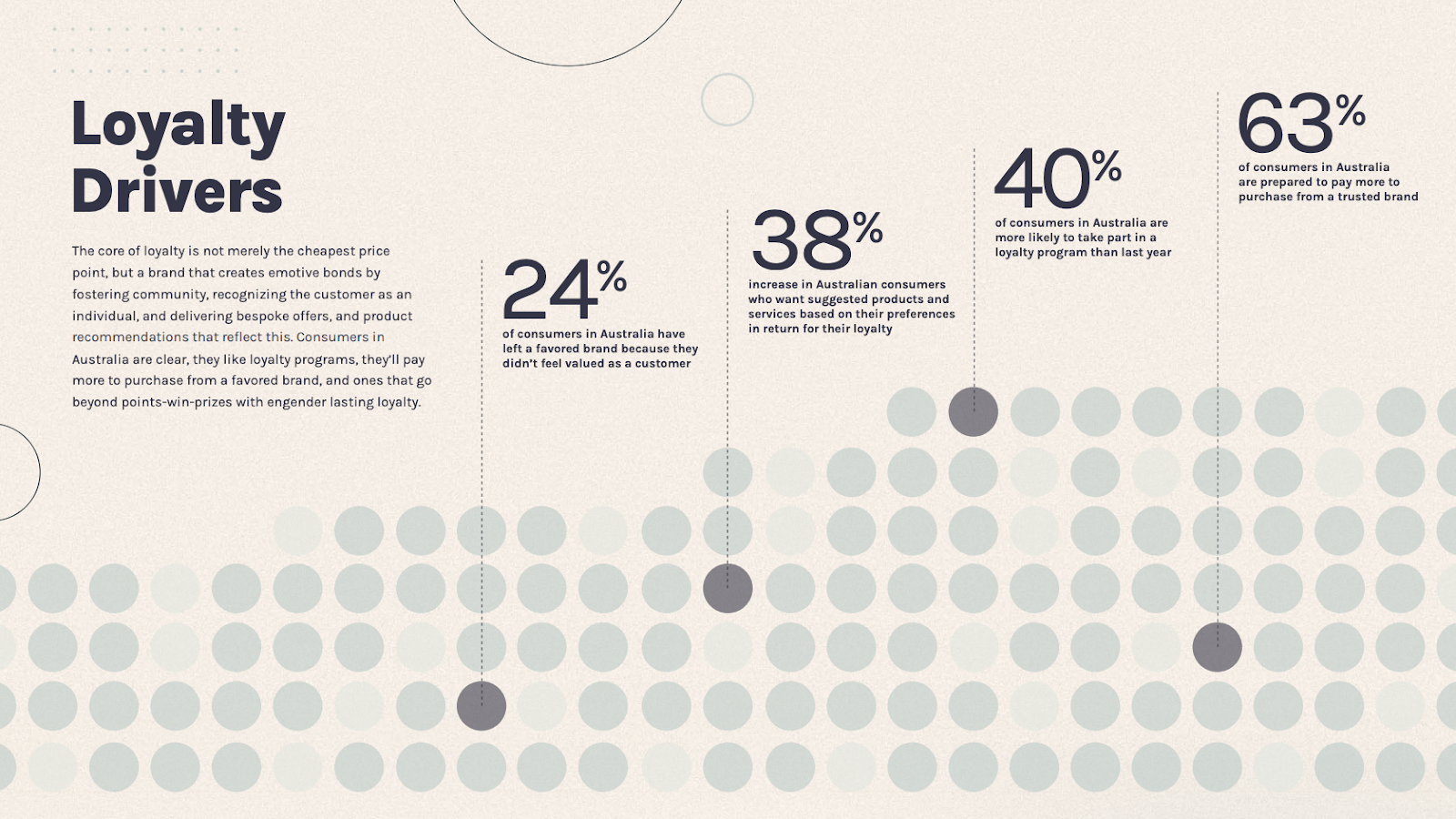
The cheapest price point is only one factor of loyalty. Today, Australian consumers are loyal to brands that create emotive bonds by fostering community, recognising their customers as individuals, and delivering bespoke offers and product recommendations that reflect this. Even more, 63% of Australian consumers are willing to pay more to purchase from a favoured brand.
“When done correctly, loyalty programs govern the value exchange between brands and consumers, and not just for a single interaction but for direct engagement over the customer lifetime. With contextually differentiated, personalised experiences, they can be the conduit for the one-to-one relationships that build customer lifetime value,” says Cheetah Digital’s VP for APAC Billy Loizou.
Access the Australian data findings here.
Access the global report here.
Cheetah Digital is a cross-channel customer engagement solution provider for the modern marketer. The Cheetah Digital Customer Engagement Suite enables marketers to create personalised experiences, cross-channel messaging, and loyalty strategies, underpinned by an engagement data platform that can scale to meet the changing demands of today's consumer.
Many of Australia's leading brands trust Cheetah Digital to help them drive revenue, build lasting customer relationships through leading loyalty solutions and deliver a unique value exchange throughout the entire customer lifecycle
These include local brands such as Bakers Delight, Humm Group, ING and global retail brands Williams Sonoma, Vans and Ralph Lauren who have successfully made their digital transformation and reached unprecedented milestones.
To learn more, visit www.cheetahdigital.com or hear directly from our clients where they share their success stories by visiting our Signals On-demand hub at www.cheetahdigital.com/signals

Azadeh Williams is a finalist in the 2025 PR Professional of the Year category.
This is the third consecutive year Williams has been named a finalist at these prestigious awards. After taking home the PR Professional of the Year trophy in 2024, Williams is striving for two in a row.
The Mumbrella awards recognise the PR professionals and agencies that are making a significant impact to the future success of the PR industry. The Mumbrella CommsCon Awards hosts 24 categories celebrating the best in the business and is judged by some of the biggest names in and around the industry.
The live judging day will take place on 26 February, before the 2025 Mumbrella CommsCon Awards on 27 March at Ilumina, a unique, state-of-the-art space located in the heart of Sydney’s historical and cultural civic centre of Martin Place. The awards will follow the 2025 Mumbrella CommsCon Conference, where Williams last year presented on the topic of career burnout.
“It’s a tremendous honour to be nominated for the third consecutive year, particularly after our win last year," says Williams.
"As PR specialists in the B2B technology sector – an industry growing at an unprecedented rate – it’s an exciting time to be part of this fast-evolving landscape.”
“To continue achieving exceptional outcomes, we must stay agile, adopt innovative strategies and consistently push the boundaries of what’s possible in order to deliver value for our clients.”
For more information about the Mumbrella CommsCon Awards click here.

When it comes to growth strategy in the APAC region, numerous local leaders have seen the good, the bad, and the downright ugly. From over-investing in salespeople and under-investing in PR and marketing support to trying to ‘copy and paste’ a US strategy in the region, big tech vendors looking to expand often fumble in the same areas.
In this ‘Walk and Talk’ episode, we chat with Amperity Area Vice President Billy Loizou about expanding into a new and emerging region — something he’s a bit of an expert in.
Just recently, Amperity, the leading customer data platform (CDP) for enterprise consumer brands, broke into the APAC market, opening a new office in Melbourne. And it’s up to Billy to lead the company’s sales and marketing efforts while building a team of dedicated experts. Their goal? To help local brands make better use of customer data to scale their business.
If you’re a martech vendor on a growth mission, you won’t want to miss Billy’s insights.
When trying to break into a new market, Billy says it’s vital to remember why you’re there in the first place. “Don't get caught up in an acronym that you're defined by right like CDP. What does CDP even mean?
“Instead, you need to help the market understand what problem you're solving. And show them how to use that solution to solve their pain point,” he says.
Billy says he’s also seen big tech vendors enter a new region and go on a hiring spree — something he wouldn’t necessarily advise. “The second ‘big fail’ is over hiring,” he shares.
“Some organisations assemble a big team, but then they don’t have enough clients. This leaves employees sitting there, figuring out what their job is.”
The third big fail, Billy says, is not having PR support to elevate your thought leadership in the new market. “You need a proper PR strategy. You need a go-to-market plan. And you need local agencies that can help you expand that quickly,” he says.
Without a solid foundation in place, you risk burning out your team. It’s a story heard on repeat in B2B marketing and one that has touched the lives of many across the globe. According to a survey that polled nearly 7,000 professionals, more than 83% of marketing and communications professionals said they were burnt out. The number one reason was the lack of separation between work and life. An ‘unmanageable workload’ came in at a close second.
When companies enter a new market, oftentimes, nobody has ever heard of them before. That’s where a local PR agency comes in.
“When launching in a region like Australia, PR is so important. It’s paramount to success,” Billy confirms.
“PR helps you get your message and brand out there. PR has the perfect placement of channels to make that message clear about what problems you solve.”
When it comes to selecting a local PR and marketing agency in the region you are expanding, it’s vital to consider a few things. Number one, Billy says, is to ensure a good fit culturally. After that, it’s all about skillset.
“They need to specialise in taking ideas out of your head and articulating them in a way that resonates with your intended audience before pushing them out to market. You want someone who can push you and guide you in the right direction — it’s more important than ever,” he says.
This interview was also featured in Little Black Book Online, one of the world's leading brand, marketing and creative publications.
Authored by Julie Cooper, Senior Content and Communications Specialist at AZK Media.
At AZK Media, we specialise in helping global technology companies get noticed in new and emerging markets. We make driving your growth, our business. Contact us today to see how we can strengthen your expansion efforts.

In a world where PR agencies often leave clients feeling like just another account, AZK Media stands out from the crowd. Our combination of seamless integration, storytelling mastery and natural relationship-building expertise creates an ecosystem where your PR efforts are elevated to new heights.
Don’t take our word for it. AZK Media’s Managing Director Azadeh Williams caught up with Marta Grutka, a seasoned B2B marketing leader who’s worked with AZK Media, and Trish Garner, the marketing lead for Nexxen in the APAC region, to find out why they believe AZK Media is leading the charge in transforming PR on a global scale.
Watch the video to hear our PR client testimonials!
A niche PR agency with global connections
Specialising in B2B technology vendors, AZK Media has proven time and again that we are not just another PR agency; we are the partner that guides and nurtures your B2B tech company to exceptional results.
As Steve Jobs famously said, “The ones who are crazy enough to think they can change the world, are the ones who do." It is in our nature to think outside the box and dare to be different.
We challenge ourselves to achieve beyond your expectations. As a result, we are proud to showcase impressive accolades that further prove we are leading our industry with clients who are trailblazing the tech space.
An agency that seamlessly integrates with your team
Marta first met AZK Media while leading the marketing and PR strategy for education tech company Cialfo. When she was strapped for resources, the last thing she needed was a typical agency that required hand-holding and constant direction. What she got instead was a true PR partner with critical thinking and creative skills in spades.
“It was very high level work that you provided. You came with a sense of open-heartedness to help make things easier for me,” says Marta. “It’s like you were a seamless extension of my team from day one – without the need to chase, correct, or micromanage.”
In the fast-paced world of PR, time is the most valuable resource. AZK Media’s ability to operate like an invisible yet powerful force within your team means we’re always one step ahead, freeing you up to focus on your big-picture goals.
Storytelling that makes your tech topics sing
Anyone who’s worked in B2B tech knows that complex subjects can sometimes make for dry, uninspiring narratives. But at AZK Media, we breathe life into your messages that resonate with your target audience.
As Marta puts it, “You don't just ‘get’ the technical stuff – you make it compelling and exciting. You boil topics down into engaging, bite-sized stories that people can easily understand.”
This skill of translating intricate subject matters into heart-racing stories is a trademark of AZK Media’s approach. We have a dedicated team who are former journalists in business, technology and current affairs, meaning we understand both sides of the coin. We simultaneously simplify and elevate your message to resonate with your audience in a way that hits the mark.
Relationship building: A trusted PR ally
Trish Garner, who is the marketing lead for Nexxen in the APAC region, expresses how vital AZK Media has been in connecting Nexxen with the right media in an incredibly competitive market.
“We don’t have a huge team in APAC, but the way AZK Media supports our strategy, builds relationships with the press, and helps us navigate the media landscape, it’s on par with our global US team,” says Trish.
AZK Media’s emphasis on relationship-building goes beyond pitching stories. We foster trust and maintain long-term partnerships with key journalists, something you cannot fabricate. And, that kind of credibility is invaluable when you’re trying to stand out in a crowded space.
A prosperous PR partnership
At the heart of both Marta and Trish’s experiences is AZK Media’s personable and visionary approach that drives both innovation and, ultimately, success. As your chosen specialised PR partner, collaboration is woven into every action, every decision and every campaign.
As Marta and Trish’s testimonials show, AZK Media is more than just a PR agency. When you partner with AZK, you're getting groundbreaking results while investing in a collaborator who is as committed to your success as you are.
For tech companies looking to elevate your PR strategy with impressive results, AZK Media is here to help. Contact us today.
Authored by Jessica Phillips, Senior Social Media and Communications Specialist at AZK Media.

AZK Media’s Azadeh Williams caught up with Chirag D Joshi, a leading cyber security expert and founder of 7 Rules Cyber, about the most pressing concerns organisations face in 2025. Also the vice president of ISACA Sydney – one of the largest professional associations in the world – Joshi dives into the advancement in AI increasing the sophistication of cyber threats and the efforts at the leadership level to ensure organisations are well-equipped to tackle these threats.
Regulatory changes are shaping cyber security
The Australian Cyber Security Centre receives approximately 144 reports of cybercrime a day in Australia. Due to the alarming rise of cyber threats, the Australian Government introduced the National Cyber Security Law and changes to the Privacy Act, forcing boards and executives to pay closer attention to cyber security. These regulations carry serious legal and financial consequences for non-compliance, which means Chief Information Security Officers (CISO) must play a pivotal role in helping organisations navigate these regulatory changes.
It seems businesses are finally jumping on board with cyber security. According to Forrester’s 2024 The State of Data Security report, privacy and data use will drive additional investment in data security controls. A considerable 78% of respondents in APAC said enterprise security decision-makers expect to increase investment in new data security controls to comply with privacy requirements over the next 12 months. By staying ahead of the regulatory curve, CISOs positively impact the organisation's cyber security posture and provide a competitive advantage rather than a compliance burden.
AI favours organisations and cyber attackers alike
The rapid development of AI presents both a threat and an opportunity for cyber security. On one hand, AI is being leveraged by cyber criminals to automate attacks, such as credential stuffing and phishing campaigns, which are becoming more advanced and harder to detect. On the other hand, AI also holds the potential to enhance security measures by automating threat detection, improving incident response and even predicting potential vulnerabilities before they are exploited.
"The pace of AI adoption is fast, and with that comes the potential for increased threats. At the same time, AI holds tremendous potential to enhance our security measures," says Joshi.
For tech leaders, the key challenge is balancing the speed of AI adoption with the need for responsible governance. AI can drive innovation, but it must be integrated with strong cyber security measures to mitigate the risks it brings. This involves setting clear guidelines for AI usage, establishing frameworks for ethical AI deployment and putting in place guardrails to prevent abuse. Tech leaders must not only advocate for AI integration but also ensure that security considerations are a top priority.
Shift towards identity and access management
As cyber threats evolve, so too must the methods used to protect organisations. Credential theft and credential stuffing are now popular causes of data breaches, replacing traditional methods like phishing and social engineering. This shift places identity and access management (IAM) at the forefront of cyber security.
To combat these rising threats, organisations need to move beyond basic security measures like multi-factor authentication. The focus must shift to adaptive access controls, which adjust the level of security required based on contextual information, such as the user’s location or the sensitivity of the data being accessed. Additionally, the adoption of passkeys and other passwordless technologies is expected to improve security by eliminating one of the most vulnerable points of access.
According to Joshi, tech leaders should prioritise IAM as part of their broader cyber security strategy. By advocating for more robust access management systems, they can help organisations protect sensitive information and reduce the likelihood of successful cyber attacks. This requires not only technology solutions but also a cultural shift within the organisation toward more secure digital practices.
Supply chain vulnerabilities and real-time monitoring
Supply chain attacks pose another major area of concern. As organisations increasingly rely on third-party vendors for critical services and infrastructure, they become more vulnerable to cyber attacks targeting those vendors.
“We've started to see a host of geopolitical issues related to supply chain come about just in the last six months,” explains Joshi.
An ACSC study found that in 2024, 74% of entities performed supply chain risk assessments for applications, ICT equipment and services. In a way to mitigate risks from the start, Joshi emphasises the importance of moving beyond traditional security questionnaires when evaluating vendors. Instead, tech leaders should implement real-time monitoring and adaptive controls to assess the security of key suppliers continuously. This proactive approach allows organisations to identify vulnerabilities before they are exploited.
“That's a key part of what we need to do this year, is move beyond the questionnaires, get to more adaptive control and have visibility. If we don't have visibility, we really have nothing,” says Joshi.
Joshi adds that tech leaders must take the initiative in building strong relationships with key vendors and ensuring that both the organisation's and the vendor's cyber security practices align. In appealing for greater transparency, it’s wise to ask vendors to disclose their own security practices and any subcontractors they may use. By doing so, they can better manage supply chain risks and ensure that their organisation is not exposed to unnecessary threats.
Cyber security centres around education and community building
Joshi says that cyber security is ultimately a “people problem”, and culture plays a critical role in mitigating risks.
“If you improve the company culture, you automatically address 90 per cent of your threats. Culture means not just awareness and training about cyber security, but also getting people equipped to do their jobs responsibly,” says Joshi.
Tech leaders have a responsibility to create a culture that prioritises cyber security. This means providing ongoing education, fostering a mindset of security-first thinking, and ensuring that employees are empowered to recognise and respond to threats. From the C-suite to entry-level employees, everyone should be equipped with the knowledge they need to protect the organisation.
“Cyber security is not something we can tackle in isolation,” Joshi says.
“Engagement with the wider community, thought leadership, and knowledge-sharing are crucial to our collective resilience,” he continues.
Why should tech trailblazers lead the charge?
As the cyber security landscape becomes more complex in 2025, tech leaders must step up and lead the way. Regulatory changes, the rise of AI, evolving threats to identity and access management, and the growing risks associated with supply chain vulnerabilities all require a proactive, strategic approach.
By engaging closely with the business, advocating for responsible AI adoption, implementing robust IAM systems, and prioritising supply chain security, tech leaders can ensure that their organisations are prepared for the challenges ahead.
In short, cyber security boils down to a leadership issue. Tech leaders must take the reins and guide their organisations through the evolving threat landscape, ensuring that cyber security is not just an IT function but a core business priority.
Authored by Jessica Phillips, Senior Social Media and Communications Specialist at AZK Media.
At AZK Media, we specialise in helping global technology companies get noticed in new and emerging markets. We make driving your growth, our business. Contact us today to see how we can strengthen your expansion efforts.

How do they outshine their competition? They build winning campaigns. And if they don't bring home the gold medal, the silver lining is that they go down in history for doing something iconic.
Similarly, in retail technology, seeking strong brand presence in a crowded market is one of the most difficult hurdles to jump over. How can you be more visible in your industry? Equip yourself with marketing solutions that build brand awareness and trust for your target audience.
At the recent Online Retailer Expo in Sydney, AZK Media managing director Azadeh Williams asked retail technology vendors about their focus on brand awareness and strategies they employ to market their offering. Here’s what they had to say:
The interviewees emphasised the importance of establishing a strong brand presence in a saturated market through the power of customised marketing efforts, relationship building and event networking. They emphasised that marketing is not a sprint, but a marathon to organically grow brand awareness for the ultimate goal of lead generation.
How important is marketing to your overall success as a retail tech vendor?
Zach Hotchkiss, Regional VP APAC, Attentive
Marketing is critical for our company. We came into market less than two years ago and we now have 200 customers with a strong presence at many events. We pride ourselves on building relationships and a sense of connection by hosting our own events. Our marketing spend is ample but it plays a critical role in our top funnel of our lead generation efforts.
Mark Baartse, Outsourced CMO
Cold calling or messaging on LinkedIn is not a marketing approach anymore. There must be a presence established prior to engaging with prospective customers or clients. People have multi-year buying cycles; they are not going to get a message today and then sign up for your technology tomorrow. It takes a long-term strategy to nurture relationships and build a positive brand experience.
Ivan Logan, MD and Founder, Omnivore
Marketing is absolutely essential. The reality is that retail technology is a crowded marketplace.
We have to be able to cut through the noise and promote our message into the world. With everyone plugging the notion that their technology is a game-changer for individuals and industries, it’s important to find that unique selling point to separate from the competition.
David Espitia, Account Director, Queue-it
We focus on customisation and localisation to ensure our brand adapts to the local market. We like to share stories of customers that we help. Our main market is enterprise so we have some of Australia’s largest brands on board. When customers see how our virtual waiting room can help them flourish in their business, manage online traffic and grow their loyalty base, we showcase our reliability and resilience against potential risks, such as cybersecurity.
Samved Shankar, Sales Executive, Zoho
Brand awareness and revenue go hand-in-hand. If you have a strong brand awareness channel and marketing strategy, it does help to create a better stance in the market among competitors.
Kehan Vale, APAC Growth Director, Reviews.io
It is a challenge getting your name out there. In the world of reviews, it’s about letting your customers do the work for you. We’re a review solution and customer advocacy is a strong win for us in an agency landscape.
Hugh Russell-Parsons, Strategic Partner Manager APAC, Gorgias
From a venture side, marketing is crucial. You hear brands explain that they need to hit certain channels to get in front of their ideal customer. It’s very much the same story for Gorgias. The main question to ask is how are you getting your unique selling proposition (USP) out into the world? What is your ideal customer profile (ICP) and which channels are they residing on? Hitting different channels will make a world of difference to your marketing strategy.
Authored by Jessica Phillips (née Poulter), Senior Social Media and Communications Specialist at AZK Media.
At AZK Media, we specialise in helping global retail technology companies get noticed in new and emerging markets. We make driving your growth, our business. Contact us today to see how we can strengthen your expansion efforts.

Yet, tech players – whether global giants or ambitious startups – are repeatedly making the same mistake before jumping into the market: they skip the local PR piece of the puzzle and miss the big-picture narrative that builds credibility and trust.
With more than 20 years of experience across APAC, Marta knows this market inside out. And according to her, relationship-building is the name of the game, especially in the crowded B2B tech space.
In this blog, Marta gives four effective ways on how tech companies can benefit from partnering with a local PR agency in APAC and see success in the region.
Let’s dive in!
What makes APAC different from other regions?
Unlike fast-moving Western markets, APAC is a slow burn where relationship-building is the leading character. Tech companies that want to succeed here can’t afford to cut corners, they must invest in understanding local customers, solve their problems with innovative solutions, and prioritise trust-building.
Marta warns that many tech companies, particularly those based in the United States or Europe, fall into the trap of adopting a KPI-driven, sales-first approach when entering the region. While metrics matter, this mindset can backfire, resulting in superficial connections with local audiences who crave more thoughtful, nuanced interactions.
“The approach is much more sales-like and KPI-driven, and they don't really understand the value and the need to have the longer lead type of relationship building conversations,” says Marta.
“I've seen over time, things become very transactional. I'm speaking from experience, working across multiple industry sectors, but tech is underneath all of them.”
Step 1: Build genuine, long-term relationships
Marta stresses that even as technology and marketing strategies have evolved over the years, one thing remains constant: the need for long-term, trust-based relationships.
"What's interesting to me is that even 20 years ago, the region was and still is very relationship-driven, whether it's B2B or B2C. That aspect hasn't changed, and I see it as a great opportunity,” she says.
Unlike many Western markets, where transactional sales approaches are common, APAC business culture places a premium on personal connections, mutual respect and consultative discussions.
A local B2B tech PR agency brings invaluable knowledge of these cultural nuances. They understand the pace and style of decision-making in each APAC country, ensuring that your communications are not only effective but also culturally appropriate. These agencies can help you move beyond the “hard sell” to position your brand as a trusted partner rather than just a vendor.
Step 2: Simplify complex tech messages for local audiences
Tech solutions can be intricate, abstract, and complex to break down. Marta advocates for keeping things simple: focus on core value propositions and the specific problems your tech solves.
Whether it’s AI, cloud computing, cybersecurity, or data analytics, the challenge centres around how to communicate complex concepts in a way that resonates with the local market.
“It’s about helping articulate ‘who we are’. It's my same mantra,” Marta says.
“I say it for any industry – ‘this is what we stand for’, ‘this is what makes us stand out’ and ‘this is what we're doing for the world at large’, and bringing those conversations up to the highest level without getting too much into the weeds of the tech stuff.”
This is where a local tech PR agency shines. At AZK Media, we possess the skills to articulate complex, global solutions in a way that is both clear and relevant to local audiences. We can break down your technology into digestible, relatable stories without sacrificing the technical integrity of your offering.
By framing your solutions in terms that matter to local businesses – whether it's improving efficiency, reducing costs, or solving industry-specific challenges – your chosen PR agency can make your message more compelling.
Local agencies are often better equipped to translate technical language into practical benefits that connect with the day-to-day concerns of the target audience. This can be especially helpful when dealing with decision-makers who might not have a technical background but still need to understand the tangible benefits your solution offers.
Step 3: Keep global narrative consistent but add local flair
Marta believes that tech brands should aim for “globally resonant, locally relevant stories.” In other words, while the core brand narrative and values should stay consistent, the way those stories are told must be tailored to the cultural dynamics of each market in APAC.
A local and specialised PR agency can balance both these demands. PR professionals know how to craft a unified brand story that aligns with global objectives while also ensuring the narrative resonates with local business leaders, tech innovators and end-users.
This local expertise prevents brands from making the common mistake of sending out one-size-fits-all messages, which can often come across as tone-deaf or disconnected.
For example, a company might be known globally for its cutting-edge AI technology, but in APAC, the message could be tailored to emphasise how AI can help local businesses streamline operations or stay competitive in a fast-moving market.
This localisation process improves engagement and enhances the credibility of the brand by showing an understanding of local issues and priorities.
Step 4: Define your unique selling proposition
It’s the old-age question, what makes you unique? Surprisingly, many companies miss asking themselves this fundamental question before putting their products to market.
When entering a new region, tech companies need to clearly define what sets them apart from the competition. Marta advises tech companies to clearly articulate their core value proposition, emphasising the problems they solve and why their solutions are indispensable. This requires understanding both your competitive landscape and the specific needs of local businesses.
A local PR agency can be instrumental in refining this message and helping your company position itself effectively against local and regional competitors. Their local market intelligence allows them to identify opportunities that might otherwise go unnoticed, ensuring your brand stands out in the crowded APAC market.
Ready to expand into APAC? Partner with AZK Media
For tech companies expanding into the APAC region, partnering with a local B2B tech PR agency is as essential as having an innovative product.
The region’s emphasis on relationship-building, coupled with its complex market dynamics, makes it clear that a copy-paste expansion strategy won’t fly. By working with a local PR agency, you can craft messages that resonate with both local audiences and global stakeholders, simplify complex technical information, and navigate the unique business environment of APAC with greater success.
Now is the time to lay the groundwork for long-term, meaningful relationships that drive sustained growth in one of the world’s most dynamic regions.
Authored by Jessica Phillips, Senior Social Media and Communications Specialist at AZK Media.
At AZK Media, we specialise in helping global B2B technology companies get noticed in new and emerging markets. We make driving your growth, our business. Contact us today to see how we can strengthen your expansion efforts.

Through the Cairns Hatchlings program, against the backdrop of the Cairns Crocodiles event, emerging professionals gain invaluable real-world experience that prepares them for a thriving career. She believes mentorship and hands-on experience are key to building a well-rounded skill set, equipping young people with the tools and confidence they need to succeed in a highly competitive field.
“Before starting AZK Media, I lectured in media for a number of years. Having mentored and lectured hundreds of students, I realised back then the true power and value of mentoring the next generation of media, marketing and PR talent,” she says.
“Strengthening the capabilities of the next generation of marketing and PR talent is critical in today’s highly volatile landscape, where working hours can be sporadic, work-life balance challenging, and expectations sky-high. It’s also essential to move the industry forward in a positive and empowered direction,” adds Williams.
Beyond mentorship, Williams advocates for doing good in the industry. Adopting a charitable, ‘brand with purpose’ mindset can be applicable at any stage of a person’s career.
“Even as a small media agency, we work on many pro bono initiatives, including partnering with the Global AI Ethics Institute to drive meaningful conversations around the ethics of AI in our society.”
Williams’ message to the next generation is clear: with the advertising industry evolving at a fast pace, she encourages young professionals to embrace change and remain agile; always seeking out new opportunities to learn and grow.
By empowering young talent, promoting diversity, and advocating for innovation, Williams hopes her work with Cairns Hatchlings helps to shape a creative industry that is not only more dynamic but also more representative of the world we live in.
To read the full interview with Azadeh Williams, click here.

According to the Shopify Australian Retail Report 2024, data, digital experiences and commerce solutions are playing an increasingly important role in the business ecosystem. More than 90 per cent of retail leaders surveyed believe the role of chief technology officer (CTO) contributes to the evolution of the business and revenue growth. More than half of retailers surveyed (58 per cent) are boosting investment in ecommerce solutions in the next 12 months to enhance digital operations and customer reach.
Despite the ongoing uncertainty around both the Australian and global economy, many local retailers remain excited about the possibilities of technology, especially AI. AZK Media’s Managing Director Azadeh Williams recently asked industry leaders attending the Online Retailer Expo in Sydney for their perspectives on the innovation of the retail tech landscape.
The magic of AI integration
Hugh Russell-Parsons, Strategic Partner Manager APAC at Gorgias, is particularly energised by the advancements in AI automation. "The sheer volume of AI innovations is thrilling. For instance, Gorgias' AI agents can automate up to 50 per cent of customer conversations across various channels," he explains. The power of this AI-driven technology not only streamlines operations but also frees up valuable time for teams to focus on strategic growth and enhance customer experiences.
Blending online and offline innovation
Kehan Vale, APAC Growth Director at Reviews.io, shares his excitement about the rapid advancements in both online and offline retail technologies. "The integration of innovative products, POS systems and AI solutions is particularly exhilarating," he says. The seamless fusion of these elements is driving transformative change in how retailers operate, creating new opportunities for efficiency and customer engagement.
Standing out with customer-centric strategies
Zach Hotchkiss, Regional VP APAC at Attentive, highlights the importance of differentiation in a crowded market. "It’s crucial to have innovative products and stay attuned to consumer trends," he asserts. Hotchkiss shares his enthusiasm for the potential to stand out by focusing on the next generation of buyers and leveraging modern communication channels to build deeper connections with customers.
Innovating with first-party data
Outsourced CMO Mark Baartse is passionate about how technology is reshaping the data landscape. "Retailers must innovate, and the changing data landscape presents both challenges and opportunities," he says.
Baartse is particularly excited about how companies are using first-party data for personalisation and gaining deeper insights into customer behaviour. This level of data-driven innovation is a key driver of success in the retail technology sector.
Expanding market reach with technological flexibility
Ivan Logan, MD and Founder of Omnivore, is thrilled by the flexibility that technology offers retailers. "We’re enabling retailers to integrate with various marketplace channels, allowing them to test and optimise product sales across different platforms," Logan explains.
This capability to adapt and distribute products widely is transforming how brands reach their audiences and respond to market demands.
Technology is an open door to financial success
David Espitia, Account Director at Queue-it, believes ongoing technological advances are boosting e-commerce growth. "The way technology helps retailers expand their reach and increase revenue is incredibly exciting," he says.
Espitia’s enthusiasm underscores the role of tech in driving brand visibility and financial success.
Untapped potential to innovate
Samved Shankar, Sales Executive at Zoho, is captivated by the evolution of the retail tech industry. "The market is growing, and there are still untapped areas with innovations emerging regularly," Shankar remarks.
A constant influx of new technologies and solutions keeps the industry dynamic and full of potential.
From AI-driven automation to innovative data storage, the retail-tech landscape is moving fast. As these experts have pointed out, staying competitive in this fast-moving sector involves embracing new technologies, understanding shifting consumer preferences, and continually innovating.
The future of retail tech is not just about keeping up – it's about trailblazing into a new era of possibility.
Authored by Jessica Phillips (Poulter), Social Media and Communications Specialist at AZK Media.
At AZK Media, we specialise in helping global technology companies get noticed in new and emerging markets. We make driving your growth our business. Contact us today to see how we can strengthen your expansion efforts.

For organisations looking to harness the power of AI, the focus is shifting from theoretical discussions to practical, measurable outcomes.
At a 2024 SXSW Sydney conference, top tech thought leader Gladwin Mendez shared his insights with AZK Media Managing Director Azadeh Williams on how AI tech vendors can stand out in a crowded market with ROI and why marketing and PR play a pivotal role in demonstrating the true value of AI solutions.
For many businesses, 2024 was the year of AI – where the buzzword met real-world application.
A 2024 Deloitte report found that three in four Australians who use GenAI said it has improved the speed at which they can complete tasks. This increase in productivity has led to significant time savings. Almost half of GenAI users surveyed (47 per cent) said they use the time saved to complete additional tasks at work, while one in four invested time in further learning or skill development.
Despite this data highlighting an attractive ROI, Australia has the second-lowest share of GenAI users (including employees and students) of Asia-Pacific (APAC) locations surveyed – 54 per cent, compared to the Asia-Pacific average of 67 per cent. Developing locations such as India, Indonesia, and Malaysia have a stronger share of GenAI users than Australia, New Zealand and Japan.
Why is the uptake slow in APAC? One possible answer lies in businesses needing to see ROI from AI before fully committing to its adoption.
“It’s time for delivery,” Mendez says. “We’ve heard a lot of talk, but now it’s time to actually show organisations how they can realise a return on investment through AI.”
Ultimately, AI is all about delivering value – and organisations are looking for clear evidence of that value.
Mendez explains that one of the biggest mistakes vendors can make is focusing on product features or abstract benefits. Instead, the conversation should centre around ROI – what tangible improvements AI has made for customers.
“If you can show the ROI, you’ve got the customer’s attention.”
A recent McKinsey & Company study states companies that rigorously measure AI’s ROI report 20-30 per cent higher returns compared to those that don’t.
For marketers and PR professionals working with AI vendors, the goal should be to highlight results and impact through consistent messaging that captures the essence of the solution’s real-world effectiveness.
Customers no longer want to be sold on theory – they want to see how AI works and what it can do for them in practical terms. Whether through detailed case studies, client testimonials, or video content, showing AI in action and sharing concrete outcomes is essential to building trust and credibility.
In Australia, a few major players stand out as prime examples of optimal GenAI adoption, including:
With a plethora of AI solutions and tech vendors now competing for attention, the challenge is no longer about having a cutting-edge product; it’s about proving that it works.
“The real opportunity is in execution,” Mendez adds.
As new entrants come into the market with plans to utilise GenAI and challenge established business models, marketing and PR become the foundation for company success, giving technology businesses the platform to showcase tangible results and customer advocacy.
With so many companies offering AI and data analytics solutions, standing out seems as hard as winning the lottery.
For Mendez, it's not luck, it's data. Vendors who can showcase real-world applications – backed by data and demonstrable ROI – are the ones who will rise above the competition.
“It’s about showing, not telling,” he says.
Demonstrating successful AI implementations through case studies, testimonials, and specific use cases is vital for gaining trust.
Organisations are increasingly looking for clear evidence of how AI can drive measurable outcomes in areas like efficiency, revenue growth, and customer satisfaction.
Mendez points to the importance of showcasing the tangible impacts that AI has had on organisations and communities. Instead of engaging in theoretical discussions, tech vendors must shift their focus to showing how their AI tools have solved real problems, delivered ROI, and improved business performance.
In a saturated AI marketplace, the role of marketing and PR becomes the essential factor to attracting your audience. With consistent communication and effective storytelling, Mendez says cutting through the noise is achievable. But it’s not just about promoting your product – it’s about sharing authentic stories of AI in action.
“PR and marketing are critical because they help you stand out in the ‘red ocean’ of AI competitors,” he explains.
This "red ocean" refers to a market that is overcrowded with competitors, each vying for attention. To stand out, AI vendors need to deliver messages that resonate with their audience, harnessing customer testimonials and success stories that demonstrate the real-world value of their solutions.
And, traditional advertisements? Not effective. Mendez instead opts for user-generated content – such as videos and customer stories – that show AI in action.
“People want to see the product in use,” he says. “They want to see the outcomes, not just hear about them.”
In 2025, it’s clear that AI is now an integral part of the future of business. However, for AI vendors to succeed in an increasingly crowded marketplace, they must focus on what truly matters: delivering tangible results and communicating those results effectively through PR and marketing strategies that highlight the real-world impact of their solutions.
In the end, AI is all about showing how it works, not just telling people about it. By prioritising ROI, real customer success stories, and transparent communication, tech vendors can distinguish themselves in a competitive field and ultimately drive their success.
Authored by Jessica Phillips, Senior Social Media and Communications Specialist at AZK Media.

As AI and automation redefine the digital marketing landscape, brands have a choice: use these tools to truly connect or risk becoming digital wallpaper. But here’s the good news – it’s not a choice between tech and humanity. It’s about blending the two.
Azadeh Williams dives deeper into this notion at the Future Forum, hosted by Ashton Media. Here she interviews Udara Withana, Insights & Client Strategy Director at Ogury, who says that is where the real magic lies.
The privacy-first era has arrived
We’ve talked about cookies crumbling for years. Now, it’s real. In 2025, we’re entering what Withana calls “the era of privacy in digital marketing.” The outdated, creepy model of passively tracking users across the web is finally giving way to something smarter and more respectful.
AI will be at the heart of this shift. Privacy-preserving AI technology will enable brands to scale campaigns across multiple touchpoints without sacrificing user trust. Instead of relying on invasive tracking, marketers will need to understand context – where their messages appear, what content surrounds them, and whether they genuinely fit in.
“AI will be used to drive the scalability of privacy-first technology,” says Withana. “It helps propagate messages across brands and touchpoints in a way that’s compliant and effective.”
Google's AI mode: It's all about context now
One major shift in this landscape is Google’s new AI mode – a functionality that prioritises the contextual nature of content placements. For marketers, this means the lazy days of ‘spray and pray’ are over.
“For the longest time, we’ve been passively tracking users without paying attention to where the ads appear,” Withana explains. “Now, you need to resonate not just with the users – but with the content they’re consuming.”
This shift is a win for consumers and a wake-up call for marketers. Relevance won’t just be about who sees your ad, but where and why. Is your brand part of the conversation, or just awkwardly interrupting it?
Excitement or fear buzzing in marketing land?
With all this change, it’s easy to feel overwhelmed. But according to Withana, marketers should feel energised, not anxious.
“This is about helping brands resonate with audiences better,” he says. “Not just selling products blindly – but understanding where your audience is, what they care about, and how to show up in a meaningful way.”
In other words, AI isn’t here to replace marketers. It’s here to supercharge them. By offloading the grunt work – like compliance, campaign deployment, and optimisation – AI gives humans more space to do what they do best: tell stories that spark emotion.
Scaling emotion with AI: Human-tech synergy
So how do you strike the right balance between the cold efficiency of automation and the warm resonance of human storytelling?
Answer: Know what each does best and play to the strengths.
AI excels at scale, managing repetitive tasks, deploying privacy-first solutions, and ensuring campaigns run smoothly across platforms. But once you’ve captured attention, you need to go beyond just relevance and bring human connection.
“AI helps you build that rapport at scale. But when you actually go in front of an audience – what do you say?” asks Withana. “That’s where human magic comes in. You spark emotions.”
The future of marketing is not a match between humans and machines. Marketers need to create emotionally charged narratives, then use AI to deliver those messages safely, contextually, and at scale.
Four practical steps for marketers in 2025
So what now? Withana lays out a clear roadmap for brands that want to thrive amid these changes:
Use AI to ensure your campaigns meet new compliance standards while still scaling across touch-points. Privacy is the foundation of trust, which means it must be at the centre of all activity.
Focus on where your ads appear. Align with content that makes sense for your message. Relevance is about context as much as it is about the audience.
AI can scale your message, but only humans can really craft it. Invest in story-driven content that speaks to emotions, not just algorithms.
It’s less about chasing impressions and more about chasing impact. Understand the why behind your placements and the how behind your narrative.
What's the next step to evolve?
Gone are the days of marketing meaning who could shout the loudest and be on every billboard. In 2025, It’s about being the most relevant, trustworthy, and the most emotionally resonant.
As Withana puts it, “If you don’t evolve with the changing landscape, you risk being left behind.”
So indeed, AI is reshaping the game. But the secret to winning isn’t abandoning your humanity – it’s amplifying it, at scale.
Authored by Jessica Phillips, Senior Social Media and Communications Specialist at AZK Media.
At AZK Media, we specialise in helping global technology companies get noticed in new and emerging markets. We make driving your growth, our business. Contact us today to see how we can strengthen your expansion efforts.

The Collectivist Agency network includes a carefully selected group of elite global technology PR agencies representing over 46 countries. Collectivist unites complementary agencies from the US, UK, EU, Middle East, LATAM, Africa, and Asia-Pacific to form a global superpower to support the PR, communications and marketing demands of tech startups, scaleups or global brand giants.
Led by Azadeh Williams, a former journalist for The Times, Reuters and IDG, AZK Media brings deep expertise in B2B and B2C technology communications, including martech, adtech, AI, BI, retailtech, fintech, healthtech, legaltech and proptech.
Most recently, AZK Media launched an ‘AI search ready’ PR solution, designed to boost brand visibility across generative AI platforms like ChatGPT, Perplexity, and Gemini.
Founded in 2017, AZK Media has built a reputation for delivering strategic PR, marketing, content, video production, and media services that drive brand awareness, reputation, share of voice, and lead generation.
Our client portfolio includes Amperity, Eagle Eye, Workday, Nexxen, and Pronto Software.
Read the story on the Collectivist Agency here.
AZK Media is an award-winning B2B technology public relations and marketing agency that accelerates business growth in new and emerging markets. Powered by global journalistic expertise, our PR strategies, inbound lead generation programs, video storytelling and AI-driven visibility campaigns deliver significant impact for technology brands across the Asia-Pacific region. Clients include Amperity, Eagle Eye, Nexxen and Pronto Software. As a proud member of the Collectivist Group, a network of elite global technology PR agencies spanning 46+ countries, AZK Media offers clients exceptional reach and influence on the world stage. Learn more: www.azkmedia.com and follow us on LinkedIn or X.
At AZK Media, we specialise in helping global technology companies and tech start-ups get noticed in new and emerging markets. We make driving your growth, our business. Contact us today to see how we can strengthen your expansion efforts.

Research suggests that 89% of B2B buyers now use AI search platforms like ChatGPT, Gemini and Claude in their purchasing decision-making process. Meanwhile, a groundbreaking study recently revealed up to 90% of those AI citations come from earned media sources like trade publications, analyst reports, and industry coverage.
This is because AI-driven search platforms don’t just scan your website. They scan the entire internet for trusted, third-party validation.
Unlike traditional SEO, which focuses on your website ranking, ‘’Gen Engine Optimisation” (GEO) requires building your reputation across the broader internet.
The more trusted, high-quality coverage your company earns across high authority media outlets, social channels and industry platforms, the more likely AI search tools will surface your business as a reputable, recommended solution.
“The old lead gen playbook, optimising your website, running ads, setting up event booths, no longer guarantees visibility. In today's AI landscape, PR ranks as the best-performing strategy for brand visibility across AI search,” says Azadeh Williams, Managing Director at AZK Media.
“If you want prospects to discover your solution in AI results, you need more than keywords, you need credible endorsements on the right third-party channels. This means investing in AZK Media’s new ‘AI search ready’ PR solution is critical in the age of GEO, where third party credibility and endorsements trumps traditional SEO strategy.”
The Agency’s new AI search solutions have already attracted attention from large global enterprise, startup and scale-up brands, as well as global agencies who are now partnering with AZK Media to complement their own SEO solutions. The agency is also now part of the Collectivist Group, a carefully selected group of elite global technology PR agencies representing over 46 countries.
AZK Media already excels at securing top-tier and trade publication coverage, positioning executives as industry commentators, and building relationships with analysts and thought leaders. These core PR capabilities directly translate into AI search authority and strong sentiment for brands.
The agency is also developing new content formats specifically designed for how AI systems research topics, creating resources that directly answer the questions prospects ask these tools. Additionally, AZK Media has invested in reporting and tracking capabilities to measure clients' visibility in AI-generated results.
"AI doesn't just ask, 'what does your website say?' It asks, 'what does everyone else say about you?'" Williams says.
"We analyse exactly how these systems work to understand where our clients' business messaging needs to appear to influence AI recommendations, then execute on delivering those targeted media placements."
To learn more about our work to ensure clients gain share of voice in the age of agentic AI, please contact us or visit our PR and thought leadership service.
As featured in Mumbrella, Mi3 Australia, B&T, Marketech APAC, In AI Today, Startup Scaleup, CMOtech Asia, IT Brief Asia, ChannelLife Australia, IT Brief Australia, ChannelLife New Zealand, IT Brief New Zealand, ChannelLife India, CMOtech India, IT Brief India and Martech Series.
AZK Media is an award-winning B2B technology public relations and marketing agency that accelerates business growth in new and emerging markets. Powered by global journalistic expertise, our PR strategies, inbound lead generation programs, video storytelling and AI-driven visibility campaigns deliver significant impact for technology brands across the Asia-Pacific region. Clients include Amperity, Eagle Eye, Nexxen and Pronto Software. As a proud member of the Collectivist Group, a network of elite global technology PR agencies spanning 46+ countries, AZK Media offers clients exceptional reach and influence on the world stage. Learn more at www.azkmedia.com and follow us on LinkedIn or X.

The annual list recognises pioneers and change-makers who are leading the way in responsible and impactful AI adoption across industries.
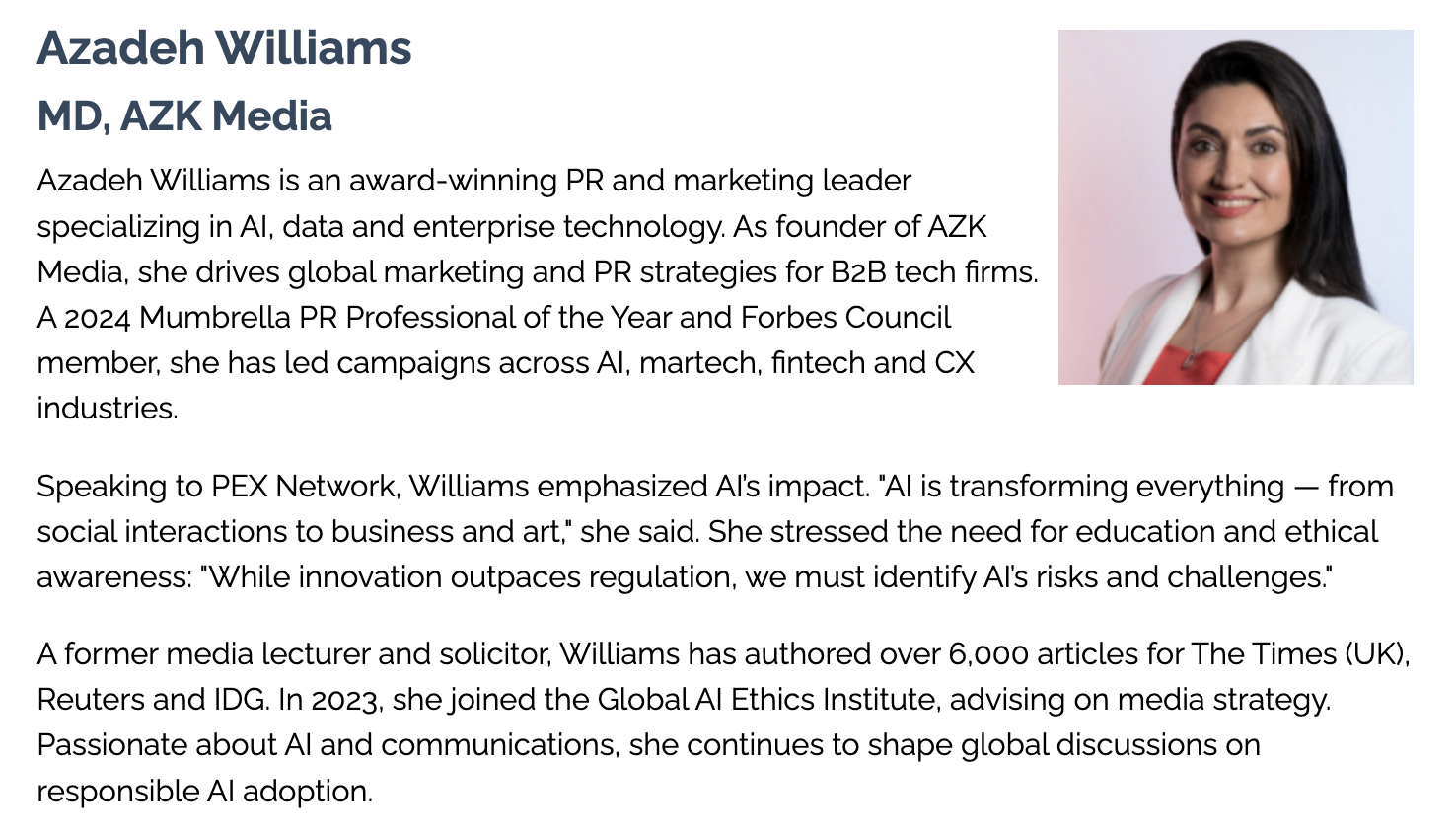
Williams, the founder and managing director of AZK Media, was singled out for her influential work in AI ethics, thought leadership, and commitment to driving positive transformation through emerging technologies. Her appointment to the executive board of the Global AI Ethics Institute in 2023 further cemented her position as a key voice in the global AI landscape.
“AI is transforming every industry at breakneck speed,” Williams said in response to the announcement. “We need more leaders who are willing to ask the difficult questions, advocate for transparency, and ensure AI is developed with cultural diversity, accountability, and human wellbeing at its core.”
The PEX Network’s Top 30 list is compiled based on a range of criteria, including industry impact, global influence, published thought leadership, and innovation in AI implementation. According to the announcement, the leaders selected this year are not only reshaping how AI is applied to process excellence, but also championing ethical frameworks and inclusive strategies in AI development.
Williams’s work has spanned both the corporate and non-profit sectors, with a particular focus on building AI governance models that reflect global perspectives. At AZK Media, she advises clients on digital transformation strategies and helps position them at the forefront of innovation. She also regularly speaks at international conferences on the intersection of marketing, ethics, and AI.
Earlier this year, Williams participated in the PEX Network’s “All Access: Agentic AI in PEX APAC” event, where she joined a panel exploring how businesses can prepare their workforce and processes for the next wave of AI technologies. Her presentation highlighted the importance of cross-functional AI governance teams, ethical audits, and internal education to help companies manage risk while innovating responsibly.
Her recognition by PEX comes amid growing global debate around the responsible deployment of AI tools such as large language models and autonomous systems, like agentic AI. Williams has consistently argued that without inclusive ethical standards and a commitment to long-term human impact, AI innovations risk losing public trust and creating unintended harm.
With this latest accolade, Williams joins an elite cohort of AI leaders from across the globe, including academics, entrepreneurs, and C-suite executives, who are charting the path forward for AI.
As AI adoption accelerates, Williams’s voice continues to serve as a vital reminder: technological advancement must go hand-in-hand with ethical foresight, human values, and inclusive leadership.
Read the original blog here.
At AZK Media, we specialise in helping global technology companies get noticed in new and emerging markets. We make driving your growth, our business. Contact us today to see how we can strengthen your expansion efforts.

In the world of AI agents enabling stronger data stitching and identity resolution, why is data democratisation across organisations still lagging?
At the 2025 CDAO conference in Sydney, Billy Loizou, Area Vice President, APAC at Amperity and a recognised thought leader in the marketing and technology space, shared powerful insights on how brands can truly democratise data by harnessing AI, without losing the magic of human thinking.
Data is currency as some would say, but for many organisations, it remains frustratingly out of reach for the people who need it most.
“The biggest challenge is that business users often don’t have access to the data,” addresses Loizou.
“And even when they do, data literacy within departments can be low.”
The problem isn’t only about data availability, it’s about usability. Teams need information in a format that’s both accessible and easy to understand for effective decision-making.
To solve this, companies like Amperity are thinking beyond centralised dashboards and moving towards hyper-tailored data environments.
“We don’t just build a view of the customer,” says Loizou. “We build it specifically for each team.”
In practice, that means marketing teams receive a different set of data points than customer service teams. While marketing may focus on personalisation attributes – browsing behaviour or category interests – customer service teams might need last purchase dates, satisfaction scores or case histories to resolve issues faster.
This approach supports real-time, role-specific decision-making while also mitigating risk.
“Not everyone needs access to all the PII…just the relevant attributes that help them do their jobs better.”
When it comes to customer data, AI can really take the painful and tedious work out of data engineering. For Amperity, AI is deeply embedded into how users interact with data, regardless of technical skill level.
There are two main ways this plays out.
First, for more technical users: “If I’m writing SQL, we have an AI assistant that helps generate that code,” Loizou says.
“It’s simple, helpful and really speeds up the value track.”
But where things get really interesting is for the non-technical users like the marketers, CX leads or analysts who aren’t fluent in SQL.
“We’ve built a capability that understands your data’s relationships and allows you to ask natural language questions,” he says.
It’s as intuitive as asking, “How many customers purchased in the last 30 days?” or “Which of them are high value, and how do they compare to others?”
Behind the scenes, AI interprets these questions, runs the necessary queries, visualises the data, and enables segmentation all in one flow.
“It removes the data literacy barrier, which is still a real issue in ANZ,” says Loizou.
And for customers, this capability unlocks the kind of deeply personalised experiences that make them feel recognised and understood.
With all the power AI offers, there’s a growing temptation to rely on it for everything. But Loizou cautions against over-automation, especially in areas that require emotional intelligence or lateral thinking.
“I’ve been playing with AI for years,” he says, “and the more I engage with it, the more human it starts to feel. But it still doesn’t think laterally the way a human does.”
In other words, AI is a phenomenal enabler of operational efficiency, but it’s not a replacement for human insight.
“The expression, the creativity, the execution of what you identify, that still needs a human,” Loizou explains.
While AI can analyse and surface patterns, humans are capable at contextualising meaning, understanding nuance and aligning data with broader brand narratives.
Loizou also raises important considerations around AI governance, especially when AI does hiccup on the odd occasion. Without human oversight, the risks to brand reputation and customer trust become significant.
“We’re seeing things like bias and hallucinations emerge more often in enterprise environments,” he warns.
“Companies need to be careful how much control they give AI.”
The organisations that will thrive in the AI era are those that strike the right balance between empowering teams with access to data, simplifying the user experience with AI and preserving the creative intuition only humans can bring.
Loizou’s perspective reflects a maturing industry mindset; one where personalisation doesn’t just come from data or algorithms, but from understanding people at a deeper level.
“Hopefully all of this translates into more personalised experiences where customers feel genuinely known by the brand,” he says.
That’s the future of customer experience. Not one ruled entirely by automation, but one enhanced by it and anchored in human insight, powered by intelligent tools, and accessible to every team across the business.
Authored by Jessica Phillips, Senior Social Media and Communications Specialist at AZK Media.
At AZK Media, we specialise in helping global technology companies and tech start-ups get noticed in new and emerging markets. We make driving your growth, our business. Contact us today to see how we can strengthen your expansion efforts.

In B2B marketing where everyone is in the game of selling and networking, sounding generic is going to produce mediocre results.
As Robin O’Connell, Senior Content Solutions Consultant at LinkedIn, explained in a recent conversation with Azadeh Williams at the 2025 Future Media Forum, it’s time for marketers to shift focus.
Azadeh Williams interviews Robin O'Connell about B2B content trends on LinkedIn and how to break free from the mould.
From content efficiency to effectiveness
Here’s a common pitfall: teams celebrating reduced content production time without measuring whether that content delivered real business outcomes.
"You can do the wrong things 100 percent efficiently," O’Connell says.
Instead, marketers should prioritise effectiveness. That means leveraging AI not just to speed things up, but to empower employees to create compelling, engaging content that resonates.
For B2B marketers, this shift is important. Moving away from short-term, hyper-ROI strategies towards long-term, emotionally engaging brand content is the path to building relevance and trust.
Out-of-the-box creativity is the answer to ad fatigue
Ad fatigue is a real thing.
Audiences are saturated on a 24/7 basis with news and content. Meanwhile, attention spans are shrinking and advertising costs are rising.
What’s the solution? Original, bold creativity.
O’Connell believes marketers should double down on bold, unique content that stands out rather than following the herd.
"If your competitors are all blue, be pink. If they’re all talking about AI, focus on the human element," he says.
The key is to not just fit into the professional mould but to break it completely. B2B content doesn't have to be boring. In fact, it shouldn't be.
Build trust with content consistency and human sparkle
The digital world is becoming very ‘cloudy’. No one really knows who they can trust when we live in an era of deepfakes and AI-generated influencers.
That is why building trust is as golden as currency.
"Trust equals consistency over time,” explains O’Connell.
That means ditching one-off campaigns for ongoing conversations with your audience.
And it means staying human. Real people, real stories, real emotions. Audiences crave authenticity, and nothing beats the genuine emotional connection created by content shared from a person, not a logo.
According to O’Connell, employee-shared posts often get double the engagement of brand posts. People connect with real people.
Azadeh Williams asks Robin O'Connell how to enhance content on LinkedIn.
Three easy stesp to improve your B2B content on LinkedIn
When it comes to building an engaged presence on LinkedIn, O’Connell offers three golden rules:
To automate content or not?
While AI is transforming marketing, O’Connell cautions against over-reliance on automated content.
"Pause on AI-generated influencers and think: is this building trust or breaking it?"
The most powerful content still comes from people who care. It’s emotive, specific, and human.
Great content on LinkedIn is about creating connections. If marketers want to truly cut through, they need to flex their human super muscles more than ever before.
Ready to break your own mould? Start with people, not perfection.
Authored by Jessica Phillips, Senior Social Media and Communications Specialist at AZK Media.
At AZK Media, we specialise in helping global technology companies and tech start-ups get noticed in new and emerging markets. We make driving your growth, our business. Contact us today to see how we can strengthen your PR and media efforts.

The way people search, discover, and purchase products is no longer limited to typing queries into Google or browsing shelves online. Instead, AI is re-sewing the very fabric of the shopping journey – from generative platforms like ChatGPT transforming product discovery, to agentic AI models that could soon shop on behalf of consumers.
Online Retailer Conference and Expo 2025 round-up of AZK Media interviews with Azadeh Williams.
AI is already rewriting one of retail’s most fundamental steps: product search.
A recent Adobe Analytics report found that web traffic to retail sites driven from generative AI-powered chatbots surged by 1,300 percent between July 2024 and February 2025. This is a clear indication that AI is not only augmenting the shopping journey, but actually transforming how people shop.
According to Jayesh Mori, CEO at Experro, traditional search engines like Google are losing ground to emerging AI-driven platforms such as ChatGPT and Perplexity.
“One of the big trends we are seeing is the entire search and product discovery space being completely transformed…Google is losing the search volume, whereas ChatGPT and Perplexity are gaining the volume,” he said.
“The entire pattern of finding the products is very different, and there will be a time when AI agents will shop on behalf of shoppers.”
For retailers, this represents both a threat and an opportunity. If discovery shifts outside of Google’s walled garden, brands will need to rethink their SEO and digital marketing strategies, optimising instead for conversational and AI-driven discovery engines.
Jayesh Mori, Experro
It seems AI is the buzzword of the decade. Retailers across the globe are exploring ways to deploy it, but some risk being swept up in hype rather than strategy.
Rob Scott from Comet CX cautions that while AI is undeniably reshaping retail, the term is often used too loosely.
“We love AI, but I think it's being thrown around very liberally at the moment, and even things that historically would have just been like a rules based engine are now being called AI.”
Many legacy tools – from simple recommendation engines to rules-based chat scripts – are now being rebranded as “AI.” But the real opportunity, Scott emphasises, lies in generative AI’s ability to deliver the right message to the right customer at the right time.
For retailers, the challenge will be looking past the hype and focusing on where AI can create meaningful business impact, from revenue growth to customer satisfaction, rather than chasing buzzwords.
Rob Scott, Comet CX
Beyond discovery, the next frontier of AI in retail lies in agentic AI, which are systems that don’t just respond to prompts, but proactively act on a customer’s behalf.
The evolution of agentic AI hasn’t been without setbacks, says John Whaling, Head of Sales & Business Development APAC at Royal Cyber.
“If you wind back five years, the agentic AI type ventures that companies went into weren't entirely successful, but they were great learning lessons.”
Today, large language models and AI “foundries” give retailers a range of powerful tools to choose from. The challenge lies in selecting the right model for the right use case, ensuring alignment with customer needs and business goals.
At Royal Cyber, proprietary solutions like AIAgentBot and Nora illustrate the possibilities for retail and e-commerce. On the sales side, AIAgentBot removes the need for traditional faceted navigation. Instead of clicking through categories, a shopper can simply tell the bot what they’re looking for, and within a few interactions, it can recommend products, suggest accessories, and even guide them through checkout.
On the service side, Nora provides human-like, real-time conversations to resolve customer issues, blurring the line between digital assistance and human support. Together, these tools demonstrate the growing potential of conversational commerce, where AI not only enhances engagement but also intelligently drives conversions and customer satisfaction.
“The power in the bot now becomes probably the best shopping cart uplift agent you could ever have,” said Whaling.
John Whaling, Royal Cyber
While agentic AI focuses on function, generative AI is redefining form.
Juan Velasquez, co-founder at Shipperfy, points to content generation as one of the clearest wins for his business. From creating product images and branded assets to tailoring marketing copy, AI allows e-commerce teams to scale creative production without sacrificing quality.
For resource-constrained retailers, AI-generated content offers a “perfect use case,” saving time and costs while also enabling rapid experimentation with visuals, formats, and messaging that resonate with different audiences.
Juan Velasquez, Shipperfy.
Angie O’Rielly highlights that personalisation – a long-time buzzword in retail – is finally reaching its full potential with AI. Beyond surface-level segmentation, AI makes it possible to tailor experiences to lifestyle, location and context.
“People say, ‘Yeah, we're good at personalisation’. But what does it really mean? You've got a lot of really cool platforms, like LivePerson, that can do really traditional personalisation, but it can be taken to that next level,” said O’Rielly.
Instead of generic recommendations, AI enables hyper-contextual experiences. For example, a rural shopper might see a product styled in a country setting, while an urban customer would see the same item presented in a city apartment. AI allows brands to dynamically tailor imagery, messaging, and even product bundles based on lifestyle, location, and intent.
Yet, barriers remain. Many businesses hesitate to adopt AI fully, citing cost, complexity, or fear of missteps. To truly benefit, retailers must redefine what personalisation means for their brand and embrace AI confidently as a tool to meet customers where they are, with relevance and authenticity.
Angie O'Rielly, Salsify ANZ
The retail industry stands at an inflection point. AI is moving from hype to hard results – from transforming search and discovery, to powering agentic shopping assistants, to enabling brand narratives and next-level personalisation.
The lesson for retailers is that AI can be a tool, but it can also act as the new infrastructure for customer experience. Those who embrace it strategically by focusing on business impact rather than hype, will be best placed to build trust, loyalty, and long-term growth.
Just as Henry Ford’s car redefined transportation, AI is redefining retail. To keep pace with the rest of the retail and e-commerce industry, both locally and on the global stage, the question is how fast brands can implement AI responsibly and effectively.
By Jessica Phillips, Senior Social Media and Communications Specialist at AZK Media.
At AZK Media, we specialise in helping global technology companies and tech start-ups get noticed in new and emerging markets. We make driving your growth, our business. Contact us today to see how we can strengthen your expansion efforts.

Emerging technologies like cloud computing, the Internet of Things (IoT), and generative AI are making digital ecosystems more interconnected—and more exposed. This growing attack surface calls for a proactive, strategic approach to protect data, preserve brand trust, and ensure long-term resilience.
AZK Media’s Managing Director, Azadeh Williams, spoke with Amelia Gowa, leading CISO and NSW State Director at Trustwave, to explore how security leaders can navigate this expanding threat landscape and prepare for the cyber challenges of the future.
The expanding cyber attack surface
The rapid adoption of cloud services, IoT devices, and AI-driven applications has significantly broadened the digital perimeter.
“This creates new challenges for security teams. However, these same technologies also drive innovation, which can benefit both sides of the cybersecurity equation. That’s why it’s in every organisation’s best interest to stay ahead of the curve,” says Gowa.
Each new connection point introduces potential vulnerabilities that cybercriminals can exploit. According to the World Economic Forum's Global Cybersecurity Outlook 2025, 66 per cent of organisations expect AI to have the most significant impact on cyber security in the year to come, but only 37 per cent report having processes in place to assess the security of AI tools before deployment.
What does this mean? Organisations need to focus on cyber security as a business imperative in order to combat sophisticated cyber threats – particularly if the threats are AI-driven.
Emerging threats: AI and shadow IT
Generative AI is not only enhancing operational efficiencies but also empowering cybercriminals to execute more sophisticated attacks. These include advanced phishing schemes and the creation of convincing deepfakes, which can deceive even the most vigilant users.
Simultaneously, the proliferation of shadow IT – unauthorised devices and applications used by employees – further complicates security efforts.
“As a result, organisations must strengthen their AI governance and develop well-rounded strategies based on best practice to reduce the risk of data breaches and leaks,” says Gowa.
Without proper oversight, these tools can create unmonitored entry points for cyber threats.
The role of third-party suppliers and AI governance
As businesses increasingly rely on third-party suppliers and partners, the security of these external entities becomes critical. A breach in a supplier's system can have cascading effects on your organisation's security posture.
““From a security perspective, a more interconnected ecosystem means a larger attack surface – and with that comes a greater reliance on third-party suppliers, vendors, and partners. This naturally increases an organisation’s overall risk profile,” acknowledges Gowa.
“Security teams must stay ahead of these evolving threats, but the responsibility doesn’t lie with them alone. Organisations now have a clear mandate – and a vested interest – to build trust across their entire ecosystem. That includes their hardware, software, business operations, and third-party relationships, all of which play a critical role in shaping their security strategies,” she adds.
Establishing stringent AI governance frameworks and conducting thorough security assessments of third-party vendors are essential steps in protecting sensitive data and maintaining trust.
Without robust strategies in place, a data breach can cause irreversible reputational damage and erode customer trust. Organisations need to develop and implement strategies that not only prevent attacks but also ensure rapid recovery and continuity of operations in the event of a breach.
What's next for CISOs?
The cost of inaction is simply too high.
As we lean into the modern and complex digital landscape, cyber security leaders must remain future-focused. That means embracing emerging technologies responsibly, implementing rigorous security protocols, and fostering a culture of trust and adaptability.
Gowa closes with one final message: “We want organisations to stay ahead of the curve – and that means constantly learning and evolving. As emerging threats and the broader threat landscape continue to shift, organisations must adapt in step. If you don’t evolve with it, you risk being left behind.”
Authored by Jessica Phillips, Senior Social Media and Communications Specialist at AZK Media.

For Chief Information Security Officers (CISOs) and technology officers, this presents both challenges and opportunities. Traditional approaches are no longer enough to stay ahead of the curve, companies are now looking to modernise their cyber security infrastructure to handle the advanced threats derived from AI.
In a recent discussion with Andrew Lawrence, Chief Technology Officer at 6clicks, we explored the cyber security outlook for 2025, shedding light on the critical shifts organisations must make to protect themselves effectively. From AI advancements to the growing importance of regulatory compliance, here’s what security and technology officers need to know to modernise their strategies for the years ahead.
The rising cyber threat landscape
Cyber security threats are becoming more complex and frequent, particularly as geopolitical tensions escalate around the globe. Nearly 60 percent of organisations state that geopolitical tensions have affected their cybersecurity strategy, finds a 2025 report by World Economic Forum. With conflicts involving major cyber players such as Russia, China, and North Korea, along with the rise of well-funded criminal organisations, businesses face an ever-expanding threat surface. These threats are not just more frequent but also increasingly sophisticated, leveraging AI to launch automated and highly targeted attacks.
This evolving threat landscape necessitates a shift in how we approach cyber security.
“Governments and organisations are taking this seriously, moving away from simplistic governance and risk management approaches to more sophisticated, continuous monitoring solutions,” Lawrence says.
With cyber criminals using AI to their advantage, it’s essential for security teams to adopt a similarly advanced approach to combat these threats.
AI is creating a dynamic approach to combat advanced threats
One of the most significant technological developments impacting cyber security is AI. With the potential to revolutionise how security professionals detect and respond to threats, AI is leading the charge by analysing vast amounts of data in real-time. AI-driven tools can also help identify patterns and anomalies that might otherwise go unnoticed and automate routine tasks – such as patch management and threat detection – which allows security teams to focus on more complex issues.
However, AI also poses its own set of risks. Hackers are leveraging AI to create more advanced phishing schemes, craft hyper-personalised attacks, and even automate the exploitation of vulnerabilities. As AI tools become more widely available, both good and bad actors will increasingly use them, making the cyber security landscape even more fragile.
For organisations, this means adopting AI should be part of their broader cyber security strategy, not just a standalone solution. AI can help improve the efficiency of existing security measures, but it should be paired with a robust understanding of its risks and limitations.
Continuous compliance monitoring: A new standard
Compliance has always been a critical part of cyber security, but as regulatory requirements grow in complexity and scope, organisations must adopt more sophisticated compliance strategies. In the past, compliance efforts often relied on annual audits, static reports and manual processes. Today, organisations must move toward continuous compliance monitoring.
“Organisations are moving towards continuous penetration testing and continuous compliance monitoring, using advanced tools to ensure they stay on top of regulatory requirements,” says Lawrence.
This ongoing approach not only ensures that companies meet compliance standards but also helps them stay agile in the face of evolving regulations.
Advanced AI tools can play a key role in helping organisations streamline compliance processes. These tools can automatically map between different regulatory frameworks, ensuring that companies meet all necessary requirements without the burden of manually cross-referencing multiple standards.
Three key steps for modernising security strategies
To keep up with these changes and ensure robust cyber security in the years ahead, Lawrence outlines three critical steps that technology and security officers should take:
Building trust with customers
In addition to securing systems and meeting compliance requirements, organisations must also focus on building trust with their customers. In a crowded cyber security space, trust and credibility are invaluable assets.
Lawrence shares how 6clicks builds trust by being the first to use its own platform and by achieving certifications like ISO 2001 and ISO 2701.
“We practise what we preach,” he says, underscoring the importance of demonstrating commitment to security through action.
This trust is further reinforced through customer success initiatives. By listening to customer feedback and continuously improving the product, Six Clicks has shown that it is dedicated to not only securing its own systems but also helping its clients achieve the same level of protection.
The future of cyber security
Looking ahead, the possibilities for cyber security are endless. As AI continues to evolve, so too will the tools and processes that organisations use to secure their networks. The next few years will likely see new innovations that will make cyber security easier, more efficient, and more effective. For CISOs and technology officers, staying ahead of these trends will be key to maintaining robust security.
Modernising cyber security strategies is about changing how organisations think about security. By embracing AI, continuous compliance monitoring, and a more proactive approach to risk management, businesses can better prepare themselves for the challenges of 2025 and beyond.
“The journey is ongoing, and there is much potential for innovation and improvement,” says Lawrence.
The future of cyber security is exciting. Organisations that stay ahead of the curve will be well-equipped to navigate it.
Authored by Jessica Phillips, Senior Social Media and Communications Specialist at AZK Media.

Let’s take a step back for a moment and meet Juan Velasquez; a visionary tech entrepreneur and software engineer who co-founded CorrelLink with Shahriar Jamshidi.
A decade ago, Velasquez and his wife began their ecommerce journey from the comfort of their home, hoping to earn some extra income on the side. What started as a modest side hustle soon turned into a thriving business, pushing them to expand into a dedicated warehouse and broaden their reach across multiple online marketplaces.
AZK Media's Azadeh Williams interviews Juan Velasquez and Shahriar Jamshidi about Shipperfy's beginning.
But with this dream growth came complexity.
As orders started flowing in from different platforms, managing fulfillment became a logistical nightmare. Velasquez found himself manually checking and syncing orders, dealing with missed cancellations, and re-entering parcel dimensions for every shipment. The available software solutions fell short. None offered real-time tracking or the automation he desperately needed.
Frustrated but determined, Velasquez leaned into his background as a software developer and decided to build something better.
Shipperfy is the result of Velasquez’s real-world frustrations and his technical know-how.
“We evaluated four or five solutions,” he recalls, “but none of them met our expectations. That’s when we thought, ‘We can do better.’”
So, he and his business partner and software developer, Shahriar Jamshidi, started building a platform that solved the exact problems ecommerce retailers face every day.
At the core of Shipperfy is real-time order syncing, a critical feature that existing platforms failed to deliver.
“With Shipperfy, you just click once, and instantly see the same orders as your marketplaces or website,” Velasquez explains.
“No more guessing, no more missed cancellations. You just click, send, and ship.”
Shipping is not only a headache with painstaking logistics and costs, but it is a tedious time-consuming process. Shipperfy takes an easy-breezy approach for customers by automatically pulling parcel dimensions and weights, eliminating the need for manual entry on every order.
It also offers built-in invoicing; something other solutions lacked when Velasquez first searched for an alternative. These features, he says, not only streamline the order process but also reduce human error, helping small and medium-sized businesses scale with confidence.
Generally speaking, when the front-end of a solution is seamless, the back-end is running its legs at full speed. Developed on Correllink architecture, which powers enterprise and commercial software solutions, Jamshidi shares that the platform has been designed from the ground up to support high volumes and high usage.
“We’ve built it to be deployable across various environments, from cloud platforms like AWS to on-premises servers. It’s a 100 percent homegrown Aussie solution, tested and proven to handle the demands of serious ecommerce businesses.”
Now, after the development and live use within their own ecommerce business, Velasquez and Jamshidi are ready to take Shipperfy to the wider market at the 2025 Online Retailer Expo.

“This is a big thrill for us,” Velasquez says.
“It’s our first time presenting at an event like this. I’ve attended Online Retailer for the past few years as a business owner, and I always thought, ‘When the solution is ready, we’ll bring it here.’ Well, now it’s ready.”
With a booth to showcase the platform’s capabilities, Shipperfy hopes to capture the attention of retailers who are tired of juggling fragmented systems and manual processes.
Whether you’re running a growing online store or managing a multi-channel operation, Shipperfy promises to bring sanity back to fulfillment with a smart, intuitive platform built by people who’ve walked the same path.
Today’s ecommerce landscape is hyper-competitive, where operational efficiency can be the difference between scaling profitably and falling behind. Retailers need solutions that adapt to their needs, automate tedious tasks and provide reliable visibility across all their channels.
Shipperfy ensures these demands are met by creating a platform that’s grounded in real retail experience and elevated by technical excellence.
For Australian ecommerce brands ready to simplify, scale and succeed, Shipperfy just might be the missing link.
Visit Shipperfy at the 2025 Online Retailer Expo or learn more at www.shipperfy.com
Authored by Jessica Phillips, Senior Social Media and Communications Specialist at AZK Media.
At AZK Media, we specialise in helping global technology companies and tech start-ups get noticed in new and emerging markets. We make driving your growth, our business. Contact us today to see how we can strengthen your expansion efforts.

At the recent All Access: Agentic AI in PEX APAC webinar, Azadeh Williams – founder and managing director of AZK Media and executive board member of the Global AI Ethics Institute – shared her perspectives on the ethical considerations surrounding this transformative technology. She was joined by thought leaders from the banking, insurance, and telecommunications industries.
Let’s dive in.
What is Agentic AI?
Agentic AI refers to systems designed to act independently on behalf of users or organisations to accomplish specific goals. Unlike traditional AI, which analyses data and makes recommendations, agentic AI can make decisions and take actions with minimal human intervention. These systems navigate complex environments, learn from outcomes, and adapt their approaches – characteristics that make them particularly valuable for business process automation.
It sounds impressive – and it is – but this technology also demands careful human oversight and clear ethical frameworks to be implemented responsibly.

Balancing autonomy with accountability
How do we align agentic AI systems with human values?
The Global AI Ethics Institute aims to raise awareness of the cultural dimensions of AI ethics and to promote respect for cultural diversity in how those ethics are applied.
With this in mind, Williams poses critical questions:
“How are we ensuring these systems make decisions aligned with human values?
What are the challenges you are facing for accountability and trust?
Who do you think is responsible when an agentic AI makes a mistake?”
Williams advocates for clearly defined accountability structures to address potential errors or biases in AI decision-making. She emphasises that ethical AI frameworks must account for diverse cultural norms to ensure global fairness and applicability.
These questions above need to be answered in order to meet the urgent demand for strong, inclusive frameworks to guide the design and deployment of agentic AI.
Putting in AI guard-rails to build trust
Gladwin Mendez, Fractional Chief Data and Analytics Officer at GEC Prudentia and a respected leader in AI governance, focuses on the intersection of innovation and ethical oversight.
With nearly 20 years of experience in leading data transformations, Mendez explains the importance of “guardrails” in building public trust in agentic AI.
“Guardrails are what will drive trust,” stressing the need for technical, legal, and ethical parameters that help steer agentic AI toward responsible outcomes.
His insights reinforce the necessity of proactive governance to ensure AI behaves as intended in unpredictable, real-world environments.
Mendez advocates for the development of clear regulatory frameworks that assign shared responsibility among developers, manufacturers, and operators. He also highlights the value of incorporating advanced monitoring systems that trace AI decision paths to ensure transparency and accountability.
Additionally, he proposes the concept of AI-specific insurance models, which could offer tailored coverage for autonomous systems and help distribute risk more equitably.
The role of human oversight and communication
Drawing from her extensive media and PR experience, Williams highlights the vital role of communication in fostering ethical AI practices.
"At the heart of building sustainable ethical AI frameworks is communication.”
By encouraging transparency and open dialogue, organisations can build public trust and ensure AI systems are designed and used responsibly.
Both Williams and Mendez acknowledge the potential for bias and discrimination in agentic AI systems, as these technologies are often trained on large datasets that may reflect existing societal biases. They call for:
The panelists agree: human oversight must remain central in AI decision-making processes. While agentic AI enhances efficiency, it’s crucial to avoid treating these systems as “black boxes.”
By developing intuitive models that explain their decision-making clearly, organisations can improve user understanding and maintain trust.
Preparing for an Agentic AI future
As agentic AI becomes more advanced, Williams urges organisations to proactively address its ethical implications. This means:
By championing these principles, AZK Media and Azadeh Williams are helping to shape a future in which agentic AI is developed and deployed in ethical, responsible ways that remain aligned with human values.
Authored by Jessica Phillips, Senior Social Media and Communications Specialist at AZK Media.

Today, sales and marketing professionals can lean on powerful automation tools that not only take the fear out of cold outreach but make it completely personalised, localised and that best reflects your values, tone and ideas.
According to Rory Clark, founder of NeuralNet Chat, now is the time to pay attention to the demand in AI automation while we still are in AI’s infancy.
Speaking with Azadeh Williams, managing director of AZK Media, Clark likened today’s AI moment to the early 2000s tech boom, when companies like Amazon and Facebook were just starting to take off.
“We’re at that dot-com moment again,” Clark says. “There are so many AI opportunities emerging daily, and businesses that act now will gain a huge competitive edge.”
Part 1: Azadeh Williams interviews Rory Clark on the topic of AI opportunities.
Why AI is changing the path for sales and marketing
AI’s core power lies in its ability to automate the grunt work – those repetitive, manual tasks that slow down productivity and creativity in sales teams.
Clark explains that technologies like agentic AI – AI models that can make autonomous decisions – are transforming the way companies operate by aggregating vast data sets, identifying prospects, and enabling salespeople to spend more time on strategy, storytelling and customer engagement.
This is the vision behind NeuralNet Chat’s tool, NeuralNet Leads. It scrapes live data from 15 different web sources and uses AI to generate hyper-personalised outreach.
“We can find almost anyone, in any industry, and generate emails that feel tailored to their exact location and job role,” says Clark.
For example, a real estate agent in Parramatta or Brooklyn, New York, might receive an email referencing their work and location specifically – an approach that enhances relevance and trust right out of the gate.
“People open those emails and think, ‘How do they know so much about me?’ That’s the reaction we want,” adds Clark.
Part 2: Azadeh Williams interviews Rory Clark about AI's power in sales automation.
From cold outreach to connection
In traditional sales funnels, building rapport in an authentic manner takes time. But NeuralNet Leads compresses this process by using contextual personalisation – making the recipient feel seen, not spammed.
This kind of hyper-localisation has clear value in high-volume outbound sales strategies, particularly across industries where relationship-building is essential. And while it starts with automation, Clark is quick to point out that the human element isn’t lost – it’s enhanced.
Can AI deliver authentic customer conversations?
One concern raised by Williams was whether AI can ever truly deliver authentic human interaction – especially when it comes to customer service and ongoing engagement.
Clark’s take is that authenticity doesn’t have to mean doing every step manually.
“With prompt-based AI systems like ours, teams can refine messaging continuously. Nothing is set in stone – we’re always improving based on feedback and performance.”
Rather than relying on rigid scripts or generic templates, users can adjust AI-generated outreach as they go.
“AI gets smarter every day,” Clark adds. “And we’re using that intelligence to build more natural, human-sounding interactions.”
Part 3: Azadeh Williams interviews Rory Clark on the topic of AI and authentic human storytelling.
Cutting through the noise of "AI washing"
The conversation also turned to a growing frustration in the tech community: AI washing. This is when companies overstate or falsely claim to use AI, often to ride the wave of hype and attract customers or investors.
“AI washing is just a PR stunt, really,” Williams remarks – and Clark agrees.
“AI is a buzzword right now, and that makes it harder to stand out with genuine value,” says Clark.
“A lot of tools are being labelled as ‘AI-powered’ when there’s barely any real AI behind them.”
To cut through the noise, Clark leans on his background in big brand marketing and behavioural psychology, integrating tried-and-tested strategies into his AI tools.
“We’re not just building tech for tech’s sake. We’re creating marketing funnels that convert – backed by real insight into how people think and buy.”
Part 4: Azadeh Williams interviews Rory Clark on the subject of AI washing.
The future belongs to those who blend human storytelling and AI power
AI will never replace human connection – but it can amplify the impact of every interaction. From automating lead generation to scaling personalised outreach and enabling more strategic conversations, AI-powered sales tools are proving to be an asset rather than a threat.
As Clark puts it: “The companies that adopt AI now won’t look back. They’ll be glad they jumped in early.”
But that doesn’t mean chasing every trend. The future belongs to businesses that combine smart automation with authentic engagement, marketing savvy, and a strong understanding of their customer journey.
AI is here to stay (just like the internet) – but how you use it is going to make all the difference.
Authored by Jessica Phillips, Senior Social Media and Communications Specialist at AZK Media.
At AZK Media, we specialise in helping global technology companies and tech start-ups get noticed in new and emerging markets. We make driving your growth, our business. Contact us today to see how we can strengthen your expansion efforts.